Loss and Hardship: A Test of Faith and a Path to Reward

.
In the name of Allah, the Compassionate, the Merciful
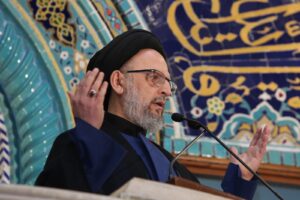
His Eminence, Sayyed Ali Fadlallah, delivered the two Friday prayer sermons at the Imamain Al-Hassanain Mosque , Friday 21 Zulqida 1447H/ May 8, 2026. Several prominent religious scholars, dignitaries and hundreds of believers attended the Jumu’a prayer. Following is summary of his sermons
First Sermon
Loss and Hardship: A Test of Faith and a Path to Reward
Allah, the Most Exalted, says in the Holy Qur’an:
“And We will surely test you with something of fear and hunger and a loss of wealth, lives, and fruits, but give good news to the patient — those who, when disaster strikes them, say: ‘Indeed we belong to Allah, and indeed to Him we shall return.’ Those are the ones upon whom are blessings and mercy from their Lord, and it is they who are rightly guided.”
Allah, the Most Exalted, has made it clear that hardship is part of this life. Life will not always be easy or exactly as we want. There will be fear, hunger, financial loss, the loss of loved ones, and destruction of crops and blessings.
But Allah, the Most Exalted, does not want people to drown in sorrow and pain. Instead, He wants them to turn hardship into an opportunity to become closer to Him and improve themselves if they deal with trials properly.
A person may become too attached to worldly life, become arrogant, or neglect Allah’s guidance. Hardships wake a person up, break his pride, and bring him back to Allah, the Most Exalted, after self-reflection.
Many people change after going through difficult experiences. They become more aware of the reality of life, less attached to worldly things, more connected to the Hereafter, closer to Allah, and more merciful toward others
Faith does not only appear during comfort, safety, and health. True faith becomes clear during loss, fear, pain, and suffering.
A person may claim to have strong faith during good times, but tests reveal the reality of that faith. Allah, the Most Exalted, says:
“Do people think they will be left alone because they say, ‘We believe,’ and they will not be tested? We certainly tested those before them, so Allah will surely make evident those who are truthful and those who are liars.”
Trials are like fire that purifies gold. Just as fire removes impurities from metal, hardships reveal what is truly inside the he
The Prophet(p.) taught that:
“Hardships are keys to reward.”
“The greatness of the reward comes with the greatness of the trial.”
“There is no hardship except that Allah, the Most Exalted, places within it a blessing.”
These high ranks are gained when a person deals with hardship in the way Allah, the Most Exalted, wants.
The Glorious Quran mentions two important things needed to gain Allah’s reward.
1. Patience
Allah, the Most Exalted, promised immense reward for those who are patient:
“Indeed, the patient will be given their reward without measure.”
And:
“Today I have rewarded them for their patience; indeed, they are the successful ones.”
Patience means remaining firm in faith and trusting Allah, the Most Exalted, during hardship. It means not abandoning principles, not saying or doing what displeases Allah, the Most Exalted, and not falling into despair.
This does not mean a person cannot express sadness or cry, because grief is natural and human.
It is narrated that Prophet Muhammad (p.) was in a house where someone had died, and women were crying. Some people tried to stop them, but the Prophet(p.) said:
“Leave them, for the eyes shed tears, the heart feels sorrow, and the loss is recent.”
When the Prophet’s son Ibrahim died, the Prophet(p.) cried until tears flowed down his cheeks and said:
“The eyes shed tears, and the heart grieves, but we only say what pleases Allah.”
2. Saying: “Indeed We Belong to Allah and to Him We Return”
A believer should say this whenever facing any hardship, not only death.
Allah, the Most Exalted, says about those who say it sincerely and understand its meaning:
“Those are the ones upon whom are blessings and mercy from their Lord, and they are the rightly guided.”
When saying:
“Indeed, we belong to Allah,” the believer admits that he belongs to Allah, the Most Exalted, and that everything he owns is entrusted to him by Allah, the Most Exalted. Therefore, he accepts Allah’s judgment.
And when saying:
“And indeed to Him we shall return,”the believer remembers that everyone will return to Allah, the Most Exalted, for judgment and accountability, both for actions during ease and during hardship.
The true value of a believer appears when he deeply lives these truths and reflects them in behavior and actions.
A true believer is not destroyed by hardships. Instead, he sees them as opportunities to show faith and gain Allah’s support, guidance, and reward in this life and the Hereafter.
Second Sermon
Worshippers of Allah, the Most Exalted, I advise myself and you to make the supplications that the prophets(a.s.) used during hardship:
The prayer of Prophet Ayyub (a.s.) during illness:
“My Lord, harm has touched me, and You are the Most Merciful of the merciful.”
The prayer of Prophet Yunus (a.s.) inside the whale:
“There is no god except You. Glory be to You. Indeed, I was among the wrongdoers
The prayer of Prophet Musa (a.s.) after leaving Egypt in fear:
“My Lord, I am truly in need of whatever good You send down to me.”
The prayer of Prophet Muhammad (p.):
“O Allah, I hope for Your mercy, so do not leave me to myself even for the blink of an eye. Set all my affairs right. There is no god except You.”
And:
“There is no god except Allah, the Great, the Forbearing; there is no god except Allah, Lord of the Mighty Throne.”
The prayer of Imam Hussein(a.s.) in Karbala:
“O Allah, You are my trust in every hardship, and my hope in every difficulty. You are my support and provision in every matter that befalls me. How many troubles weaken the heart, reduce one’s ability, cause friends to abandon us, and make enemies rejoice — yet I turned them over to You and complained of them only to You, seeking You instead of anyone else. Then You relieved me of them and removed them. So, You are the Guardian of every blessing, the Source of every goodness, and the ultimate goal of every desire.”
Dear beloved ones, let this be our prayer whenever we face challenges, while fully trusting Allah’s promise when He said:
“And your Lord said: Call upon Me; I will answer you.”
Through this faith, we become able to face challenges and hardships.
Israeli aggressions, which persist in destroying homes and infrastructure in the villages along the border strip. The attacks have expanded to villages in southern Lebanon and the Bekaa Valley, and recently reached the southern suburbs of Beirut.
These attacks have left — and continue to leave — massive destruction, martyrs, and wounded people behind. Women, children, the elderly, healthcare workers, and civil defense teams have not been spared, despite the declared ceasefire, whose fragility becomes more obvious every day.
All of this comes as part of pressure on both the Lebanese state and the Lebanese people to push them toward choices that do not fulfill the Lebanese people’s needs for full sovereignty over their land, freedom in their decisions, and the return to their towns and villages.
In light of what is happening, we must salute our steadfast people who continue to endure displacement, migration, destruction of their homes and workplaces, and many other sacrifices. Despite the imbalance in military capabilities and resources, and despite the support the enemy possesses, they insist on preventing it from achieving its goals and expanding its control over the land.
Through this steadfastness, they demonstrate their deep love for their homeland, their attachment to every grain of its soil, and their loyalty to the trust left to them by their fathers and grandfathers.
In response to all this, we renew our call for the Lebanese state to faithfully carry out its responsibility toward its citizens by working seriously to stop this ongoing bloodshed and destruction.
At the same time, we want the Lebanese state not to see itself as weak, because it possesses internal strengths and external relationships with those who genuinely wish good for this country — strengths that can help achieve what the Lebanese people aspire to.
We also renew our call for the Lebanese people to unite in facing what is happening and to move away from anything that threatens national unity. They must not allow those who seek to damage national cohesion to find an opening, because this country cannot confront its suffering through division and weakness.
We do not deny that there are disagreements regarding the methods and approaches for dealing with the country’s situation. However, these differences should not lead to hostility, hatred, or accusations of treason, whether in politics, media, or social media.
Instead, they should encourage cooperation, extending hands to one another, and engaging in dialogue to reach the safest solution that can rescue the country from the dark tunnel into which it is being pushed.
The consequences of this crisis will not affect only one region, sect, or religious group — they affect the entire people.
Lebanese people must realize that unity is a precious asset they possess, and they must not waste it.
On another level, due to the increasing displacement caused by the widening aggression, we once again stress that the state must strengthen its role in supporting displaced citizens so they feel respected, honored, and protected wherever they go.
This is their right upon their state, so that the state becomes their refuge and strengthens their trust in it.
At the same time, we want all Lebanese people to stand together, cooperate, and rise above sectarian, political, and religious sensitivities, expressing through this solidarity their humanity and the spiritual and moral values they carry.

You may also like