Humility and Nobility in the Life of Imam al-Rida (a.s.)
.
In the name of Allah, the Compassionate, the Merciful
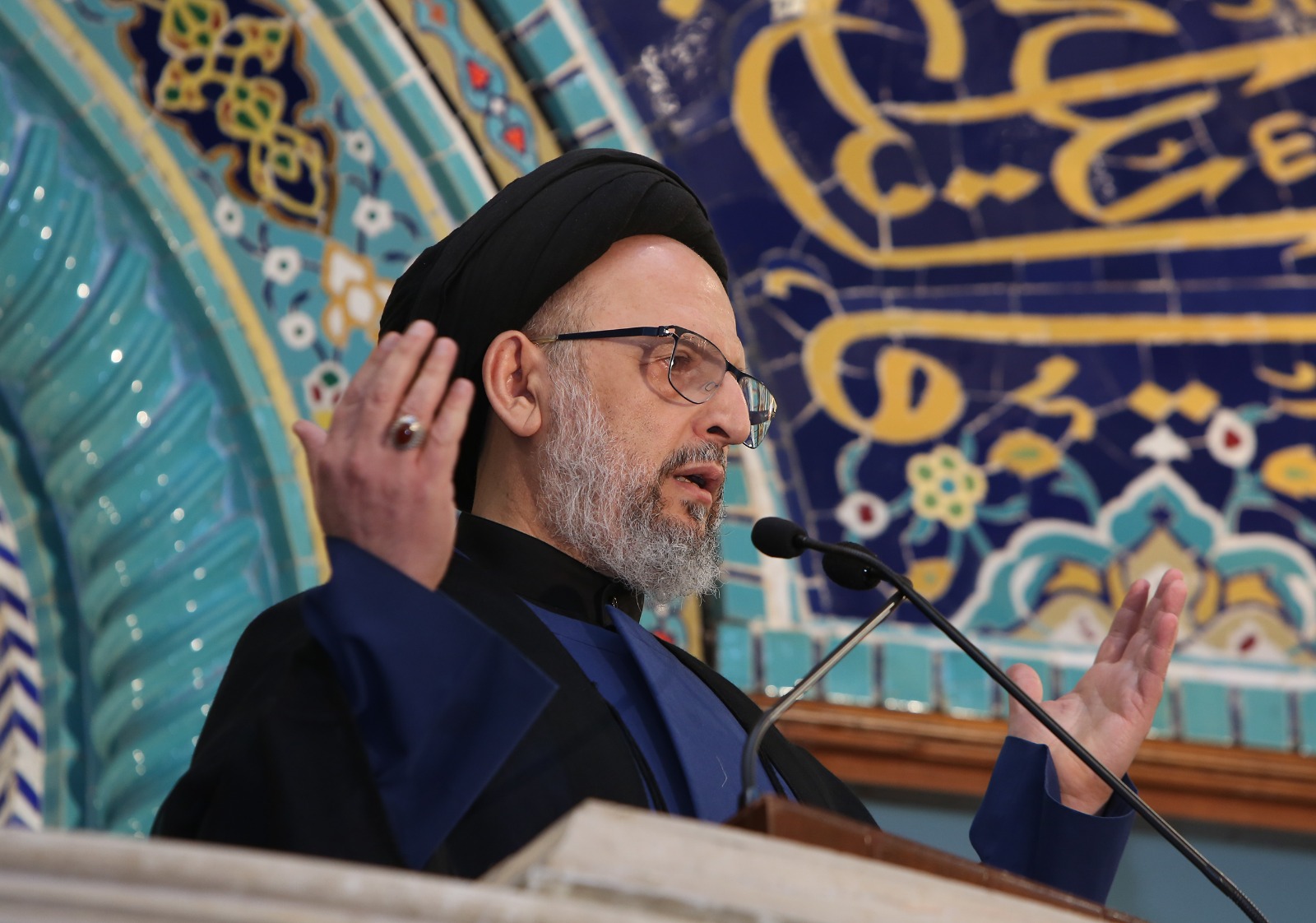
His Eminence, Sayyed Ali Fadlallah, delivered the two Friday prayer sermons at the Imamain Al-Hassanain Mosque Friday 14 Zulqida 1447H/ May 1, 2026. Several prominent religious scholars, dignitaries and hundreds of believers attended the Jumu’a prayer. Following is summary of his sermons
First Sermon
Humility and Nobility in the Life of Imam al-Rida (a.s.)
Allah, The Most Exalted, says in His Glorious Book:
{And We made them leaders guiding by Our command, and We inspired to them the doing of good deeds, establishment of prayer, and giving of zakah; and they were worshippers of Us.}
Allah, the Most Exalted, has spoken the truth.
On the eleventh of the sacred month of Zu al-Qa‘dah, we commemorated the blessed birth anniversary of Imam Ali bin Musa al-Rida (a.s.). This Imam is one of the blessed chain of the Imams of Ahl al-Bait (a.s.).
The title(al- Rida) associated with this Imam (a.s.) points to the place he held in people’s hearts. This title shows the high position he attained with Allah, The Most Exalted, and in the hearts of all people, whether those who believed in his Imamate or those who did not. This was testified to by those who lived with him. Ibrahim ibn al-‘Abbas al-Suli said:
“I never saw or heard of anyone better than Abu al-Hasan al-Rida. I witnessed from him things I never witnessed from anyone else. I never saw him offend anyone with his speech, nor did I ever see him interrupt anyone before they finished speaking. He never turned away anyone who had a need he was able to fulfill. He was always smiling and repelled evil with goodness… He gave abundantly and gave charity secretly, and most of that would take place during dark nights.”
Today, on this blessed occasion, we will reflect on two situations that reveal the depth of his humanity, qualities that we are in great need of adopting and drawing inspiration from.
The first incident took place one day when Imam al-Rida (a.s.) invited people to a meal that had all kinds of food prepared. Those present included leaders, ministers, and prominent figures, and this was during the early period of his appointment as crown prince. Yet the Imam (a.s.) insisted that he would not sit down until everyone present had also been invited, including the workers, the servants, even the doorkeeper and the caretaker of the horses.
One of his companions, whom he had instructed to invite them, said to him: “My master, what if a separate table were prepared for them?” Meaning that the Imam’s position as Imam of the Muslims and crown prince, along with the high status of those sitting with him, did not seem fitting for them to sit at the same table as those workers and servants. So he suggested that a separate table be prepared for them.
The Imam (a.s.) replied: “Enough. The Lord, Blessed and Exalted, is One, the mother is one, the father is one, and people are rewarded according to their deeds. Allah says: {Indeed, the most noble of you in the sight of Allah is the most righteous of you.}”
Through this behavior, Imam al-Rida (a.s.) wanted to present an example of the humility he lived by, and to reshape the mentality that judged people’s worth according to status, wealth, or number of followers. He showed that the true standard, as Allah, the Most Exalted, intended, is taqwa(piety), and how well a person fulfills the responsibility in the work they do, whether great or small.
This is what Imam Zayn al-‘Abidin (a.s.) expressed in his supplication:
“O Allah, protect me from thinking lowly of someone because of his poverty, or believing someone superior because of his wealth. For the noble one is the one honored through obedience to You, and the honored one is the one given dignity through worshipping You.”
People who hold high positions should not see themselves above others. Rather, they should see their positions as carrying greater responsibility and requiring greater humility.
The second incident was mentioned by one of the Imam’s companions, who said:
“I was sitting in the gathering of Abu al-Hasan al-Rida (a.s.), and many people had gathered around him asking about matters of their religion. Then a man entered, greeted him, and said: ‘I have lost my money and I no longer have enough to return to my hometown. If you see fit, help me get back home, and Allah will reward you. When I reach my hometown, I will give in charity on your behalf what you give me, for I am not someone deserving of charity.’”
The Imam (a.s.) replied: “Sit down, may Allah have mercy on you,” and then continued speaking with the people until they all left.
After that, the Imam entered his room, then came back with a pouch containing an amount of money greater than what the man needed. He handed it to him from behind the door and said: “Use this for your expenses and travel costs… and do not give it in charity on my behalf.” Then the Imam left.
According to the historical reports, one of the Imam’s companions who was present found it surprising that the Imam hid his face from the man while giving him the money. Usually, a person might do that if the amount given was small, out of embarrassment. But the Imam had given him a generous amount. So he asked him:
“May I be sacrificed for you, you gave generously and showed mercy, so why did you hide your face from him?”
The Imam (a.s.) replied: “I feared seeing the humiliation of asking on his face because I fulfilled his need.” Meaning: I did not want to see him feeling humiliated because I had given him charity.
This deeply human feeling shown by Imam al-Rida (a.s.) toward the man reflected the Islamic approach that calls on believers to preserve the dignity of the people around them and not expose them to humiliation because of their need.
The Qur’an has invalidated charity that is accompanied by hurting the dignity of the needy. Allah, The Most Exalted, says:
{O you who have believed, do not invalidate your charities with reminders or injury.}
At the same time, Islam calls on a person not to throw away his own dignity or allow others to take it from him. Allah has entrusted the believer with all of his affairs, but He did not permit him to be humiliated.
{And to Allah belongs all honor, and to His Messenger, and to the believers.}
So no one should bargain away his dignity for money, position, or security
This is only a small glimpse of the human nobility reached by Imam al-Rida (a.s.) in giving, generosity, love for people, and concern for their dignity.
On this anniversary, let us turn to him and pledge that we will strive to reflect his image and example in this life, so that we may truly deserve our following and loyalty to him. We ask Allah, the Most Exalted, to grant us the honor of visiting him in this world and receiving his intercession in the Hereafter. That indeed is the great success.
In the Name of Allah, the Compassionate, the Merciful
Second Sermon
Worshipperss of Allah, I advise you and myself with what Allah, The Most Exalted, advised us when He said:
{And We have instructed those who were given the Scripture before you and yourselves to fear Allah.}
And He commanded us to take provision from it when He said:
{And take provisions, but indeed, the best provision is fear of Allah, the Most Exalted,(Taqwa).}
Taqwa means possessing an inner protection that causes us to stop at the limits set by Allah, the Most Exalted, and not go beyond them, so that we are where Allah, the Most Exalted, wants us to be. As for the results, they will benefit us in this world android the Hereafter.
Through taqwa, the blessings of this world are opened for the believers:
{And if only the people of the cities had believed and feared Allah, We would have opened upon them blessings from the heaven and the earth…}
{And whoever fears Allah – He will make for him a way out * And will provide for him from where he does not expect. And whoever relies upon Allah – then He is sufficient for him.}
Allah, the Most Exalted, also said:
{Indeed, Allah is with those who fear Him and those who are doers of good.}
As for the Hereafter, Allah said:
{And the best outcome is for the righteous.} (those who fear Allah, the Most Exalted, and do good )
Therefore, beloved ones, in the face of the challenges confronting us, we are in great need of seeking help through taqwa, so that we may face all that we suffer from as individuals and as a society. We need to examine ourselves carefully and see how much taqwa is truly present within us and how much we possess it. Once it becomes firmly rooted in our souls, then, as Allah, the Most Exalted, has promised us, we will be able to confront the challenges before us, and there are many.
We begin with this country, where the Zionist enemy continues its aggression and massacres against the Lebanese people, and continues targeting infrastructure through destruction and bulldozing what remains of homes, buildings, and institutions in the villages along the border strip.
In the face of this continuing escalation, we salute our people for their patience and steadfastness despite all the suffering caused by displacement and the destruction of their homes and shelters.
At the same time, we renew our call to the Lebanese state to fully carry out its responsibilities toward its citizens and to work seriously to stop this aggression and the ongoing bloodshed and destruction. This is their right upon the state: that it works to end this aggression and suffering and makes it its highest priority. No priority should come before stopping this aggression and all its consequences. Nor should it compromise their rights. This should happen by pressuring those sponsoring and calling for the ceasefire to fulfill what they committed themselves to, and they are capable of doing so if they truly wish.
We do not wish to downplay the scale of the pressures being imposed on this country, nor the challenges it faces to push it toward choices that affect its legitimate rights in reclaiming its land and removing the burden of occupation from every inch of its soil.
But this does not mean surrendering to these pressures. Lebanon is not weak to the point that terms can simply be imposed upon it. Rather, it is capable of imposing its own position through the strength it possesses, strength that has proven itself in the field and through its presence on the Arab, Islamic, and international levels.
What is truly regrettable amid this bloody and painful scene is the rising level of internal tension, which has even reached the highest positions in the state. We fear that this may have negative consequences on both the national and popular levels, at a time when the country is in greatest need of unity, solidarity, and combined efforts, whether at the level of the state or among the people themselves. This challenge cannot be confronted through weakness and division such as what we are witnessing.
Therefore, we once again call for swift efforts to bridge any divisions among those in positions of decision-making. This requires meeting together to reach an agreed formula that guarantees an exit from this difficult and deteriorating reality facing the country and its people, and that restrains the enemy from continuing its aggression, the consequences of which, as we always say, affect the entire nation.
This country cannot stand or be built except through agreement and consensus, which we want to be for the benefit and interest of this country.
We also want the Lebanese people, from all sects, schools, and political lines, to be protectors of this country through their unity, by becoming callers to unity through strengthening the language of dialogue instead of the provocative and tension-filled speech we witness on social media and in the media. Such speech benefits no one. Rather, it only serves those who wish evil for this country.
So they must not allow those who play with this unity and seek discord to find a way into their society. They must stand together as one hand in confronting such efforts.
At this time, and in light of the scale of displacement and the disaster that has struck a large number of people who were forced to leave their homes and livelihoods, we renew our call for the state to strengthen its role and to increase solidarity and cooperation among the Lebanese people in facing the growing burdens, which unfortunately are unlikely to stop here. Their future consequences may become even more dangerous and difficult.
Through this solidarity, the Lebanese should present the image we want for this country: that they be like one body. If one group of its citizens suffers, the entire nation responds with sleeplessness and fever, so that they may all remain safe and the nation along with them.
Finally, on International Workers’ Day, despite all the difficult conditions workers are suffering from, we extend our congratulations to all workers who strive and labor sincerely and diligently in order to build their dignity and honor and raise their countries to levels of dignity and honor.
Workers have the right upon their country, and upon all those they work for, to receive care and attention, to be honored, and at the very least, not to have their rights denied. They should feel secure and be able to live with dignity…

You may also like