Lessons from the Sayings of Imam al-Hadi (a.s.)
In the name of Allah, the Compassionate, the Merciful
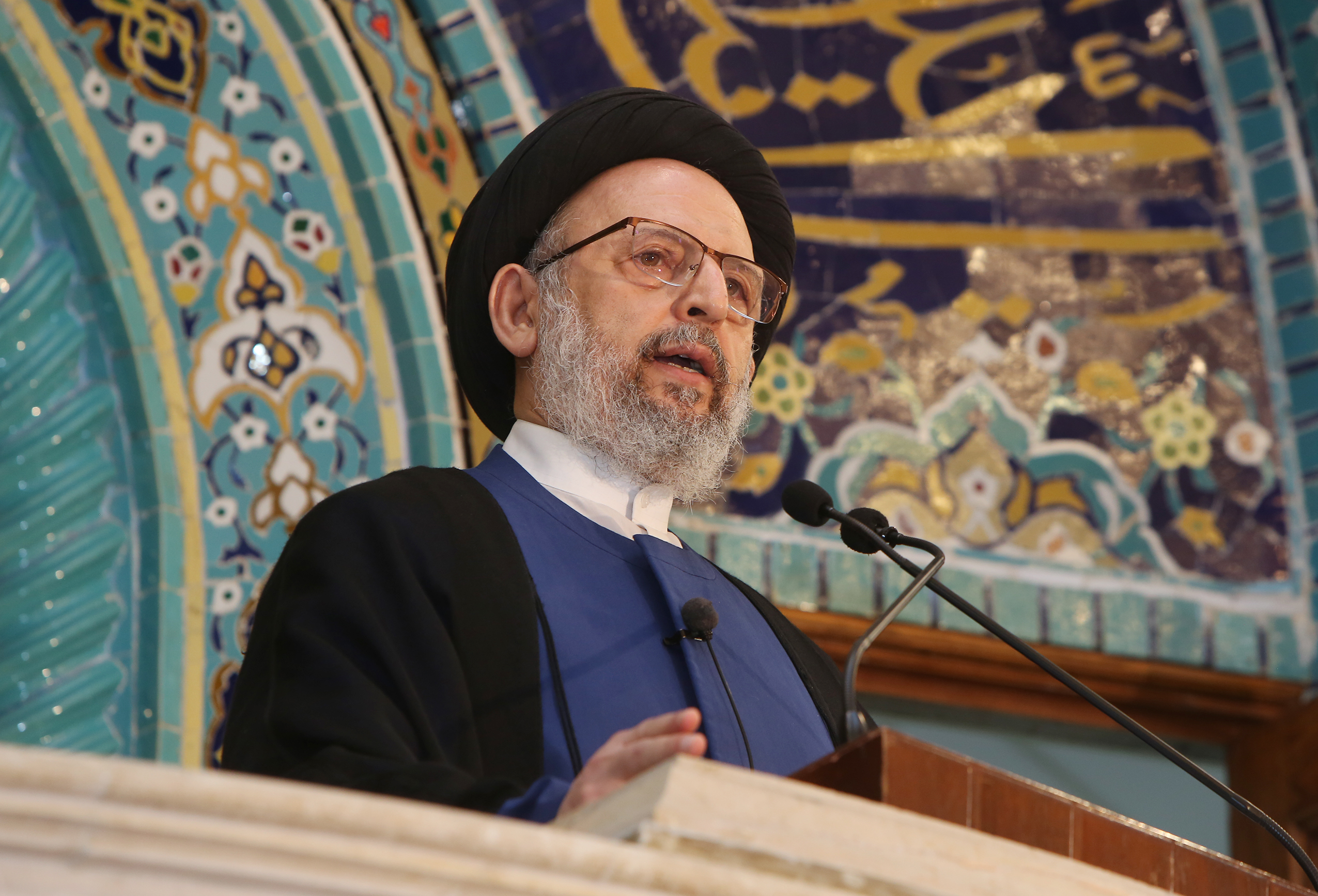
His Eminence, Sayyed Ali Fadlallah, delivered the two Friday prayer sermons at the Imamain Al-Hassanain Mosque, Friday Zulhijja 12, 1447H/ May29, 2026. Several prominent religious scholars, dignitaries and hundreds of believers attended the Jumu’a prayer. Following is summary of his sermons
First Sermon
Lessons from the Sayings of Imam al-Hadi (a.s.)
Allah, the Most Exalted, says:
{And We made them leaders guiding by Our command, and We inspired to them the doing of good deeds, the establishment of prayer, and the giving of zakat, and they were worshippers of Us.}.Allah, the Most Exalted, says the truth.
On the fifteenth of this month, the month of Zu al-Hijjah, we commemorate the birth of one of the Imams of the Ahl al-Bait (a.s.), Imam Ali ibn Muhammad al-Hadi (a.s.). Everyone who lived during his time testified that he was the most knowledgeable of the people of his age, the most devoted in worship, the most forbearing, and the finest in character. He was known for his humility and generosity.
The Imam (a.s.) was born in Madina and passed away at around the age of forty. He was buried in Samarra. Throughout the period of his Imamate, he suffered from the injustice and oppression of the Abbasid caliphs who succeeded one another in power. His greatest suffering came at the hands of the Abbasid caliph al-Mutawakkil, who was intensely hostile toward the Ahl al-Bait (a.s.). It was he who summoned the Imam from Madina to Samarra so that he could remain under his watch, after hearing someone say to him: “If you have any need in Madinah, remove Ali ibn Muhammad from it, for he has won the hearts of the people.”
Yet all this siege and pressure did not prevent the Imam from carrying out his role in spreading the teachings of authentic Islam and confronting intellectual and doctrinal deviations. He did this through the religious scholars who came to him to draw from his abundant knowledge, and through the representatives who acted on his behalf in different regions and served as the link between him and the people.
Today, on this blessed occasion, we will reflect on some of his sayings.
The first saying:
“Preserve blessings through good companionship with them (making good use of them), and seek increase of them through gratitude …”
In this saying, the Imam (a.s.) pointed out that preserving the blessings Allah, the Most Exalted, grants His servants — whether wealth, health, status, beauty, strength, or anything else — is not achieved merely by preserving them, but through proper conduct in benefiting from these blessings. This means avoiding extravagance(overspending) and waste, not using them for corruption or in ways that harm people’s interests, and not becoming arrogant toward others. Rather, one must fulfill the responsibilities Allah, the Most Exalted, has attached to these blessings, as referred to in the narration:
“Allah does not grant a servant a blessing except that He places upon him responsibility regarding it… Whoever Allah grants wealth and abundance, then his responsibility lies in his wealth: that he looks after the poor through obligatory and recommended acts. Whoever Allah grants physical strength, then his responsibility lies in fulfilling what Allah has obligated upon him and bearing with those weaker than him. Whoever Allah grants nobility among his people or beauty in appearance, then his responsibility is not to deny the rights of the weak because of his status or beauty…”
Without this, a person is not truly mindful of Allah, the Most Exalted, regarding these blessings.
In another narration:
“Whenever Allah’s blessings upon a servant increase, people’s needs from him also increase. If he fulfills the duties Allah, the Most Exalted, has obligated toward them, he helps preserve those blessings and make them lasting; but if he neglects those duties, he exposes those blessings to loss and disappearance.”
The Imam (a.s.) then explained the means by which these blessings increase, saying:
“Seek increase through gratitude for them.”
Allah increases these blessings for the servant when he is grateful for them. This is what Allah, the Most Exalted, promised when He said:
{And [remember] when your Lord proclaimed: “If you are grateful, I will surely increase you; but if you are ungrateful, indeed My punishment is severe.”}
“And gratitude for blessings,” as stated in the narration, “is by avoiding what is forbidden, and complete gratitude is for a person to say: ‘Praise be to Allah, Lord of the worlds.’
The second saying:
“The forbearing person is the one who controls himself and restrains his anger, and this is only meaningful when one has the ability [to act otherwise].”
The Imam (a.s.) wanted to explain that forbearance is of immense importance, as indicated by the narrations:
“A forbearing person nearly becomes a prophet,” and: “Whoever is forbearing gains mastery (leadership).”
A person is only truly forbearing when he controls himself at the moment of anger, so that his anger does not drive him to say or do what harms himself or others and what he will later regret in this world and the Hereafter.
The Imam (a.s.) was keen to show that forbearance, which some may consider a sign of weakness or inability, is actually a sign of strength. It reflects awareness, maturity, self-control, and freedom from emotional impulsiveness. Hence the hadith:
“A strong person is not the one who can physically overpower others. Instead, the truly strong person is the one who can control themselves when they are angry.”.
The third saying:
“Verification[thinking of probable results ]before action is protection from regret.”
Through this saying, the Imam (a.s.) calls upon the believing person not to rush into any matter he wishes to do, whether it is speech, action, a transaction, support, or opposition, but rather to examine it carefully so that he may be protected from regret.
Verification means thinking carefully, studying the matter, consulting those with expertise, and considering its consequences and outcomes. One should not rush in his positions, decisions, or judgments, nor allow himself to be driven by personal desire, fanaticism, emotional reaction, or impulsiveness.
It is narrated:
“People are only destroyed by haste. Had people verified matters carefully, no one would perish.”
The fourth and final saying:
“Whoever is pleased with himself will find many displeased with him.”
The Imam (a.s.) wanted to show the danger of self-admiration, when a person sees himself as perfect and unmatched by anyone else. He then becomes blind to his own faults, weakens in self-criticism and self-accountability, and this leads him to arrogance toward people, belittling their opinions, and rejecting sincere advice.
This leads to the increase of those displeased with him , because his mistakes will multiply, and people naturally turn away from the arrogant and self-conceited, while they incline toward those who are humble and attentive to them.
Hence the narrations:
“The fruit of self-admiration is hatred.”
“Self-admiration prevents growth.”
“Whoever becomes plagued with self-admiration is ruined.”
Beloved ones, this is but a small part from the rich legacy of Imam al-Hadi (a.s.), who filled his era with knowledge, action, struggle for the cause of Allah, generosity, and sacrifice, and whose noble character made him beloved by all people.
Will we, who claim devotion to him, rise toward his level by following his path and being guided by his words, so that we may attain true loyalty to him — a loyalty that is only achieved through faith and righteous deeds?
On his blessed remembrance, we send him our salutations and say to him from the depths of our hearts that we shall strive to be an adornment to him and not a disgrace.
Peace be upon Imam al-Hadi(a.s.i on the day he was born, the day he departed to his Lord, and the day he shall be raised alive.
In the Name of Allah, the Most Compassionate, the Merciful
Second Sermon
Worshippers of Allah, I advise you and myself with what Imam al-Hadi (a.s.) advised one of his companions when he said to him:
“Remember your death among your family, when no doctor can protect you and no beloved one can benefit you.”
The Imam (a.s.) calls upon us to remember the moment when we depart from this life, when neither our family, our loved ones, nor the doctor treating us will be able to prevent death from reaching us, and they will stand helpless despite their deep concern for our lives.
We remember this so that we would not die before our actual death, but rather to prepare for it through deeds that will benefit us and protect us from what we will face when we stand alone before our Lord, where:
{Neither wealth nor children will benefit, except one who comes to Allah with a sound heart.}
We are in desperate need of following this advice , so that we may become more aware of life and not be deceived by it, more responsible, and more capable of confronting challenges
We begin with the continuing aggression of the Zionist enemy against Lebanon and the Lebanese people, which has caused- and continues to cause – more bloodshed. It has spared neither women, children, the elderly, civil defense crews, nor members of the army. Its campaign of assassinations has continued, recently reaching the southern suburbs of Beirut. It has now taken on a new and dangerous dimension through ground advances, through which the enemy seeks to secure gains on the ground and strengthen its positions in the ongoing negotiations, whether on the Lebanese level or in relation to the talks taking place between the United States and Iran.
Here, we must salute those who stand in the South and the western Beqaa, despite the imbalance in capabilities and resources, confronting the enemy and preventing it from achieving its goals and settling in this blessed land. They continue to present a model of sacrifice and devotion. We also salute the steadfastness of our people who insisted on remaining on their land despite their awareness of the dangers, out of attachment to their homeland and loyalty to their country, as well as those who were forced to flee and endure severe hardship because of it.
At the same time, the negotiations currently taking place in Washington continue, which the Lebanese state sees as its only option for confronting what is happening. Yet we still believe that these negotiations will not proceed in the manner hoped for, nor achieve what the Lebanese people long for — namely, ending this aggression and allowing people to return to their villages and cities — due to the enemy’s stubbornness and insistence on conditions and objectives that violate the country’s sovereignty, security, and unity, and its insistence that negotiations continue under fire and while seizing more territory.
Here, we once again call on the Lebanese state to fulfill its responsibilities toward its citizens by insisting upon the principles it has declared, foremost among them a complete ceasefire, the withdrawal of the enemy from the occupied territories, and the return of their people to them. Its reliance should be based upon the elements of strength possessed by its people — their patience, their readiness for sacrifice for their homeland — as well as the activation of its foreign relations to achieve these goals.
We are fully aware of the suffering taking place and the pressures imposed upon the state. Yet while we suffer, we must not forget that the enemy suffers as well:
{If you suffer, they too suffer as you suffer, while you hope from Allah that which they do not hope for.}
{If a wound touches you, a similar wound has touched the people. And these days We alternate among the people.
At the same time, we once again stress to the Lebanese people, especially in this stage, the necessity of strengthening their unity, for it is the most valuable asset of this nation and the source of its strength. Through this unity, we can confront the political, security, social, and humanitarian crises facing the country.
In this nation, we may differ in sects, schools of thought, political positions, certain choices, and approaches toward current events. But we must never differ on preserving this country, keeping it free, preventing occupation from controlling it, and ensuring that disagreements do not damage our national, moral, and human feelings, so that we continue to feel one another’s pain and share the suffering of those who suffer in this homeland.
On the domestic level, we urge the state to pay attention to the economic situation and fulfill its role in confronting the outrageous inflation we are witnessing. This requires strengthening oversight over goods and services and preventing further price increases.
At the same time, we call upon merchants to show mercy toward citizens and not exploit the difficult circumstances facing the nation and the absence of effective state oversight for the sake of greater profits, even at the expense of the pain and needs of the Lebanese people.
Turning to developments in the region, we continue to hope that the negotiations taking place between the Islamic Republic of Iran and the United States will succeed, in order to prevent the consequences of their failure on the security and stability of the region — consequences from which Lebanon would naturally suffer as well. Their success could contribute to stopping the bloodshed and destruction affecting Lebanon.

You may also like