Imam Al-Jawad (a.s(:: Early Leadership that Built Awareness

In the name of Allah, the Compassionate, the Merciful
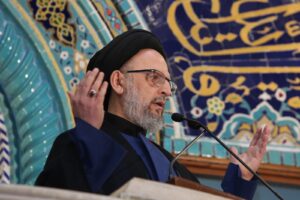
His Eminence, Sayyed Ali Fadlallah, delivered the two Friday prayer sermons at the Imamain Al-Hassanain Mosque , Friday 28 Zulqida 1447H/ May 15, 2026. Several prominent religious scholars, dignitaries and hundreds of believers attended the Jumu’a prayer. Following is summary of his sermons
First Sermon
: Imam Al-Jawad (a.s(:: Early Leadership that Built Awareness
We begin with the words of Allah from the Holy Quran:
And We made them leaders guiding by Our command. And We inspired to them the doing of good deeds, establishment of prayer, and giving of zakat; and they were worshippers of Us. Allah, the Most Exalted, speaks the truth
Today, we commemorate the passing of one of the Imams of the Prophet’s family (Ahl al-Bait), Imam Muhammad bin Ali al-Jawad (a.s.).
His noble name is closely connected to a great value before Allah and the people: Al-Jawad (The Generous). He was given this title because of his immense giving and generosity. True generosity means giving with love and actively searching for people in need to help them before they even have to ask, thereby preserving their dignity.
Imam Al-Jawad (a.s.) took over the leadership (Imamate) after the death of his father, Imam Al-Rida (a.s.). He lived a short life of only 25 years, making him the youngest of the Imams of Ahl al-Bait (a.s.). Despite his young age, his status was so high that he won the hearts of the people, even those who did not follow his leadership. Religious scholars traveled from far away to learn from his deep knowledge.
This drew the attention of the Abbasid Caliph, Al-Ma’mun. The prominent reliogiousscholar Sheikh Al-Mufid stated that Al-Ma’mun was deeply impressed by the Imam’s virtue, knowledge, wisdom, and manners, which no one else at the time could match. Because of this, Al-Ma’mun offered his daughter’s hand in marriage to the Imam. The Abbasid elites objected to this marriage, fearing that the ruling power would shift to the family of the Prophet (Ahl al-Bait), but Al-Ma’mun responded to them: “Woe to you! I know this young man better than you do. He has more understanding of religion, and more knowledge of Allah, the Most Exalted,, His Messenger (p.), his tradition, and his rulings than all of you.”
On this sad occasion, we look at some of his sayings to benefit from them in our daily lives:
The First Saying: “Three traits protect a person from regret: avoiding haste, consulting others, and relying on Allah.”
Avoiding Haste: A person who takes time and does not rush into speaking, making decisions, or judging things will not regret it. As the traditions say: “Haste has destroyed people; if people were patient and careful, no one would be destroyed.” Another tradition says: “Safety comes with carefulness )deliberation), and regret comes with haste.”
Consulting Others (Shura): A person will not regret seeking the knowledge and experience of others, even if they have lesser status. This reduces mistakes. The tradition states: “Whoever consults people shares their minds.” Also, “Consultation is the essence of guidance, and whoever thinks he can rely only on his own opinion takes a big risk,” and “He who consults others will not fail.” Allah wanted this to be a core practice of the believing society when He said: “And whose affair is [determined by] consultation among themselves.” Even Prophet Muhammad (p.) was commanded by Allah, the Most Exalted, to consult his companions before making decisions: “And consult them in the matter. And when you have decided, then rely upon Allah.”
Relying on Allah (Tawakkul): Relying on Allah means leaning on a powerful and unbreakable support. Allah keeps His promise when He says: “And whoever relies upon Allah – then He is sufficient for him.”
The Second Saying: “A servant’s blessings from Allah do not grow greater without the needs of the people toward him also growing greater. Whoever cannot bear those needs exposes that blessing to loss.”
Imam Al-Jawad (a.s.) wanted to teach us that when Allah, the Most Exalted, gives us many blessings, we should not see them as a privilege, but as a test. Allah gives us blessings not just for ourselves or our families, but to help others. Those who refuse to help others risk losing these blessings. Another tradition supports this: “Allah has certain servants whom He chooses for specific blessings to benefit other servants; He keeps these blessings with them as long as they give to others, but if they withhold them, Allah strips the blessings away and gives them to someone else.”
The Third Saying: A young follower of Ahl al-Bait (a.s.) wrote to Imam Al-Jawad (a.s.), saying: “My father strongly hates you and your family, and I face great harshness and difficulty from him. What do you advise me to do? Should I confront him or use gentleness and tactfulness (Mudarat)?”
The Imam (a.s.) wrote back: “I have understood your letter and what you mentioned about your father. I will not stop praying for you, if Allah wills. (Mudarat) is better for you than confrontation. With hardship comes ease, so be patient, for the final good end is for the righteous.”
The Imam (a.s.) teaches us that the best way to deal with people who treat us badly, insult us, or show hatred because of religious, sectarian, or political differences is not to respond with bad behavior, but to use Mudarat . Mudarat means kindness, soft speech, and not paying back bad treatment with bad treatment. This is the most effective approach. Responding harshly only increases hatred.
History shows that the young man followed the Imam’s advice and treated his father with extreme kindness. This made the father rethink his behavior, stop opposing his son, and eventually become a lover and follower of Ahl al-Bait (a.s.).
The Final Saying: “Whoever listens to a speaker has worshipped him. If the speaker speaks on behalf of Allah, the listener has worshipped Allah. But if the speaker speaks on behalf of Satan, the listener has worshipped Satan.”
The Imam (a.s.) highlights how much we are influenced by what we hear from the media, social platforms, and speeches. He warns us not to give our attention to just anyone. We should only listen to those who speak the truth, justice, and values that Allah has set for life. Listening to those who speak out of personal desires or fanaticism means listening to Satan, who drives people toward evil, immorality, and speaking about Allah without knowledge.
Dear loved ones, these are some of the wise words of this pure Imam (a.s.), who was truly generous in his piety, knowledge, and guidance. Our true loyalty to him on the anniversary of his passing is to follow his guidance in our lives. We must live by his famous request to his followers: “Be an honor to us, and do not be a disgrace to us.”
Peace be upon Imam Al-Jawad (a.s.) the day he was born, the day he passed away , and the day he will be raised alive.
—
Second Sermon:
In the name of Allah, the Compassionate, the Merciful.
Worshippers of Allah, I advise you and myself to make the most of the first ten days of the holy month of Zul-Hijjah, which begin this Monday, if Allah, the Most Exalted, wills. Allah, the Most Exalted, urges us to remember Him during these days, saying: And mention the name of Allah on known days. Prophet Muhammad(p.) said: “There are no days in which righteous deeds are more beloved to Allah than these ten days.” It is highly recommended to fast during the first nine days, perform extra prayers, supplicate, and praise Allah.
Let us fill these ten days with fasting, prayers, and remembrance so that we may receive Allah’s blessings, forgiveness for major sins, and answers to our prayers for this life and the next. We desperately need to strengthen our bond with Allah, the Most Exalted, , especially during these hard times, as He alone can change our condition for the better and give us the strength to face challenges.
We begin with the Israeli aggression. The enemy continues its destructive campaign by forcing residents of southern Lebanese villages and the Western Beqaa to leave their homes through forced warnings, causing a massive rise in the number of displaced people. Their airstrikes are destroying buildings and infrastructure, killing and wounding civilians—including women, children, and rescue workers. They continue targeting citizens in their cars and trying to push into Lebanese territory to occupy more land.
Despite this, negotiations are taking place through Lebanese and Zionist envoys. However, it does not look like these talks will achieve Lebanon’s goals, which are: a total ceasefire, a full withdrawal of the enemy from newly occupied positions, the return of displaced people to their towns, and the release of prisoners. The enemy is refusing to meet even the minimum Lebanese demands, starting with a total stop to the attacks. The enemy acts during negotiations as if it can dictate its own terms, using its military power, international backing, and the total silence of the world. No international or effective Arab voice is rising to stop these actions. We worry that the enemy’s conditions aim to create a wider political division and gap among the Lebanese people.
Therefore, we urge all Lebanese people to protect their internal unity, which is the main source of strength for this country, both at the official and public levels. We must reject anything that damages this unity and engage in serious, constructive political dialogue to agree on a unified choice to face this dangerous phase. We must stop the ongoing political and media attacks against each other, which only benefit the enemy.
The Lebanese people must realize that they have to solve their own problems; no one else will do it for them. Sovereignty and freedom are taken, not given as gifts. What is happening does not just affect one specific group or sect—as some try to portray it to keep others from doing their duty. The consequences of this crisis will negatively impact the future, safety, and independence of the entire Lebanese people and all its communities.
Turning to domestic issues, we demand that the Lebanese government step up and play an active role in taking care of citizens who had to flee their towns and villages. The government must not leave them stranded on the streets or staying in places that lack basic living requirements, care, and dignity. These citizens are sacrificing everything, and their dignity must be preserved.
At the same time, we call on all Lebanese citizens to fulfill their humanitarian and national duties by cooperating and supporting one another during this immense suffering, which strengthens their national unity.
Finally, the world is watching the outcomes of the US-China Summit, as well as the negotiations aimed at ending the US war/sanctions against the Islamic Republic of Iran. We hope these talks will help resolve the crises in the region, bringing a positive impact on global security, the economy, and stability, which Lebanon will naturally benefit from.
.

You may also like