
The Change of the Qiblah

In the Name of Allah, the Compassionate, the Merciful
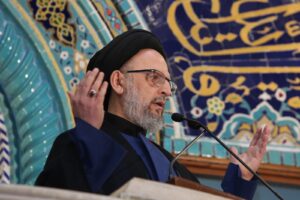
His Eminence Sayyed Ali Fadlallah delivered the two Friday prayer sermons at the Imamain al-Hassanain Mosque on Sha’ban 18, 1447 AH / February 6, 2026. Several prominent religious scholars, dignitaries, and hundreds of believers attended the Jumu‘a prayer.
The Change of the Qiblah: Between the Wisdom of Divine Legislation and the
Strengthening of Islamic Identity
Allah, the Most Exalted, says:
We have certainly seen the turning of your face toward the heaven, and We will surely turn you to a qiblah with which you will be pleased. So turn your face toward Al-Masjid Al-Haram. And wherever you believers are, turn your faces toward it. Indeed, those who have been given the Scripture know that it is the truth from their Lord. And Allah is not unaware of what they do.
So that the people will have no argument against you, except those of them who commit wrong; so fear them not, but fear Me. And that I may complete My favor upon you and that you may be guided.”
Allah, the Most Exalted, has spoken the truth.
On the fifteenth of Sha’ban in the second year after the migration of the Prophet (p.) from Mecca to Medina, revelation came down to the Messenger of Allah (p.). At that time, he was praying with his companions in the Mosque of Bani Salim in Medina, now known as Masjid al-Qiblatayn (the Mosque of the Two Qiblahs).
He was performing either the Duhr or the ‘Asr prayer, according to different narrations. After completing two units of the prayer, Angel Jibreel took the Prophet (p.) by the arm while he was praying and turned him toward the Kaaba in Al-Masjid Al-Haram, after he had previously been facing Al-Masjid Al-Aqsa by the command of Allah, the Most Exalted.
The noble verses indicate that this change of qiblah was something the Prophet (p.) had been anticipating. He knew that facing Al-Masjid Al-Aqsa was a temporary command from Allah, the Most Exalted—especially after the Jews used this fact to suggest that he was following them, since Jerusalem was also their direction of prayer.
This was pointed out by Imam Ali (a.s.), who said that the Messenger of Allah (p.), from the beginning of his mission, prayed toward Jerusalem. After his migration to Medina, the Jews mocked him, saying: “You follow our qiblah.” This saddened the Prophet until Allah, the Most Exalted, revealed the verses commanding the change of the qiblah.
A natural question arises:
If Allah, the Most Exalted, intended the Kaaba to be the qiblah for Muslims—and this was what the Prophet (p.) desired—why was Jerusalem chosen first .This was for several reasons:
First
At that time, the Kaaba was filled with idols. Allah, the Most Exalted, commanded the Muslims to face Jerusalem so that their prayers would not be directed toward a place of idol worship, and so they would be distinguished from the polytheists, who worshipped idols and faced the Kaaba.
Second
Jerusalem was the qiblah of the Jews and Christians. Facing it showed that Islam did not come to cancel the previous divine religions, but rather to complete and confirm them. Islam extended a call for dialogue and cooperation, as Allah, the Most Exalted, says:
“Say, ‘O People of the Scripture, come to a word that is equitable between us and you—that we will not worship except Allah and not associate anything with Him and not take one another as lords instead of Allah.’”
This helped reduce barriers and sensitivities that arose due to differences between Islam and earlier religions.
Third
Allah, the Most Exalted, wanted to firmly establish the status of Al-Masjid Al-Aqsa in the hearts of Muslims. By commanding them to face it for nearly fifteen years, it remained forever remembered as the first qiblah of Islam, preserved in their consciousness just as the Sacred Mosque and the Kaaba are preserved.
This ruling led to negative reactions from those who sought to undermine the Prophet (p.) and his message.
The Jews claimed that if Muhammad were truly a prophet, he would not have changed the qiblah of the previous prophets.
The hypocrites said: If the first qiblah was true, then abandoning it was false; and if the second is true, then the first was false.
The polytheists mocked the change and questioned the validity of the prayers previously performed toward Jerusalem.
Allah, the Most Exalted, responded clearly that the matter of the qiblah belongs to Him alone, not to the Prophet (p.):
“And for every religion is a direction toward which it faces.”
Allah, the Most Exalted, also said:
The foolish among the people will say, ‘What has turned them away from their qiblah which they used to face?’ Say, ‘To Allah belongs the east and the west. He guides whom He wills to a straight path.’
As for those who asked about their brothers who had died while praying toward Jerusalem, Allah reassured them:
“And Allah would never have caused you to lose your faith. Indeed Allah is, to the people, Kind and Merciful.”
The Quran also affirmed that the People of the Scripture recognized this event as truth:
“And indeed, those who were given the Scripture know that it is the truth from their Lord. And Allah is not unaware of what they do.”
This fundamental event in Islamic history highlights several important lessons:
First: It demonstrated the believers’ obedience and steadfast faith. They submitted to Allah’s command without hesitation:
“It is not for a believing man or a believing woman, when Allah and His Messenger have decided a matter, that they should have any choice about their affair.”
The change of qiblah was a test, as Allah, the Most Exalted, says:
“And We did not make the qiblah which you used to face except that We might make evident who would follow the Messenger from who would turn back on his heels.”
Second :It shows the flexibility of Islamic legislation and that rulings may change according to wisdom, benefit, and circumstance:
“We do not abrogate a verse or cause it to be forgotten except that We bring forth one better than it or similar to it.”
Third
It highlights the great blessing Allah, the Most Exalted, bestowed upon the Muslim Ummah by uniting them upon one qiblah, the Sacred Mosque in Mecca:
“Indeed, the first House established for mankind was that at Bakkah—blessed and a guidance for the worlds.”
This unity strengthens the bond among Muslims of all schools, cultures, and nations, dissolving division and making them—when they truly live this meaning—one cooperating Ummah, as Allah, the Most Exalted, intended, so that they may be the best nation brought forth for mankind.
The Second Sermon
In the Name of Allah, the Compassionate, the Merciful
Worshipers of Allah, I advise you and I advise myself to strengthen within ourselves having good expectations of Allah. We must embody this value and keep it present in our hearts when we face trials and hardships—whether on a personal level, within our families, or at the level of the community and the Ummah.
When difficulties intensify and crises grow, we should see Allah in all of this as the Best Protector, the Best Supporter, and the Best Helper, and trust His promises and His covenant with us, believing with certainty that He intends nothing for us except good—even if we are tested, suffer, feel pain, or experience loss.
This is what Allah, the Most Exalted, pointed to in a Divine Hadith addressed to His Prophet Musa (a.s.)“O Musa, I have not created any creation more beloved to Me than My believing servant. I test him only for what is good for him, and I grant him well-being only for what is good for him. I know best what sets My servant right. So let him be patient with My trials, grateful for My blessings, and content with My decree. If he acts according to My pleasure and obeys My command, I will record him among the truthful ones with Me.”
We have also been promised that whoever has good expectations of Allah will receive what he expects from Him. It is narrated from the Messenger of Allah (p.):
“By the One besides whom there is no god, no servant has good expectations of Allah, the Most Exalted, except that Allah gives him according to what he expects, for all goodness is in His hand.”
Through this, we become stronger and more capable of facing challenges, crises, and hardships.
We begin with the Israeli attacks that we witnessed this past week. The enemy targeted many southern towns, extending to the Bekaa region. These attacks led to the destruction of infrastructure used for reconstruction and forced dozens of families to flee their homes.
At the same time, assassinations and home demolitions continue in the border villages to prevent residents from returning. For the first time, the enemy resorted to spraying toxic substances over forests and agricultural lands, causing severe damage—an attack on the environment and crops. The Minister of Agriculture warned of their grave danger to life, land, water, and people.
Meanwhile, enemy drones continue to violate Lebanese sovereignty, even reaching the capital.
All of this is happening amid the silence of the countries sponsoring the ceasefire agreement which continue—despite these violations—to avoid fulfilling their responsibilities by forcing the enemy to comply with its commitments toward Lebanon, even though Lebanon has fulfilled its own obligations. Instead, pressure is being placed on Lebanon to do more than what is required of it under the agreement.
It has become clear that what is happening aims to push the country toward choices that serve the enemy’s agenda—choices that would come at the expense of Lebanon’s security, sovereignty, and stability. The enemy benefits from its military capabilities, the freedom of movement granted by external support, and from the internal divisions that Lebanon continues to suffer from.
In light of what is happening, we salute our people in the South and the Bekaa, who insist on remaining on their land and standing firm upon it. They present every day a powerful example of sacrifice, steadfastness, patience, and love of land and country, despite the heavy price they pay in their lives, property, and livelihoods.
By doing so, they deprive the enemy of achieving its goal of breaking their will and forcing them to accept its options.
Here, we call upon the Lebanese state to fulfill its required role in supporting their steadfastness and providing them with everything they need—materially and morally. They should not be left alone to suffer the consequences of the enemy’s aggression; rather, the state must be their support and strength.
We hope that the initiative of the Prime Minister to visit the South and witness the suffering of its people will contribute to achieving what they rightfully expect from their state, and in a way that strengthens their trust in it.
At the same time, we call on all Lebanese people to stand as support and strength for those facing the enemy’s aggression, so they feel they are not alone—that the entire Lebanese people, with all their sects and communities, stand with them. This strengthens their resilience, boosts their morale, and reinforces national unity—whose benefits will not be limited to them alone, but will extend to the entire country and all Lebanese people.
We also want the Lebanese to be fully aware of the coming dangers that will inevitably affect Lebanon, to unite in confronting them, and to deal with them according to the interest of the country—not the interest of this sect or that, this group or that party. The Lebanese must realize that they are in one boat: if it sinks, everyone sinks; and if it is saved, everyone is saved.
Domestically, we reaffirm the need for the state to listen carefully to the demands of the public sector and school teachers, to secure their rights and enable them to carry out their responsibilities—so that the state functions properly, citizens are served, and education in public schools continues.
We also stress the importance of continuing efforts to restore depositors’ funds.
At the same time, we stand with all those calling for elections to be held on time, so the Lebanese people can choose representatives capable of assuming responsibility, carrying their concerns, freeing the country from corruption and sectarian quota systems, and restoring its land and sovereignty.
We turn to the Islamic Republic of Iran, which continues to face challenges arising from the deployment of military fleets aimed at preventing Iran from exercising its sovereignty over its land and resources, and from benefiting from peaceful nuclear technology—technology that strengthens its scientific standing and advances its industrial, technological, and medical development.
In light of this situation, we trust the wisdom of its leadership in dealing with this challenge. We also join our voices with all those who condemned the insults and threats directed at the Leader of the Islamic Republic, the religious position he represents, and the role he plays at the Islamic and global levels.
We hope that all efforts aimed at reaching an agreement will succeed—one that guarantees Iran its rights and prevents the dangerous consequences of a potential war, whose effects would not stop at Iran’s borders but could spread across the entire region.
Finally, we turn to Gaza, where the enemy continues to violate the agreement through assassinations, killing, destruction, and siege—while the same approach continues in the West Bank.
In response, we renew our call to the countries sponsoring the agreement to fulfill their responsibilities by deterring the enemy from continuing these violations and undermining the agreement.
At the same time, we call upon Arab and Islamic countries to shoulder their responsibility in protecting the Palestinian people and preventing the ongoing genocide and forced displacement they are facing.

You may also like

Reflections from the Life and Sayings of Imam al-Riḍā (a.s.)
7 August, 2026