The Hijri Year: Lessons from the Sacrifices in the Dawn of Islam
[
In the name of Allah, the Compassionate, the Merciful
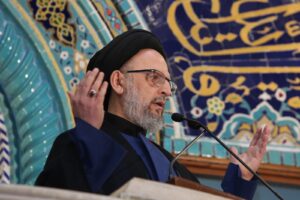
His Eminence, Sayyed Ali Fadlallah, delivered the two Friday prayer sermons at the Imamain Al-Hassanain Mosque, Friday Zulhijja 26, 1447AH /June14, 2026. Several prominent religious scholars, dignitaries and hundreds of believers attended the Jumu’a prayer. Following is summary of his sermons
The Hijri Year: Lessons from the Sacrifices in the Dawn of Islam
Allah, the Most Exalted, says in His Noble Book:
{Indeed, those who have believed and those who emigrated and strove in the cause of Allah – those expect the mercy of Allah. And Allah is Forgiving and Merciful.}
Allah, the Most Exalted, has spoken the truth.
In a few days, with the arrival of the sacred month of Muharram, we will enter a new Hijri year, the year 1448 AH. This year encompasses the twelve lunar months that Allah ordained for His servants from the day He created the heavens and the earth, when He said:
{Indeed, the number of months with Allah is twelve months in the register of Allah from the day He created the heavens and the earth; of these, four are sacred.}
The importance of these months lies in the fact that they determine the timing of the religious obligations, recommended acts of worship, and occasions that we are called upon to observe and commemorate, through which we draw nearer to Allah, the Most Exalted. These include the month of Ramadan, the months of Hajj (Shawwal, Dhu al-Qi’dah, and Dhu al-Hijjah), and the sacred months during which Allah prohibited warfare and fighting, calling for conflicts to cease and hostilities to be suspended.
The Messenger of Allah (p.) chose for this calendar to be linked to the most significant event in Islamic history: his migration from Makkah, where he and the Muslims were enduring the pressures of Quraish, to the atmosphere of freedom they found in Madina. This migration enabled the Messenger of Allah (p.) to convey his message and spread it to the farthest reaches of the world.
The Prophet (p.) made the decision to migrate when the leaders and chiefs of Quraish gathered to confront the growing challenge he represented. His influence had expanded, and his message had already reached Madina. After all the methods of persuasion and intimidation they had employed failed to deter him from continuing his mission, they were left with three options: to imprison him and restrict his freedom until death, to kill him, or to expel him from Makkah.
Allah, the Most Exalted, referred to this when He said:
{And [remember] when those who disbelieved plotted against you to restrain you or kill you or evict you. But they plan, and Allah plans. And Allah is the best of planners.}
After their deliberations, they concluded that the best solution was to kill the Messenger of Allah (p.) while he slept in his bed. The plan was for representatives from all the clans of Quraysh to participate in the assassination so that responsibility for his blood would be spread among all tribes. In that case, Banu Hashim and Banu al-Muttalib, the Prophet’s family, would be unable to avenge his death, as they could not confront all the tribes of Quraish together, and the matter would come to an end
The meeting ended with this decision, and preparations began. Forty men representing the clans of Quraish were assigned to attack the Messenger of Allah (p.) while he slept in his bed.
When news of the plot reached the Prophet (p.), he realized that the time had come to migrate to Madina, a step he had already been planning after a supportive base had been established there, making it a safe place from which to spread his message.
To ensure the Prophet’s safe departure, someone had to sleep in his bed to give the impression to those watching him that he had not left.
No one was more suited for this role than Imam Ali (a.s.). The Messenger of Allah (p.) informed Ali (a.s.) of the plan. Ali (a.s.) simply asked, “Will your safety be secured if I sleep in your place, O Messenger of Allah?” The Prophet (p.) replied, “Yes.” Ali (a.s.) smiled and said, “Then proceed with what you have been commanded. May my hearing and sight be sacrificed for you.”
Concerning this event, the following verse was revealed:
{And of the people is he who sells himself, seeking the approval of Allah. And Allah is Kind to His servants.}
The Messenger of Allah (p.) then set out on his migration, while forty young men from Quraish surrounded his house with drawn swords, waiting for dawn. As soon as the first light of dawn appeared, they rushed forward to carry out their plan and attacked the bed of the Prophet (p.). At that moment, Ali (a.s.) rose before them. They were shocked and drew back.
Not wishing to lose the opportunity to catch the Messenger of Allah (p.) before he reached his destination, Quraish dispatched horsemen and young men across the desert in pursuit. They followed the footprints of the Prophet (p.) and his companion until they reached the entrance of the Cave of Thawr, where the Messenger of Allah (p.) was staying with his companion.
Allah, the Most Exalted, willed to protect His Messenger and frustrate their scheme, causing them to refrain from entering the cave.
Allah, the Most Exalted, referred to this when He said:
{If you do not aid him – Allah has already aided him when those who disbelieved had driven him out as one of two, when they were in the cave and he said to his companion, “Do not grieve; indeed Allah is with us.” Then Allah sent down His tranquility upon him and supported him with soldiers you did not see, and made the word of those who disbelieved the lowest, while the word of Allah – that is the highest. And Allah is Exalted in Might and Wise.}
The Messenger of Allah (p.) remained in the cave for three days with his companion until he was assured that Quraish had lost any hope of finding him. He then resumed his journey until he reached the outskirts of Madina, where its people welcomed him with the finest expressions of hospitality and joy.
After settling in Madina, the Messenger of Allah (p.) began preparing for the new phase of his mission.
The first thing he did was build the Noble Prophet’s Mosque, so that it would serve as a gathering place for Muslims of all backgrounds and a symbol of their unity.
He then established brotherhood between the Muhajirun from Makkah and the Ansar of Madina to strengthen the foundations of the Muslim community. The Ansar demonstrated this brotherhood by sharing their homes, wealth, and workplaces with the emigrants from Makkah.
Through the Constitution of Madinah, the Prophet (p.) also strengthened relations among the city’s diverse religious communities. This paved the way for the Messenger of Allah (p.) and the Muslims to return to Makkah as victors, ushering in a new dawn in human history.
Dear beloved ones, we are called upon to commemorate the Hijri New Year and the meanings it carries by strengthening its presence in our homes, workplaces, media outlets, and communication platforms. We should adopt the Hijri calendar in recording the events of our lives and our history.
At the beginning of this new year, we should recall the sacrifices endured by the Messenger of Allah (p.) and the Muslims who migrated with him from Makkah to Madina, leaving behind their homes, families, and livelihoods for the sake of Allah and His cause, so that this religion could reach us and we could enjoy its blessings.
We should likewise be prepared to exert every effort to pass this faith on to future generations, regardless of the cost or the sacrifices required.
Finally, the beginning of the Hijri year should be an opportunity for us to review our deeds during the past year. We should repent to Allah if we have fallen short in our duties toward Him or neglected the responsibilities entrusted to us, and let our supplication be:
“O Allah, make the future of our year better than its past, make the best of our deeds their endings, and make the best of our days the day we meet You.”
In the Name of Allah, the Compassionate, the Merciful
Second Sermon
worshipperss of Allah, I advise you and myself to welcome the Hijri New Year with what has been mentioned in some narrations: praying two rak‘ahs and then supplicating:
“O Allah, whatever I have done during this year of deeds that You forbade and were not pleased with, which I forgot while You did not forget, and for which You called me to repentance despite my audacity toward You, O Allah, I seek Your forgiveness for it, so forgive me. And whatever deed I have done that brings me closer to You, accept it from me, and do not cut off my hope in You, O Most Generous.”
It is reported that when Satan sees a Muslim turning toward his Lord in repentance and regret for past sins and shortcomings, he says:
“Woe to me! All that I labored for throughout this year has been destroyed by these words, and the past year bears witness that he ended it well.”
As for the beginning of a new year and its first day, it is reported that the Messenger of Allah (p.) would pray two rak‘ahs and then supplicate:
“O Allah, You are the Eternal God, and this is a new year. I ask You in it for protection from Satan, strength against this soul that constantly commands evil, and engagement in that which brings me nearer to You, O Generous One, O Possessor of Majesty and Honor.”
Dear beloved ones, this is how we should bid farewell to a passing year and welcome a new one: by conducting a careful review of what we have done, strengthening our positive actions, avoiding the repetition of mistakes, and preparing ourselves so that the coming year may be better as we strive to attain Allah’s pleasure.
In this way, we deal wisely with the time that has passed and the time that lies ahead, and we gain the ability to face challenges.
We begin with the ongoing and escalating Israeli aggression, which continues to target villages and towns in the South and the Bekaa, leaving behind more martyrs, wounded people, and destruction of homes and commercial institutions, while causing further displacement of residents from their land. At the same time, it continues its attempts to advance and occupy additional territory.
All of this is taking place without anyone effectively stopping this aggression or restraining it, except those who have dedicated themselves to defending their land and homeland, protecting it from this enemy despite the disparity in capabilities and resources. Day after day, they continue to pay a heavy price and offer the greatest sacrifice.
It is regrettable that all of this is occurring amid the sharp political division we are witnessing. The language of accusation, and even treason charges, has taken precedence over dialogue and understanding, while narrow factional interests have overshadowed national interests, with serious consequences on the ground.
For this reason, we renew our call for all state institutions and influential forces in the country to come together and reach a comprehensive national formula that will prevent the country from further decline and secure what is necessary to preserve its security, sovereignty, and territorial integrity.
It has become clear that continued division, along with its political, security, and social consequences, will only lead to greater weakness from which the enemy benefits.
We commend all initiatives aimed at creating the conditions necessary for such a meeting and at finding solutions that can stop the country’s ongoing suffering, end the burden of occupation, and allow people to return to all of their land.
We also hope that the atmosphere surrounding the agreement currently being pursued between the Islamic Republic of Iran and the American administration, which we pray will be achieved, will have positive effects on Lebanon and contribute to ending the aggression against it.
In this regard, we appreciate the position of the Islamic Republic in insisting that ending the war in Lebanon be a fundamental component of that agreement.
We once again stress the need for the Lebanese to move away from the provocative and inflammatory rhetoric that dominates media platforms, social media, and public forums, rhetoric that threatens national unity and creates opportunities for those who seek to undermine it. The Lebanese have no choice but to live together and accept one another.
Turning to domestic matters, we renew our call on the state to play a more active role in addressing citizens’ concerns and confronting the economic and living burdens they face due to rising prices.
Although these increases are partly linked to external crises and ongoing wars, there are also internal factors for which the state bears responsibility through monitoring prices, preventing monopolistic practices, and seriously addressing the growing displacement crisis. The state must ensure decent living conditions for displaced people and not leave them vulnerable to those who exploit their need for housing and other necessities, thereby increasing their hardship
.
Finally, beginning on Tuesday, we will enter the season of Ashura. We want this season to strengthen the values for which Imam al-Hussein (a.s.) sacrificed his blood, along with the blood of his companions and family members.
These values are the values of reform. We must prepare for a comprehensive effort to reform our reality from all forms of deviation, corruption, injustice, and occupation at every level.
From Ashura we should draw the meanings of dignity, honor, and freedom, and learn that we should never submit in humiliation nor surrender as slaves.

You may also like