On the Anniversary of the Death of the Messenger of Allah (p): The Trust of the Message and the Covenant of Loyalty
In the name of Allah, the Compassionate, the Merciful
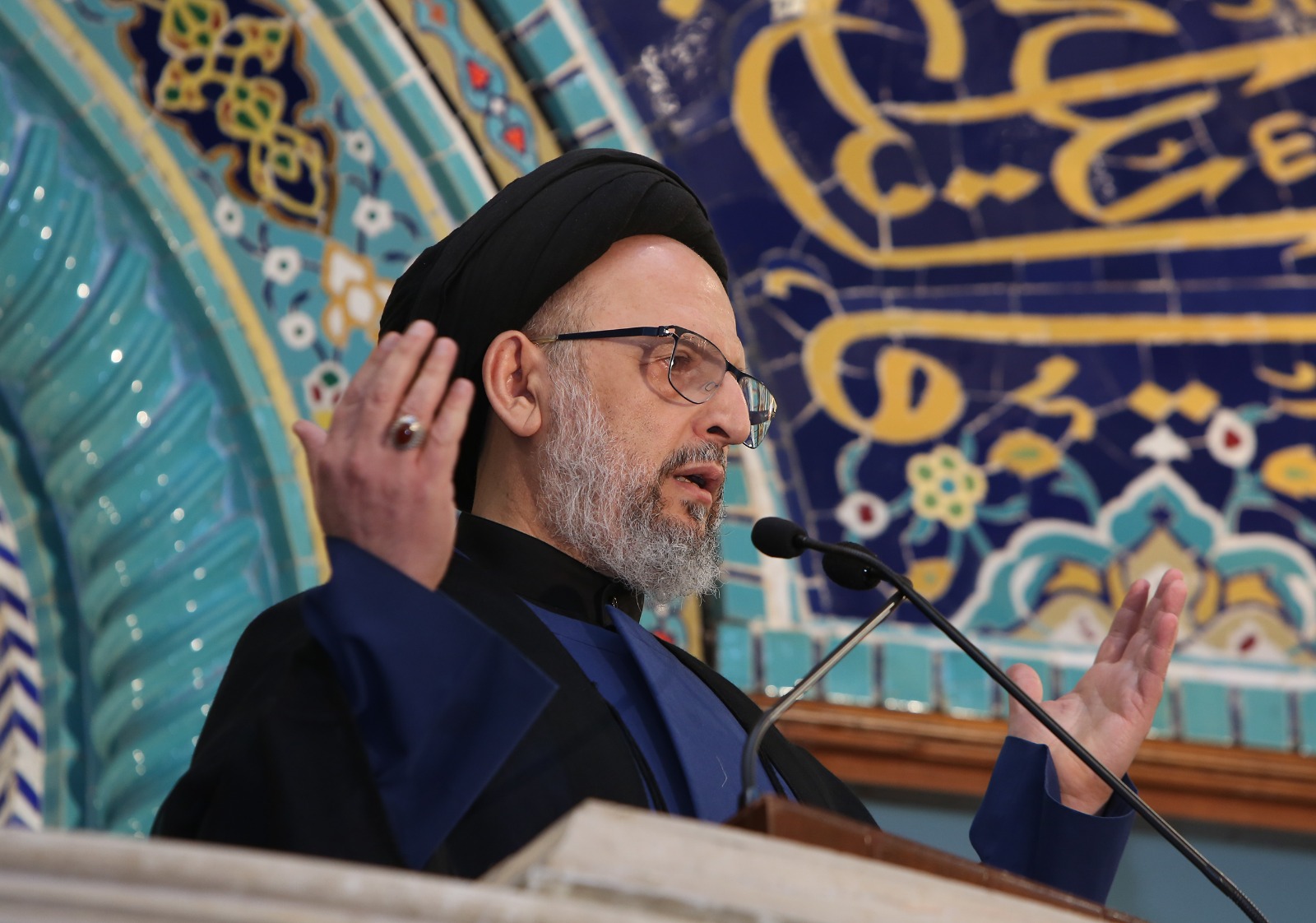
His Eminence, Sayyed Ali Fadlallah, delivered the two Friday prayer sermons at the Imamain Al-Hassanain Mosque, Friday Safar 24, 1448H/ August 7, 2026. Several prominent religious scholars, dignitaries and hundreds of believers attended the Jumu’a prayer. Following is summary of his sermons
First Sermon
.
On the Anniversary of the Death of the Messenger of Allah (p): The Trust of the Message and the Covenant of Loyalty
Allah, the Most Exalted, says in His Glorious Book:
“There has certainly come to you a Messenger from among yourselves. Grievous to him is what you suffer; he is concerned over you and, to the believers, is kind and merciful.”
Allah, the Most Exalted, has spoken the truth.
On the twenty-eighth day of the month of Safar, we commemorate the passing of the Prophet of Mercy, Muhammad ibn Abdullah (p.). It was on this day that the Messenger of Allah (p.) departed from this world, leaving behind grief, pain, and sorrow in the hearts of the believers.
With his departure, Muslims lost the one who had been the link between them and revelation; the one who had brought them out of the darkness of the ignorance in which they lived into the light of knowledge and guidance; the one who had been a father, teacher, and educator to them, and the warm refuge to which they would turn whenever they faced worries, anguish, difficulties, and challenges—as indicated by the verse we have recited.
Yet this did not cause them to retreat from fulfilling their responsibilities toward the call brought by the Messenger of Allah (p), nor from continuing the work of spreading it. The Messenger of Allah (p.) had prepared and trained them for the day on which he would depart this life.
From the very beginning of his mission, he had instilled in their minds that he was a human being, and human beings die; that their relationship with him was ultimately a relationship with the Message that he had brought and called them toward.
If the Messenger were to die, the Message would remain. This is what is expressed in the Noble Verse:
“Muhammad is only a Messenger. Other messengers have passed on before him. So if he dies or is killed, will you turn back on your heels? Whoever turns back on his heels will never harm Allah in the least.”
And this is what happened. After the Messenger of Allah (p.) was gone, the believers fulfilled their role despite the enormity of their loss and the void he left behind.
Through their efforts, their struggle, and the sacrifices they made, they succeeded in spreading Islam, carrying its voice to every place, and preserving it throughout the ages.
Here we are today, benefiting from its presence, enriched by it, and drawing from it dignity, freedom, and a sense of responsibility toward people and life.
Today, on the anniversary of his passing (p.), we will pause at some of his positions and encounters with his companions so that we may learn from them, as Allah, the Most Exalted, says:
“Indeed, in the Messenger of Allah you have an excellent example for whoever has hope in Allah and the Last Day and remembers Allah often.”
The first example occurred after the death of his uncle Abu Talib and his wife Khadijah (a.s.), when the persecution of the Prophet (p.) by Quraish intensified.
He (p) traveled to the city of Ta’if to invite its people to worship Allah, The Most Exalted, alone. He hoped that he would find hearts willing to respond to his call.
But the leaders of Ta’if responded to his concern for them by inciting their children and fools against him. They pelted him with stones until blood flowed from him.
He then sought refuge in one of its gardens and turned to his Lord, saying:
“O Allah, to You I complain of the weakness of my strength, the scarcity of my means, and my humiliation before people… You are the Most Merciful of those who show mercy. You are the Lord of the oppressed, and You are my Lord… To whom will You entrust me? To a distant person who would frown at me, or to an enemy to whom You have given control over my affairs? If You are not angry with me, then I do not care.”
Jibril came to him that day to convey to him the greetings of his Lord and to tell him that He had heard his complaint. He offered him the possibility of having the people crushed between the two mountains surrounding Mecca
But the Prophet (p.) said:
“Rather, I hope that Allah will bring forth from their descendants those who worship Allah alone and associate nothing with Him.”
He did not think of revenge. Instead, he hoped that these very people might one day be guided. And if they were not guided, he hoped that Allah, The Most Exalted, would bring forth from their descendants people who would be guided through him.
Indeed, this is what happened. Years later, the people of Ta’if entered Islam and believed in his Message.
The second example occurred after the Prophet (p.) returned from one of his battles. He and his companions stopped in a valley to rest from the intense heat.
The companions dispersed beneath the trees seeking shade, while the Prophet (p.) found a tree beneath which he rested. He hung his sword from one of its branches and fell asleep.
At that moment, a man from among the polytheists was watching the Prophet (p). When he saw him alone, he seized the opportunity, took the sword from the tree, drew it from its sheath, and stood over the Prophet (p).
The Prophet awoke, and the man said to him while pointing the sword at him:
“Who will protect you from me?”
The Prophet (p.) answered with complete tranquility and belief in his Lord:
“Allah.”
He repeated it three times:
“Allah. Allah. Allah.”
The man trembled, and the sword fell from his hand. Fear overtook him to such an extent that he was unable to pick it up.
The Prophet (p.) took the sword from him and said:
“And who will protect you from me?”
The man replied that The Messenger himself would
The Prophet (p) forgave him, despite everything the man had intended to do to him. The man then returned to his people and said:
“I have come to you from the presence of the best of people.”
The third example
When the illness of the Messenger of Allah (p.) became severe, he came to the mosque with his head bandaged, leaning upon Ali (a.s.) and his cousin al-Fadl ibn Abbas, after the fever had taken a heavy toll on him.
He praised and thanked Allah, the Most Exalted, and then said:
“O my companions, what kind of prophet was I to you? Did I not struggle among you? Was my tooth not broken? Was my forehead not covered with dust? Did blood not flow across my face until it covered my beard? Did I not endure hardship and difficulty at the hands of the ignorant among my people? Did I not tie the stone of hunger around my stomach?”
They replied:
“Yes, O Messenger of Allah. You were patient for the sake of Allah and forbade us from wrongdoing. May Allah reward you on our behalf with the best of rewards…”
He then said:
“Indeed, my Lord, the Almighty and Glorious, has decreed and sworn that He will not allow the injustice of an oppressor to pass. Therefore, I ask you by Allah: if any man among you has a grievance against Muhammad, let him stand and take his due from him. Retribution in this world is more beloved to me than retribution in the Hereafter …”
Through this, the Messenger of Allah (p.) wanted to teach his companions—and, through them, teach us—a lesson: that we should strive not to leave this life while carrying an obligation toward another person.
The situation before Allah, the Most Exalted, is extremely difficult when the oppressed hold the oppressor accountable, for:
“The day of the oppressed against the oppressor is more severe than the day of the oppressor against the oppressed.”
The Messenger of Allah (p) demonstrated this practically when a man among those present in the mosque stood and said:
“May my father and mother be sacrificed for you, O Messenger of Allah, The Most Exalted,. When you returned from Ta’if, I encountered you while you were riding your she-camel, and you had a slender staff in your hand. You raised it as you intended to strike the riding animal, and it struck my stomach. I do not know whether you did it intentionally or by mistake.”
The Messenger of Allah (p.) replied:
“Allah forbid that I would have done it intentionally.”
Then he said:
“O Bilal, go to Fatima’s house and bring me the slender staff.”
Bilal went, while the Muslims were astonished and objecting to what this man was doing.
When Bilal returned with the staff, the Messenger of Allah (p.) exposed his stomach so that the man could take his due.
But the man had another intention. He began kissing the stomach of the Messenger of Allah (p.), saying:
“I seek refuge in the place of retribution on the stomach of the Messenger of Allah from the Fire on the Day of Judgment.”
The Messenger of Allah (p.) said:
“Will you forgive or take retribution?”
He replied:
“Rather, I forgive, O Messenger of Allah.”
The Prophet (p) then said:
“O Allah, forgive Sawadah ibn Qays just as he has forgiven Your Prophet Muhammad.”
The final example concerns the time when he learned that the people—men and women—were weeping because his death was drawing near, after they learned that his illness had become severe.
He came to them leaning upon Ali (a.s.) and his uncle al-Abbas. He stood before them and explained that he did not want their tears; rather, he wanted action—action through which they could fulfill their duty toward him.
He said:
“Indeed, I am about to depart to my Lord. I have left among you that which, if you hold firmly to it, you will never go astray: the Book of Allah, which is among you; you read it morning and evening. It is the remedy for your ailments. In it is what you should do and what you should refrain from. So do not compete with one another, do not envy one another, and do not hate one another. Be brothers, as Allah has commanded you. And I also enjoin upon you the People of my Household; never separate yourselves from them until the Day of Judgment.”
On the anniversary of the passing of the Messenger of Allah (p), let us turn our hearts and souls toward his noble station and renew our covenant of loyalty to him: that we will continue to walk according to the guidance of his words and draw inspiration from his life.
Let us pray for him with the supplication that Imam Zain al-Abidin (a.s.) used to offer:
“O Allah, raise him, for all that he struggled and labored for Your sake, to the highest rank in Your Paradise, until no one may equal him in station, no one may rival him in rank, and neither a near angel nor a sent prophet may be comparable to him in Your sight. Make known to his pure Household and his believing nation the greatest measure of intercession that You have promised him. O You whose promise is fulfilled, O You whose word is true, O You who replace evil deeds with many times their reward in good deeds. Indeed, You are the Possessor of immense bounty.”
The Second Sermon
Worshippers of Allah, I advise you and advise myself with the final counsel that the Messenger of Allah (p) repeatedly gave until he departed this life:
“Prayer, prayer—hold fast to it. Let no distraction keep you away from it. Perform it abundantly, for it is the pillar of your religion, and the religion cannot stand without it…”
And:
“And those whom your right hands possess,”
meaning those who are under your authority: do not oppress or weaken them; fulfill their rights, treat them well, and do not allow them to be wronged in your presence.
He then advised them not to leave this life except with hearts filled with a good opinion of Allah, with confidence in His mercy, His love for His servants, and His promises; knowing that He is the best support and helper for you.
This enables you not to fall into despair, regardless of how numerous the sins may be, how difficult circumstances become, or how fiercely challenges may strike.
In this way, we remain true to the Messenger of Allah (p), express our love and loyalty to him, remain committed to his guidance, and become better equipped to confront the challenges we face.
We begin with the Israeli aggression. The enemy continues what it had begun by blowing up homes, schools, public and private institutions, and commercial establishments in the villages and towns it has occupied, rendering them unfit for life.
At the same time, the circle of its attacks continues to expand. They have not remained confined to areas adjacent to its positions of occupation, but have extended to locations farther away, as we have witnessed recently.
The enemy is disregarding ceasefire decisions and the negotiations taking place with it. This once again indicates its lack of seriousness in honoring agreements and reveals how it approaches the ongoing negotiations.
Based on this, we reiterate our call to the Lebanese state: it must not base its strategy on rights that it begs from the enemy, or on pressures imposed upon it in the hope that it will deliver what the Lebanese people and the Lebanese state seek.
The enemy has shown no willingness to halt its aggression. It has openly declared its refusal to withdraw from any of the villages and towns it has occupied, and it continues to threaten to expand its aggression whenever it considers this to serve its interests.
We want the Lebanese state to place its confidence in working to build a unified Lebanese position that takes into account the interests of this country and its sovereignty over its land.
It should make use of the elements of strength it possesses internally, the hands extended in support of its cause externally, and whatever understandings and arrangements are taking place at the regional level—developments that can positively affect Lebanon and strengthen its position.
The unity of the Lebanese position at this stage is the most powerful weapon.
Lebanon will not be weak if its efforts are united and everyone moves beyond their private calculations and sectarian or factional interests toward the interests of the nation.
This does not mean denying that there are differences among the Lebanese regarding the choices they face in confronting current circumstances, nor does it mean minimizing these differences.
But we have always emphasized that we do not want these differences to lead to division of the kind we are witnessing politically, through the media, or on social media.
Rather, we want these differences to be managed in a manner that does not lead to internal tension, weaken the domestic situation, or undermine the Lebanese position.
Therefore, we call—and continue to call—for an end to emotionally charged and tense rhetoric, for a return to calm and rational discourse, and for an end to the exchange of rhetoric that leads nowhere.
We call for internal dialogue as the path toward reaching genuine understandings that take into consideration Lebanon’s supreme national interest and Lebanon’s complete sovereignty over its land.
At this time, we call upon the state to fulfill its responsibility toward its citizens and to mobilize its efforts to address what the Lebanese are suffering on the economic and living fronts as a result of the rising cost of living, which increases day after day.
Its causes can no longer be attributed merely to wars taking place abroad, but also to the greed of traders, monopolistic practices, and the state’s failure to properly monitor prices.
We also pause at the increase that was approved in the salaries of members of parliament.
We say that it is the right of members of parliament to receive a salary that secures for them the requirements of a dignified life. However, we did not want them to increase their salaries or accept such increases before military personnel and public-sector employees, who are struggling to obtain their financial rights—rights that, until now, have not been secured as they seek.
Turning to occupied Palestine, the Zionist enemy continues to violate the agreement reached with it in Gaza by continuing assassinations and airstrikes against it.
In the West Bank, it is escalating its actions through raids on refugee camps and the destruction of their infrastructure, with the aim of forcibly displacing the residents of these camps, which stand as witnesses to the cause of a people expelled from their land.
This calls upon all Arabs and Muslims—governments and peoples alike—to fulfill their responsibilities toward the Palestinian people and their cause, which must remain their central concern and foremost cause.
Finally, in light of what is taking place in the Islamic Republic of Iran, we hope that a serious agreement can be reached to end the war that was launched against it, thereby contributing to restoring stability to the region and the world and preventing the continuation of the human and economic bleeding.
At the same time, we believe that reaching a fundamental and lasting solution remains complicated, given the intransigence of the American administration and its insistence on refusing to respond to the legitimate demands of the Islamic Republic of Iran and its right to allow its people to fully benefit from its resources and wealth.