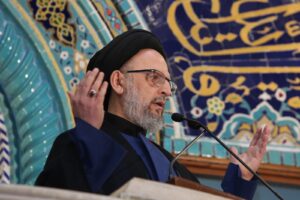
First Sermon Maintaining Family Ties: A Human Relationship Encouraged by

In the Name of Allah, the Compassionate, the Merciful
His Eminence Sayyed Ali Fadlallah delivered the two Friday prayer sermons at the Imamain al-Hassanain Mosque on Ramadan 3, 1447 AH / February 20, 2026. Several prominent religious scholars, dignitaries, and hundreds of believers attended the Jumu‘a prayer. Following is a summary
First Sermon
Maintaining Family Ties: A Human Relationship Encouraged by the Qur’an
Allah, the Most Exalted, says in His Glorious Book:
“O mankind, fear your Lord, who created you from one soul and created from it its mate and dispersed from both of them many men and women. And fear Allah, through whom you ask one another, and the wombs. Indeed Allah is ever, over you, an Observer.”
This noble verse shows the great importance Allah, the Most Exalted, has given to maintaining family ties, as He joined it with His command to fear Him: “And fear Allah… and the wombs.” This indicates strong emphasis on preserving this human relationship and not neglecting it.
Family is the first relationship in which a person grows. When this bond is maintained, it provides emotional, psychological, and material support. It reduces tensions, contains conflicts, and strengthens a person when facing challenges so that he does not stand alone.
Ali ibn Abi Talib (p.) said: “Honor your clan, for they are your wing with which you fly, your origin to which you return, and your hand with which you strike.”
Allah, the Most Exalted, also says:
Only those of understanding take heed —
Who fulfill the covenant of Allah and do not break the contract,
And those who join that which Allah has commanded to be joined and fear their Lord and dread the evil of [their] account.
And the meaning of “joining” here is maintaining family ties (ṣilat ar-raḥm), for Allah made it the way of the people of understanding, and He linked it with those who fear their Lord and dread the evil of [their] account.
Many narrations have encouraged this connection and clarified the effects it brings, and the great benefits that an individual and society gain if it is maintained. It was narrated from Muhammad (p.):“The quickest good deed in reward is maintaining family ties (ṣilat ar-raḥm),” meaning that whoever maintains his family ties sees its blessings appear quickly upon him
“Whoever would like his provision to be expanded or his life to be prolonged, let him maintain his family ties… Indeed, a person maintains his ties while he has only three days left of his life, and Allah prolongs it for him by thirty years; and a man severs his ties while he has thirty years left, and Allah reduces it to three days.”
In another narration:
“Maintaining family ties purifies deeds, increases wealth, averts calamities, eases the account, and prolongs life.”
Allah, the Most Exalted, warned against severing family ties in the Qur’an:
“So would you perhaps, if you turned away, cause corruption on earth and sever your [ties of] relationship?
Those [who do so] are the ones whom Allah has cursed; He deafened them and blinded their vision.”
Allah, the Most Exalted, linked corruption on earth with severing ties of kin, making it a cause for His curse and removal from His mercy.
The Hadith says:
“Mercy does not descend upon a people in whom there is one who severs family ties.” Ali ibn Abi Talib (a.s.) said:
“I seek refuge in Allah from sins that hasten destruction.”
It was asked: “Are there sins that hasten destruction?” He replied: “Yes, woe to you, severing family ties.”
When we speak of maintaining family ties, we do not mean only the ties of a Muslim or believer; it applies to all relatives. It is obligatory to maintain ties even if the relative disagrees with one’s beliefs, sect, or political opinion.
A man asked Imam Ja’far al-Sadiq (a.s.): “I have relatives who are not like me in faith; do they have a right over me?”
He (a.s.) replied:
“Yes. The right of kinship cannot be cut off by anything. If they share your faith, they have two rights: the right of kinship and the right of Islam.” By “kinship” (raḥm), it means relatives through father and mother, including parents, siblings and their children, uncles, aunts, and cousins from both paternal and maternal sides.
The connection Allah, the Most Exalted, says that it does not break at distance. You must maintain ties even if they have traveled far or are far from you. It is your duty to reach out and communicate, and the means of communication today make this obligation fully possible.
The Messenger of Allah (p.) said:
“I advise those present of my nation and those absent, and those in the loins of men and the wombs of women until the Day of Resurrection, to maintain family ties, even if it requires a journey of a year; this is part of the religion.”
How much more today, when communication can occur with a simple phone call. The narrations also indicate that this connection should occur even if the relative severs ties. It was narrated:
“The one who maintains ties is not the one who reciprocates, but the one who reconnects when others cut him off.”
The Messenger of Allah (p.) said:
“Maintain ties with the one who cuts you off, and be good to the one who harms you.”
And he (p.) said:
“Do not sever your family ties even if they sever you.”
Ali ibn Hussein, Zain al-Abidin (a.s.), said:
“No step is more beloved to Allah, the Most Exalted, than two steps: a step by which a believer supports the rank in the way of Allah — meaning he stands with the fighters in His path — and a step toward a relative who has severed ties.”
Hence, it is narrated that the best charity is that given to a relative whose relations are cut.
Imam Zain al-Abidin (a.s.) exemplified this with a cousin who used to harm him and dislike him. At night, the Imam would wrap himself, go to him, and give him whatever he needed in food and money, without revealing himself. The man would say to whoever brought it: “You maintain me and give charity to me, while Ali ibn Hussein does not maintain me; may Allah reward you.” When the Imam passed away, the connections ceased, and the man realized that the one who was helping him was the very one who he had harmed.
This connection takes multiple forms: visiting, phone calls, social media, or groups created for this purpose; visiting the sick, helping those in need, supporting them in hardship and sorrow, and sharing in their joys and sadness. Families are encouraged to establish a fund to help relatives and to form a committee to resolve disputes among members.
The Messenger of Allah (p.) said:
“Maintain your family ties even by greeting them.”
“Maintain ties even with a drink of water. The best means of maintaining ties is to avoid harming them.”
However, Islam warns that maintaining ties should not turn into tribal fanaticism or injustice. You should not support relatives at the expense of truth and justice. Muhammad (p.) said:
“Support your brother, whether he is an oppressor or oppressed.”
They asked: “O Messenger of Allah, we know how to support him if he is oppressed, but how do we support him if he is an oppressor?”
He (p.) replied: “By restraining him from oppression.”
Allah, the Most Exalted, says:
“O you who have believed, be persistently standing firm in justice, witnesses for Allah, even if it be against yourselves or parents and relatives…”
And:
“And when you speak, be just, even if it concerns a near relative…”
Beloved ones, in this blessed month, we are called to strengthen these ties. Let us check on each of our relatives individually. If there is separation or enmity — and how many disputes occur over inheritance, with tragic consequences — let us take the initiative to resolve them. Let each family appoint someone responsible for this task, someone capable of resolving problems, for this brings good and righteousness in this world and the Hereafter.
The Messenger of Allah (p.) said:
“Whoever maintains his family ties in it (Ramadan), Allah will connect him with His mercy on the Day he meets Him.”
And he warned:
“Whoever severs his family ties in it, Allah will sever him from His mercy on the Day he meets Him.”
In the Name of Allah, the compassionate, the Merciful
Second Sermon
Worshippers of Allah, I advise you and myself to have taqwa (consciousness and fear of Allah), to which Allah calls upon us. It is the goal we are meant to attain in this month, so that we may realize its true meaning and be granted its blessings and goodness.
Imam Muhammad al-Baqir (a.s.) described the people of taqwa, saying:
“The people of taqwa are the least burdensome in this world and the most helpful to you. If you remember, they help you; if you forget, they remind you.
The one who has taqwa is easygoing, undemanding, beneficial to others, and steadfast in obedience to his Lord.
Allah, The Most Exalted, has promised blessings and goodness to the people of faith and taqwa. He says:
“And if the people of the towns had believed and feared Allah, We would have opened upon them blessings from the heaven and the earth.”
And He says: “Whoever fears Allah – He will make for him a way out.”
Through taqwa, crises are resolved and challenges are faced. Allah,
We begin with the Israeli attacks that continue to target this country through the assassinations of its citizens and through airstrikes affecting many locations in the South and the Bekaa. Meanwhile, the enemy persists in its aggressive practices in the villages along the border strip, carrying out shelling and demolishing the remaining residential homes, or throwing sound bombs at houses, as part of its plan aimed at emptying them of their inhabitants and creating a buffer security zone. At the same time, its Minister of War openly declares the continuation of his presence in the five strategic hills and the refusal to withdraw from them unless Lebanon submits to the conditions it seeks to impose upon it.
In light of all that has happened and what may yet happen, we renew our call to the Lebanese state to assume its responsibility in exercising sovereignty over its land toward its citizens. This does not call on it to make concessions, but rather to take all necessary measures to stop the bleeding of blood and destruction, and to lift the burden of occupation from the land of this homeland which we fear may become a fait accompli, and to make this its highest priority.
It is regrettable that we do not witness the required seriousness in this regard, as the state still considers the exclusivity of weapons to be the path to stopping the attacks and lifting the burden of occupation, while all the facts confirm that what this enemy seeks goes beyond that. Thus, we continue to witness its attacks, despite the state’s confining of weapons south of the Litani and the beginning of preparations to confine them north of it.
We now turn to the recent decisions issued by the Government, which surprised all the Lebanese who did not imagine that i would take such steps—despite its slogan of rescue and reform—at a time when it is fully aware of the extent of suffering endured by most Lebanese in their living and daily conditions, and of their inability to secure the most basic necessities of life. They are unable to bear any increase; indeed, they are already burdened by the increases imposed upon them in the latest budget. In doing so, it has repeated the mistakes committed by previous governments, which would reach into the pockets of the poor whenever they needed money.
Public sector employees, teachers in public schools, and retirees of the Lebanese Army have the right to receive what they deserve in order to live with dignity—this is what we have demanded and continue to demand. However, the state could have granted people their rights without placing additional living burdens on the majority of Lebanese that affect their basic needs. Moreover, these decisions did not resolve the problem; they gave with one hand only to take away with the other, as this has led and continues to lead to multiplied inflation in the prices of all goods. This is in addition to the impact of the increase in value-added tax if it is approved by Parliament.
In light of what has occurred, we renew our call to the Lebanese government, out of concern for it and in pursuit of restoring the confidence of the Lebanese people in it, to reconsider its decision and to study alternatives capable of securing revenues for the treasury from sources other than the poor. It is striking that we do not find anyone within the government supporting this decision; rather, everyone denies it, which raises the question: was it issued by the government or not?
We turn to the negotiations taking place between the Islamic Republic of Iran and the American administration. While we hope that the negotiations will continue in a way that guarantees the sovereignty of the Islamic Republic of Iran, its right to defend itself, and to possess the capabilities that secure its vital interests toward its homeland, we still fear that the mobilization of fleets, the resulting tension, and the continuous efforts of the Zionist entity to sabotage these negotiations may lead to a war whose repercussions would not stop at Iran’s borders but could extend to the entire region.
We now turn to occupied Palestine, where the Palestinian people are facing these days the most dangerous process of uprooting them from their land, whether through the new decisions of the enemy government—which allow the Zionist enemy to expand its control over the West Bank in preparation for displacing Palestinians and ending any formula for a Palestinian state, even within its current borders—or through what is taking place in Gaza, including continued assassinations, killing, and siege. This calls upon Arab and Islamic countries to assume their responsibility toward it.
As for the Peace Council conference that was recently held, although it does change anything of what is happening in the Gaza Strip in terms of tragedies, we do see something positive in the contributions presented by many countries for the reconstruction of Gaza, which of course will not be sufficient for its rebuilding. However, we fear that this may serve as a bribe to pave the way for implementing the steps that are intended, which would place the sector under international trusteeship instead of under the administration of the Palestinian people and their right to sovereignty over their land and their free decision upon it.

You may also like