The Characteristics of the Mission-Oriented Personality of Imam al-Kāẓim (a.s.)
In the name of Allah, the Compassionate, the Merciful
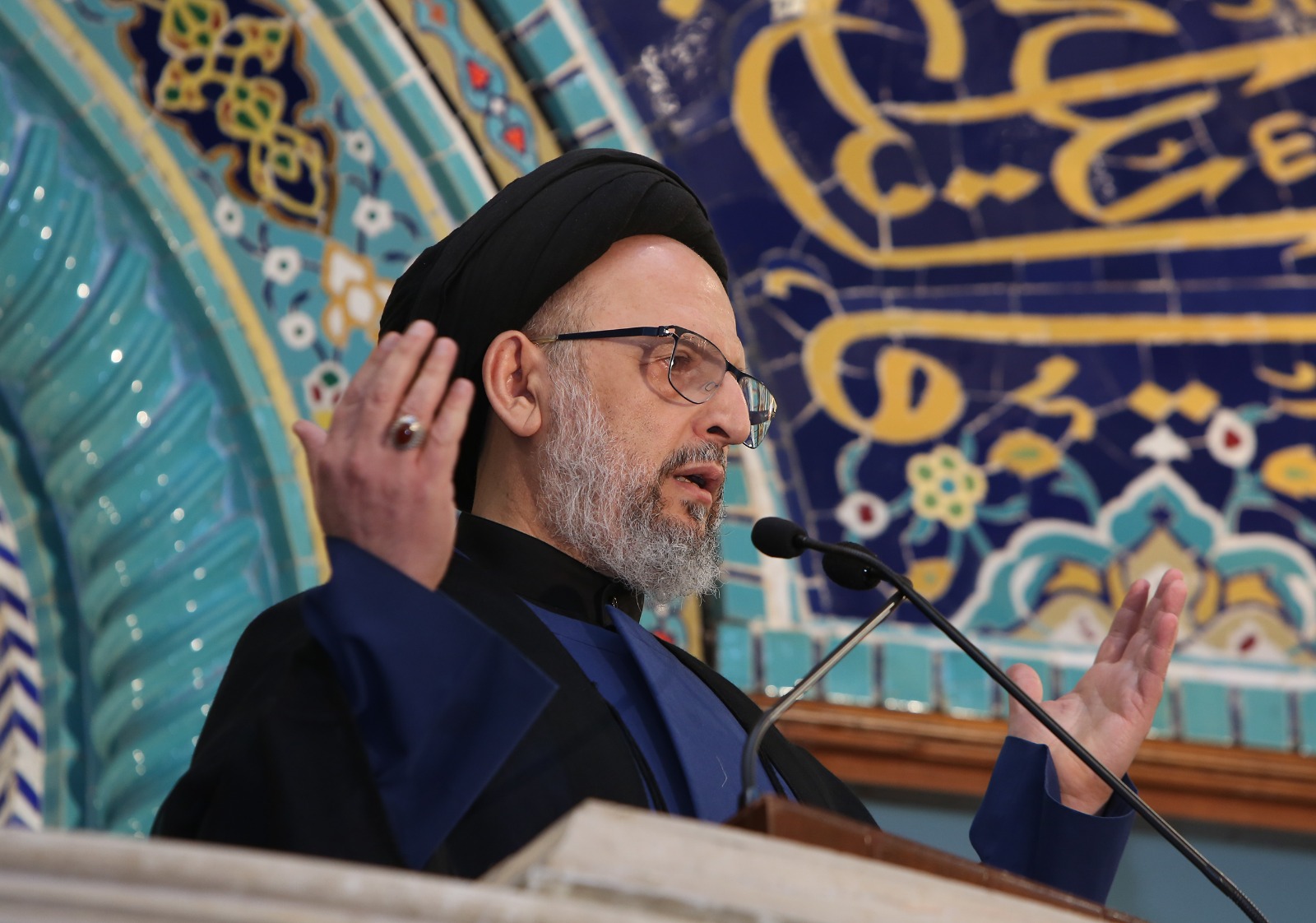
His Eminence, Sayyed Ali Fadlallah, delivered the two Friday prayer sermons at the Imamain Al-Hassanain Mosque, Friday Safar 10 , 1448H/ July 24, 2026. Several prominent religious scholars, dignitaries and hundreds of believers attended the Jumu’a prayer. Following is summary of his sermons
The Characteristics of the Mission-Oriented Personality of Imam al-Kāẓim (a.s.)
Allah, the Most Exalted, says in His Noble Book:
“And We made them leaders guiding by Our command, and We inspired them to do good deeds, establish prayer, and give zakāt, and they were worshippers of Us.”
Allah, the Most Exalted, has spoken the truth.
On the seventh of Ṣafar, we commemorated the blessed birth of the seventh Imam from the Ahl al-Bayt (a.s.), Imam Mūsā ibn Jaʿfar al-Kāẓim (a.s.).
Regarding this Imam, Shaykh al-Mufīd wrote in his book Al-Irshād:
“Mūsā ibn Jaʿfar al-Kāẓim (a.s.) was the most distinguished of the sons of Abū ʿAbdullāh (a.s.), the greatest in rank, the highest in status, and the most renowned among the people. No one in his time was seen to be more generous, nobler in character and companionship, more devoted in worship, more pious, more eminent, more knowledgeable in jurisprudence, or braver than him.”
Imam al-Kāẓim (a.s.) assumed the responsibility of the Imamate after the passing of his father, Imam al-Ṣādiq (a.s.), when he was only twenty years old. Throughout his Imamate, which lasted thirty-five years, he endured the oppression of the Abbasid rulers who succeeded one another during that period. The harshest persecution came under Hārūn al-Rashīd, who imprisoned him in underground prisons for seven to ten years, according to different narrations.
Yet despite the severity of this suffering, it never weakened the Imam or prevented him from fulfilling his divine mission or confronting intellectual, doctrinal, juristic ,and moral deviations.
Despite all the hardships he endured, the Imam left behind a rich legacy of narrations, jurisprudence, Qur’anic interpretation, sermons, and ….
On this occasion, we will reflect on several of his sayings.
The first narration is what he said to one of his companions:
“Do not be an imma’ah for the Messenger of Allah (p.) forbade a person from being an imma’ah.”
When the companion asked, “What is an imma’ah, O grandson of the Messenger of Allah?” the Imam replied:
“Do not say, ‘I am with the people, and I am just like everyone else.’ There are only two paths: the path of good and the path of evil. Never let the path of evil become more beloved to you than the path of good.”
The Imam (a.s.) wished to explain what the Messenger of Allah (p.) had prohibited: that a person should merely echo the opinions, positions, and decisions of those to whom he belongs—whether they are his family, tribe, sect, school of thought, or political group—approving whatever they approve and supporting whatever they do, whether right or wrong.
What the Messenger of Allah (p.) wanted was for a person to stand with those to whom he belongs only when they are upon the truth, (right) and to reject falsehood even when it comes from them. Right —not family, tribe, sect, or political affiliation—must determine one’s support or opposition.
The second saying is:
“Strive to divide your time into four parts: one part for intimate communion with Allah, the Almighty and Exalted—remembering Him, supplicating to Him, seeking His forgiveness, glorifying Him, and worshipping Him; one part for earning your livelihood—to provide for your own needs and those under your care; one part for associating with trustworthy brothers who make you aware of your faults and are sincere toward you in private—setting aside time to be with people whose sincerity helps improve your faith, character, and conduct by pointing out your mistakes and shortcomings, rather than flattering you or overlooking them; and one part in which you allow yourselves lawful enjoyment—making time to benefit from the permissible pleasures of life, which help you fulfill your responsibilities rather than distract you from them.”
This is what the Imam (a.s.) referred to when he said:
“Through this fourth part, you gain the strength to fulfill the other three.”
Holding Oneself Accountable
“He is not one of us who does not hold himself accountable every day. If he has done good, he asks Allah to grant him more of it and praises Him for it. If he has done wrong, he seeks Allah’s forgiveness and repents to Him.”
The Imam (a.s.) wanted to emphasize a truth that every Muslim, and everyone who follows the path of the Ahl al-Bayt (a.s.), should never lose sight of: that the measure of one’s commitment to Islam and to the path of the Ahl al-Bayt is to dedicate time each day to examine oneself—whether one has neglected duties, failed in responsibilities, or withheld kindness from those in need.
One should not postpone this self-examination until another day. Rather, one should scrutinize oneself more strictly than a business partner scrutinizes his partner. If one finds that he has done good, he should thank Allah, the Almighty and Exalted, and resolve to do even more. If he finds that he has erred, he should hasten to repent, seek forgiveness, correct what has gone wrong, and make amends for what has passed.
The fourth narration relates to the time when the Abbasid Caliph Hārūn al-Rashīd sent his minister Yaḥyā ibn Khālid al-Barmakī to Imam al-Kāẓim (a.s.) with an offer to release him from prison, provided that he apologized to the Caliph.
The Imam refused and said:
“I have nothing for which I should apologize. Go back to him and tell him: ‘The appointed time is near, and the reckoning is coming.'”
He also said:
“No day of hardship passes for me except that a day of ease passes for you, until we both arrive at a Day that has no end, on which the followers of falsehood will be the losers.”
Consider this remarkable stance. The Imam had already spent many years in prison, yet when offered freedom in exchange for an apology, he refused. Like Prophet Yūsuf (a.s.), he declared:
“Prison is more beloved to me than that to which they invite me.”
As a result, Hārūn al-Rashīd grew increasingly distressed by the Imam’s steadfastness, patience, and unwavering principles. When every attempt to change his position failed, he ultimately decided to end the Imam’s noble life while he remained imprisoned, as reported in the historical narratio
Dear beloved ones,
This was Imam al-Kāẓim (a.s.). This was his path. This was his character. He suffered, endured pain, and was wronged.
Our true loyalty to this Imam lies in embodying his words, his positions, and the virtue for which he became renowned—restraining anger, patiently enduring harm, and remaining unwavering in principles despite every hardship.
This is beautifully expressed in the Ziyārah recited at his shrine:
“Peace be upon you, O Gateway to Allah for those who seek their needs, Mūsā ibn Jaʿfar al-Kāẓim. I bear witness that you conveyed what Allah entrusted to you, preserved what He placed in your care, endured harm in the cause of Allah, and strove in His path with the striving it truly deserved until certainty came to you.”
May Allah make us among those who follow his example, walk in his footsteps, and act according to his guidance. Indeed, He is the Most Merciful of the merciful.
In the Name of Allah, the Most Compassionate, the Most Merciful
The Second Sermon
Worshippers of Allah,
I advise you and myself to follow the advice Imam al-Kāẓim (a.s.) gave to his companions:
“I advise you to fear Allah in private and in public, to uphold justice in times of pleasure and anger, to earn your livelihood whether in poverty or wealth, to maintain ties with those who cut you off, to forgive those who wrong you, and to give to those who withhold from you. Let your gaze be one of reflection, your silence one of thoughtful contemplation—not empty silence—your speech a remembrance of Allah, and let generosity become your nature, whether through wealth, time, assistance, or even kind treatment. For no miser shall enter Paradise, and no generous person shall enter the Fire.”
Dear beloved ones,
We are in great need of these teachings. If we embrace them, our lives will become more conscious, responsible, and open-hearted, enabling us to confront the challenges before us.
We begin with the ongoing Israeli attacks. The Israeli enemy continues to launch airstrikes on the outskirts of the occupied villages, while systematically demolishing homes, infrastructure, and both public and private institutions in the villages it occupies, in an effort to discourage their residents from returning.
All of this is taking place without any meaningful condemnation of the enemy for its violations against Lebanon and its people. Such actions have come to pass almost as though nothing has happened.
At the same time, the so-called “pilot zones” plan has begun with the deployment of the Lebanese Army into several southern villages designated for this purpose. We hope that this will become the first step toward allowing their residents to return freely.
We welcome the deployment of the Lebanese Army in these villages. We have always hoped that the Army would exercise its authority over every inch of Lebanese territory. This is not a favor granted by anyone, but its rightful duty and responsibility.
However, we did not want this deployment to come as the result of bargaining or to be subject to the enemy’s permission or conditions, especially since it has become clear that the villages the Lebanese Army entered were not among those occupied by the enemy, allowing it to present this as a concession to the Lebanese state and its people.
We therefore call upon the Lebanese state to strengthen the capabilities of the Lebanese Army so that it can effectively fulfill its responsibility of protecting the residents of these villages, reinforce their confidence in their national army, foster greater unity between the Army and the people, and remain vigilant against any attempts to create division between them.
We hope that the solidarity we have witnessed between the Army and the people will become the foundation for liberating the land, protecting Lebanon’s sovereignty, preserving security, and confronting the enemy’s schemes and ambitions.
At the same time, we call upon the Lebanese government, and particularly its Prime Minister, to honor the promises made to those returning to their villages by providing everything necessary to ensure their stability and continued presence on their land. This must be regarded as one of the government’s foremost responsibilities.
We also renew our call for the Lebanese state not to resign itself to the current situation, but to fulfill its duty of achieving full sovereignty over its territory and realizing the aspirations of its citizens. We support every effort the state undertakes in this regard.
Ultimately, the success of any initiative in this matter will be judged by whether it compels the Israeli enemy to cease its aggression, withdraw from every occupied part of Lebanese territory, guarantee the safe return of the displaced, and facilitate the reconstruction of what has been destroyed.
Anything short of that remains merely words, hopes, or emotions that neither change the reality of occupation nor deter its aggression.
For our part, our trust remains in the determination and unity of the Lebanese people.
We are fully aware of the deep disagreements among the Lebanese regarding how to confront this stage, liberate the occupied land, and secure the return of the prisoners. However, we hope these differences will not turn inward, causing Lebanese to direct their strength against one another rather than against their enemy. Such internal division would weaken Lebanon’s position and create opportunities for the discord sought by those who wish this country no good.
Let the constant concern of everyone be Lebanon’s welfare and sovereignty, placing them above every other inte
Finally, we turn to the ongoing aggression against the Islamic Republic of Iran, which has entered a dangerous phase as it increasingly targets the country’s infrastructure and vital facilities in an effort to force its submission, deprive it of its legitimate rights, and destroy its capabilities.
These developments are already having serious consequences for the security and stability of the peoples of the region.
We remain confident in the ability of the Islamic Republic—its leadership and its people—to manage this difficult period with wisdom and steadfastness in a way that secures its legitimate rights and contributes positively to the causes of the region, its peoples, and the wider world.