Zain al-Abidin (a.s.): The Path of Raising the Awareness of the Umma and Preserving the Goals of the Revolution

In the name of Allah, the Compassionate, the Merciful
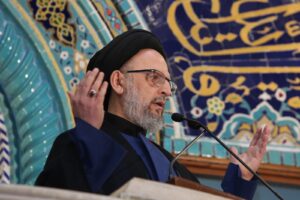
His Eminence, Sayyed Ali Fadlallah, delivered the two Friday prayer sermons at the Imamain Al-Hassanain Mosque, Friday Muhaaram 25, 1448H/ July 10, 2026. Several prominent religious scholars, dignitaries and hundreds of believers attended the Jumu’a prayer. Following is summary of his sermons
First Sermon
Zain al-Abidin (a.s.): The Path of Raising the Awareness of the Umma and Preserving the Goals of the Revolution
Allah, the Most Exalted, says in His Glorious Book:
“And We made them leaders guiding by Our command. And We inspired to them the doing of good deeds, establishment of prayer, and giving of zakat; and they
Allah, the Most Exalted, has spoken the truth.
The Commemoration of the Passing of Imam al-Sajjad (a.s.)
We meet on this day, the twenty-fifth of Muharram al-Haram, to commemorate the passing of one of the Imams of Ahl al-Bait (a.s.), the fourth Imam of this purified Household from whom Allah removed all impurity and purified with a thorough purification: Imam Ali ibn al-Hussein (a.s.).
The title that became associated with his name—Zain al-Abidin (the Ornament of the Worshippers) and Sayyed al-Sajidin (the Master of Those Who Prostrate)—indicates the extent of his connection with Allah, the Most Exalted. This was expressed through his abundant worship, his many prostrations, and his humility when he stood before his Lord in prayer and supplication.
Imam Zain al-Abidin (a.s.) lived for twenty-three years under the care of his father, Imam al-Hussein (a.s.), from whom he gained knowledge, refinement, forbearance, humility, generosity, humanity, and courage. He was among those who accompanied his father in his uprising from its beginning until they reached the land of Karbala.
He was the living witness to what occurred there after illness prevented him from taking part in the battle. He endured the greatest suffering when he saw with his own eyes the martyrdom of his father, his brothers, his uncles, his cousins, and his father’s companions.
After the martyrdom of his father Imam al-Hussein (a.s.), Imam Zain al-Abidin (a.s.) carried the responsibility of the Imamate and fulfilled its duties.
He worked along several paths.
First: He confronted the Umayyad media campaign, which had devoted all its efforts to erasing the features of the crime committed at Karbala and distorting the objectives for which Imam al-Hussein (a.s.) had launched his revolution.
Through his words and positions throughout the period of captivity and later in Madina, along with the role played by his aunt Lady Zainab (a.s.), he succeeded in immortalizing this revolution and keeping its flame alive throughout history.
Second: The Imam (a.s.) worked to educate and awaken the Umma, bringing it out of a state of silence and indifference and pushing it toward carrying the responsibilities placed upon it.
This appeared in his words, positions, and teachings. It also appeared in his supplications, which he did not intend to be merely a means through which a person communicates with Allah to seek the fulfillment of his worldly and Hereafter needs.
Rather, he made them a platform for moral education, guidance, and intellectual development.
This was also expressed in Risalat al-Huquq (The Treatise of Rights), which is considered one of the most important documents concerning rights. In it, he explained the responsibilities of the individual and the Umma toward themselves, their causes, and the rights of others.
Third: He paid attention to the social dimension. Because of his awareness of the dangers resulting from poverty and need, he personally carried sacks of bread at night to the poor and needy without them knowing who he was.
Through these diverse roles, Imam Zain al-Abidin (a.s.) was able to leave a great impact upon his society, attract people’s hearts toward him and his message, and leave us an intellectual and spiritual provision from which we continue to benefit and draw.
Today, on this painful occasion, we will reflect upon some of the words of the Imam (a.s.) so that we may learn important lessons that will guide us in this life as well as the future
The first saying is regarding fanaticism (‘asabiyyah), where Imam Zain al-Abidin (a.s.) said:
“The fanaticism for which its bearer is sinful is that a man sees the wicked among his people as better than the righteous among another people. It is not fanaticism for a man to love his people; rather, fanaticism is that he assists his people in injustice.”
The Imam (a.s.) intended through this statement to explain the meaning of the fanaticism that Allah, The Most Exalted, has prohibited when He described it as the zealotry(extremism ) of the Age of Ignorance.
Fanaticism does not mean, as some people may believe, that a person loves those to whom he belongs. Loving one’s own people is something natural and expected.
Rather, fanaticism means that a person sees the members of his family, tribe, followers of his sect or school of thought, or those who share his political position as always being right, even if they make mistakes, commit wrongdoing, or act unjustly.
Therefore, he justifies their mistakes, excuses their offenses, and stands with them even when they are upon falsehood, oppression, or sin.
The second saying is:
“The second hadith: ‘Seeking one’s needs from people is a humiliation of life, a diminishing of modesty, and a belittling of dignity. It is the poverty that is present. And asking people for fewer of one’s needs is the wealth that is present. ”
Through this saying, the Imam (a.s.) calls the believing person to depend upon himself in fulfilling his needs, because asking others may result in humiliation, weakness, loss of dignity, and the removal of modesty.
These are matters that Allah does not accept and does not desire for the believer.
This meaning was expressed by Imam Ali (a.s.) when he said:
“Need whoever you wish, and you become his captive; be independent of whoever you wish, and you become his equal.”
This does not mean that a person should not seek help, for people need one another in their needs and affairs.
Rather, the Imam (a.s.) wanted the believer to be active and productive in life, not to make asking others an easy habit, and to strive with all his effort to fulfill his needs by his own work.
This was among the matters that Prophet Muhammad (p.) advised his companions regarding: that they should not ask people for anything.
He would say to the one who asked him for his need while he knew that person was capable of fulfilling it:
“Whoever asks us, we give him; and whoever seeks independence, Allah will make him independent.”
The third saying is:
“Three things save the believer: restraining his tongue from people and from backbiting them, occupying himself with what benefits him for his Hereafter and his worldly life, and weeping extensively over his sin.”
Through this saying, the Imam (a.s.) explained the matters which, if a believer acts upon them and keeps them in consideration, will bring salvation in this world and the Hereafter.
The first means of salvation is restraining one’s tongue from people and protecting it from backbiting.
This is because of the dangerous effects it has upon a person’s position and life in this world. The traditions have indicated this meaning:
“The affliction of a person comes from his tongue.”
And:
“No one is safe from sins until he restrains his tongue.”
The believer must especially guard against backbiting, which Allah, has described by saying:
“And do not backbite each other. Would one of you like to eat the flesh of his brother when dead? You would detest it.”
Backbiting is among the actions that destroy a person’s good deeds and increase his sins.
The second means of salvation is that a person occupies himself with what concerns him and with what he will be held accountable for when he stands before his Lord.
He should work on correcting his own faults and improving his position before Allah and before people, rather than occupying himself—as many do—with the faults of others, searching for their mistakes, and engaging in rumors and idle talk.
The third means of salvation is weeping over one’s sin.
The Imam (a.s.) does not intend by this merely the outward act of crying. Rather, he means that a person should hasten toward regret for his sins and shortcomings in fulfilling his responsibilities, which drives him toward repentance and correcting what has been corrupted.
Dear beloved ones,
We are today in great need of seeking guidance from these words, so that they may become for us a source of guidance, light, and insight; that they may strengthen our awareness; and that we may spread them within our homes, in our gatherings, among people, and wherever we may be.
Through this, we express our loyalty and devotion to this Imam (a.s.), and through it we revive his matter. This is achieved by spreading the knowledge of Ahl al-Bait (a.s.), for if people come to know their teachings, they will love them.
In the Name of Allah, the Most Compassionate, the Most Merciful
The Second Sermon
Worshippers of Allah,
I advise you, and I advise myself, with what Imam Zain al-Abidin (a.s.) advised one of his companions, Tawus al-Yamani.
This man saw the Imam (a.s.) one day praying in the Sacred Mosque, supplicating and weeping during his supplication. He approached him and said:
“O son of the Messenger of Allah (p.), I saw you in this state, while you possess three things that are a source of security from fear: the first is that you are the son of the Messenger of Allah (p.), the second is the intercession of your grandfather, the Messenger of Allah (p.), and the third is the mercy of Allah.”
The Imam (a.s.) replied:
“O Tawus! As for the fact that I am the son of the Messenger of Allah (p.), it does not grant me safety, for I have heard Allah, the Almighty, say:
‘So when the Horn is blown, no relationship will there be among them that Day, nor will they ask about one another.’
As for the intercession of my grandfather, it does not grant me safety either, because Allah, the Most Exalted, says:
‘And they cannot intercede except on behalf of one whom He approves.’
As for the mercy of Allah, then Allah, the Most Exalted, says:
‘Indeed, the mercy of Allah is near to the doers of good
”
Through this, the Imam (a.s.) wanted to clarify that it is through action alone, accompanied by piety, that a person reaches what is with Allah.
Therefore, let us work to attain what is with Allah, the Most Exalted. The life in which we have been placed is our field in which we plant what we will harvest before Allah.
When we understand this reality, we become more responsible and more aware of the Day about which Allah says:
Then we will be able to face the challenges before us.
We begin with the attacks carried out by the Zionist entity against the villages and towns adjacent to the areas it has occupied. These attacks have led and continue to lead to more martyrs and civilian victims, while it continues to demolish buildings and infrastructure in the villages it has occupied and where it maintains its presence.
At the same time, its surveillance drones continue to violate Lebanese sovereignty.
This comes at a time when statements by the leaders of the enemy continue to declare their intention to remain in the territories they have occupied and not withdraw from them, under the pretext that these are security areas for them.
Unfortunately, this is taking place without any serious position from the Lebanese state, nor condemnation from international parties or those sponsoring the framework agreement. Rather, within the details of the agreement itself, we find what benefits the enemy by allowing it to consolidate its presence in the areas it has occupied and strengthen its freedom of movement there.
What is happening requires the Lebanese state to fulfill what it promised the Lebanese people when it entered negotiations: to work toward restoring all Lebanese territories occupied by the enemy and allowing their residents to return to them.
It must not surrender to what is now being offered to the Lebanese people under the name of “model villages.”
However, we believe that this will not happen through appeals or by waiting for pressures to be placed upon the Zionist entity, as such pressures often do not come.
Rather, it requires reliance upon a unified national decision based on Lebanon’s sources of strength and upon the will of the Lebanese people to protect their land, sovereignty, and readiness to sacrifice for it.
In saying this, we do not seek to underestimate the capabilities of the enemy or the extent of the support and protection it possesses. However, as we have said before and repeat today:
Freedom, sovereignty, and dignity are not granted to the Lebanese for free. They are the result of efforts, sacrifices, and the payment of costs that may be great.
From here, we renew our call to the Lebanese people for internal unity—unity among those responsible for decision-making as well as among the people themselves—to confront this difficult stage facing the country and what is taking place around it.
This cannot be confronted through the severe division we witness, nor by closing one’s ears so that no one listens to another, nor through seeking strength by overpowering others.
Rather, it is through coming together, solidarity, cooperation, moving beyond personal, factional, sectarian, religious, and political interests, and preserving the interests of the country.
Each political group in this country may have its own opinion and conviction regarding how current events should be approached. However, this does not justify anyone taking the nation toward an option whose price will be paid by all Lebanese people.
This nation is built through consensus and by preserving its rights.
We remain within this country to commend the statement issued by the municipal councils and local representatives of the Christian villages in the border strip.
The statement rejected the claim made by the enemy’s prime minister that the Christian villages in the border area had requested to join his entity, meet with him, or be placed under its protection.
This position blocked the enemy’s attempt to exploit internal division and appear as the protector of a Lebanese community, despite the fact that it does not view the unity of the Lebanese social fabric except as something opposed to its own existence.
We believe that this position reflects a national awareness that we wish to see strengthened in every place, because unity is the strongest response to everyone who seeks harm against their shared coexistence—a value that must not be abandoned.
We remain within the domestic situation to once again emphasize that the state must place, among its highest priorities at this stage, providing all the necessities that guarantee stability for those returning to their lands.
This includes infrastructure, as well as the necessary assistance for them—especially for those who have lost their homes or sources of livelihood.
Such measures strengthen their trust in their state, a state whose absence from them they have long complained about.
The presence of the state is not demonstrated merely through the strong hand it possesses. Rather, it is demonstrated through the citizen feeling the closeness of the state during times of crisis and when facing those who seek to harm them.
Finally, we recall the magnificent scene of the millions who came out in the cities of Iran and Iraq to participate in the funeral procession of Sayyed Ali Khamenei (ra), expressing through it their loyalty and devotion to all the efforts he made.
Through this, they affirmed that when blood is sacrificed in the path of dignity and freedom, it only increases nations in steadfastness.
They affirmed that leaders who live within the conscience of their peoples do not see their influence end with their departure. Rather, they remain present in the hearts of their people, and their path becomes a covenant, a responsibility, and a way toward a better life filled with dignity and honor.

You may also like