Patience and Restraining Anger in the Approach of Imam al-Hassan (a.s.)
In the name of Allah, the Compassionate, the Merciful
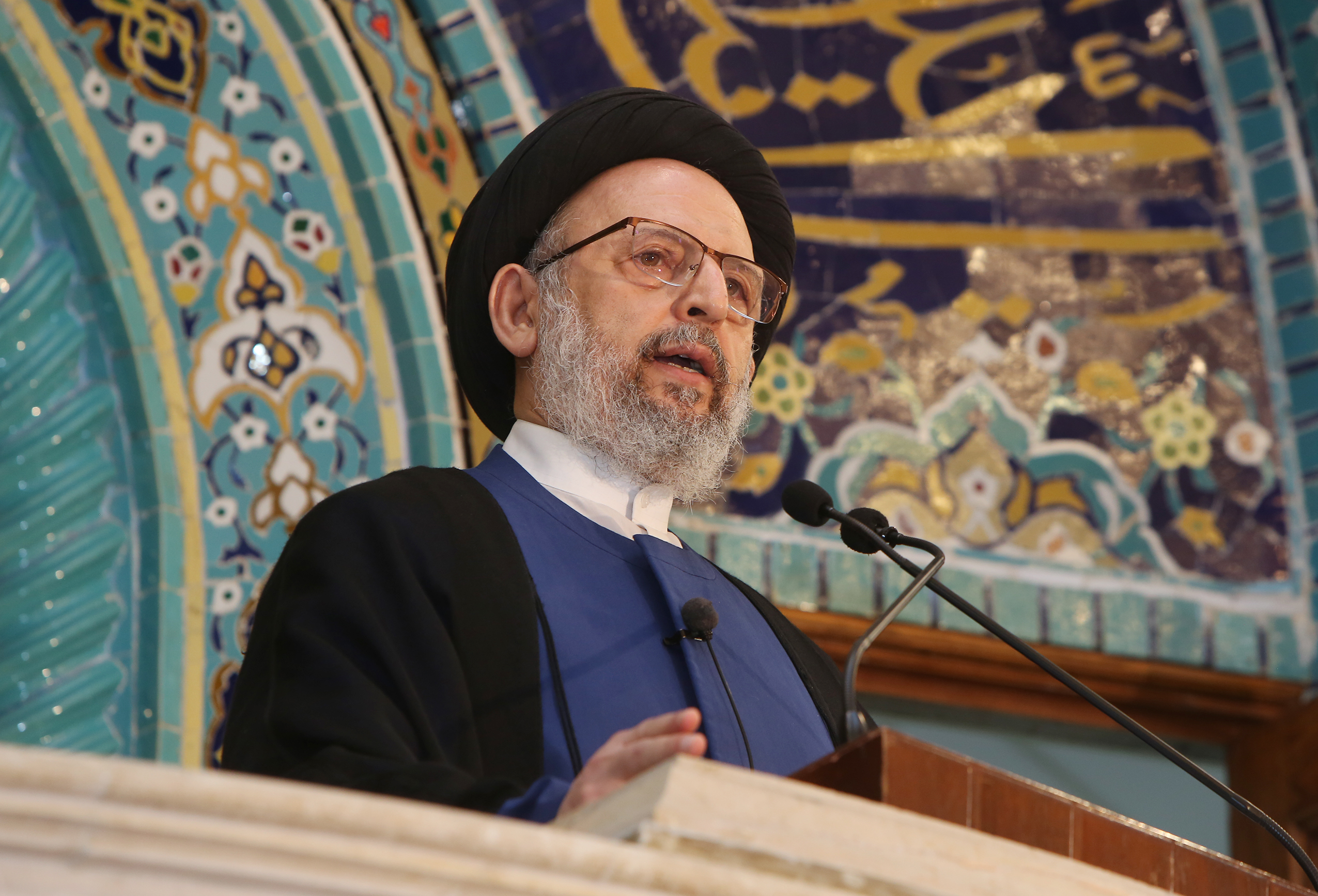
His Eminence, Sayyed Ali Fadlallah, delivered the two Friday prayer sermons at the Imamain Al-Hassanain Mosque, Friday Safar 3. 1448H/ July 17, 2026. Several prominent religious scholars, dignitaries and hundreds of believers attended the Jumu’a prayer. Following is summary of his sermons
First Sermon
Patience and Restraining Anger in the Approach of Imam al-Hassan (a.s.)
Allah, the Most Exalted, says:
{Allah only intends to remove impurity from you, O People of the Household, and to purify you completely.}
Allah, the Most Exalted, has spoken the truth.
On the seventh day of this month, the blessed month of Safar, we commemorate the passing of one of those upon whom this noble verse was revealed. The verse points to the status he attained before Allah, as He removed impurity from him and purified him completely. He was Imam al-Hassan ibn Ali (a.s.), the grandson of the Messenger of Allah and his beloved one.
This Imam (a.s.) was raised in the care of his mother, al-Zahra (a.s.), his father, the Commander of the Faithful (a.s.), and received special attention from his grandfather, the Messenger of Allah (p.). Through this upbringing, the qualities and characteristics of his personality were shaped. The Prophet (p.) expressed this when he said:
“Hassan is from me, and I am from Hassan.”
His biography records that he was the closest of people to the Messenger of Allah (p.) in character, appearance, and dignity. After the Prophet’s passing, people would look toward him whenever they longed to see the Messenger of Allah again, and they found in him his knowledge, patience, worship, asceticism, generosity, humility, love for people, and mercy toward them.
After the death of his grandfather, the Messenger of Allah (p.), Imam al-Hassan (a.s.) supported his father in his religious mission and carried the burdens of leadership when his father assumed the caliphate. He was his supporter who was present with him in all his battles and among his leading heroes.
Imam al-Hassan (a.s.) assumed responsibility after the martyrdom of his father during one of the most difficult and critical periods. Mu‘awiyah refused to pledge allegiance to him and led an army against him, which led Imam al-Hassan (a.s.) to mobilize his supporters to confront this aggression.
War was close to breaking out, but Imam al-Hassan (a.s.) chose reconciliation after realizing that war would not achieve the desired results at that stage. The details of this matter are beyond the scope of this discussion today. However, this decision did not cause Imam al-Hassan (a.s.) to withdraw from his religious and guiding role, spreading awareness among the Muslim community and confronting everything that threatened its beliefs, laws, and values.
He continued in this role until he departed this life as a result of poison placed for him by order of Mu‘awiyah, in order to prevent him from continuing this mission.
Today, we draw lessons from this occasion by highlighting one of the most prominent qualities of Imam al-Hassan (a.s.): forbearance. It was a quality so closely associated with him that he became known as the most forbearing of the Members of the Household. Even one of his strongest opponents, Marwan ibn al-Hakam, acknowledged this quality.
It is reported that when Imam al-Hassan (a.s.) passed away and his funeral procession was brought out, Marwan insisted on carrying his bier. When al-Hussein (a.s.) asked him:
“Are you carrying his bier? By Allah, you used to make him swallow bitterness.”
Marwan replied:
“I only did that to one whose patience was greater than mountains.”
When Imam al-Hassan (a.s.) was asked about the meaning of forbearance, he defined it as:
“Restraining anger and controlling oneself.”
Here, we will mention several examples from his life that demonstrate this value.
Examples of His Exemplary Conduct
First:
It is narrated that Imam al-Hassan (a.s.) was traveling in Medina with some of his companions when he encountered a man from Syria. This man had been raised by Mu‘awiyah’s propaganda to hate the Members of the Household (a.s.) and hold resentment toward them.
As soon as the man recognized that this was Imam al-Hassan (a.s.), he began insulting and cursing him, releasing the hatred that had been planted within him.
The Imam’s companions moved to silence the man and respond to him, but Imam al-Hassan (a.s.) said:
“Leave him. I will take care of his matter.”
He approached the man with his familiar smile and said:
“O elderly man, I think you are a stranger and perhaps you have mistaken me for someone else. If you sought to reconcile with us, we would gladly reconcile with you.,,
If you seek guidance from us, we will guide you. If you ask us to carry your burden, we will carry it. If you are hungry, we will feed you. If you are without clothing, we will clothe you. If you are in need, we will provide for you…If you have a need, we will fulfill it. So move your belongings toward us and stay as our guest until the time of your departure. This will be better for you, because we have a spacious place, a respected position, and abundant wealth.”
He then invited the man to his home.
The man went to the house of Imam al-Hassan (a.s.) and witnessed an atmosphere of faith and piety that had been absent from his life. He left saying:
“I testify that you are Allah’s representative on His earth. Allah knows best where to place His message. You and your father were once the most hated people to me, but now you are the most beloved of Allah’s creation to me.”
Second:
Another incident occurred after Imam al-Hassan’s decision to make peace with Mu‘awiyah. Some of his supporters did not understand the reasoning and objectives behind this decision. They viewed it as humiliation and surrender.
Some even said to him when greeting him:
“Peace be upon you, O one who has humiliated the believers.”
Others said:
“I wish you had died on that day, and that we had died with you.”
Yet such words, which could have provoked anyone, did not anger Imam al-Hassan (a.s.). Instead, he responded with wisdom, patience, and an open heart, explaining his reasoning and showing that he had acted only for their benefit.
This caused them to reconsider their words, understand the reality of his decision, and apologize to him.
Third:
This was demonstrated in his final advice to Imam al-Hussein (a.s.). He said:
“I advise you, my brother, regarding those whom I leave behind from my family, my children, and household: forgive those who wrong them, accept the good deeds of those who do good among them, and be my successor and a father to them… And bury me beside my grandfather, the Messenger of Allah, for I have greater right to him. If they prevent you from doing so, then I ask you by Allah, by our kinship and close relationship with the Messenger of Allah, not to shed even a small amount of blood because of me.”
And this is what happened. When al-Hussein (a.s.) sought to bury his brother al-Hassan (a.s.) beside their grandfather, the Umayyads prevented it. The situation nearly led to fighting, but Imam al-Hussein (a.s.) intervened and quickly carried his brother’s body to al-Baqi‘ cemetery, where he was buried beside his grandmother Fatima bint Asad, fulfilling his brother’s advice and preventing the conflict that Imam al-Hassan (a.s.) had sought to avoid, even at the expense of his own wish to be buried beside his grandfather.
Dear brothers and sisters, on the anniversary of this Imam’s passing, we are in great need of following his example in this quality: the quality of forbearance.
We need to be among those who do not rush toward tension, emotional reactions, and anger whenever causes for them arise—and there are many such causes in our present time.
We all know the consequences that can result when anger and emotional reactions control individuals or societies. This requires effort from us, patience, and divine guidance. Yet its effects are significant in this world.
It has been reported:
“Whoever practices forbearance gains authority.”
And:
“Whoever shows patience toward his enemy will overcome him.”
The Prophet’s saying also describes the status of those who possess this quality:
“The forbearing person is almost like a prophet.”
Allah, the Most Exalted, says:
{And hasten toward forgiveness from your Lord and a Paradise as wide as the heavens and the earth, prepared for the righteous: those who spend in times of ease and hardship, who restrain their anger and pardon people; and Allah loves those who do good.}
Our final supplication is that all praise belongs to Allah, Lord of the worlds.
Second Sermon
Worshipers of Allah, I advise you and myself with the advice of Imam al-Hassan (a.s.) to one of his companions, Junadah ibn Abi Umayyah, when he visited him during the illness from which he passed away, while suffering from the effects of the poison that had been given to him.
Junadah said:
“Advise me, O son of the Messenger of Allah.”
The Imam (a.s.) replied:
“Prepare yourself for your journey, and gather your provisions before your appointed time arrives. Know that you seek this world while death seeks you. Do not carry the worries of tomorrow, which has not yet arrived, into your present day. Know that whatever wealth you acquire beyond your needs, you are only a caretaker for someone else… Work for your worldly life as though you will live forever, and work for your Hereafter as though you will die tomorrow. If you desire honor without a tribe and dignity without authority, then leave the humiliation of disobedience to Allah for the honor of obedience to Allah…”
Dear brothers and sisters, we are in great need of these teachings so that we may become more aware of our path in this life, more responsible, and more capable of facing challenges.
We begin with the Zionist aggression that we have witnessed and continue to witness through the daily raids targeting villages and towns in the south. At the same time, acts of destruction, demolition, and burning of buildings, infrastructure, and forests continue in the occupied areas, with the aim of eliminating every sign of life, discouraging residents, and preventing their return.
Despite all of this, negotiations between the Zionist entity and the Lebanese state have continued. We had expected the Lebanese state to take a position regarding what is happening: not to continue these negotiations with the enemy while it carries out its aggression and fails to fully implement the ceasefire.
We understand the scale of the pressures imposed on the Lebanese state and the reality this country faces due to the Zionist occupation. However, this does not justify accepting what the enemy commits, remaining silent regarding its crimes against Lebanon and the Lebanese people, or abandoning the state’s responsibility.
The state’s responsibility is to remain faithful to its people, land, and independent decision-making, and not to surrender the rights, resources, and life savings of the Lebanese people.
We want the Lebanese state to insist on the complete withdrawal of the enemy from all occupied Lebanese territories, whether through negotiations, or before any international forum. It must not accept what the enemy claims to offer the Lebanese people regarding withdrawal from certain villages—especially when it has become clear that many of these areas were never entered by the occupying army.
This withdrawal has also been surrounded by conditions imposed by the enemy that make it impossible to achieve or maintain, especially after the enemy announced—and continues to announce—that it will not leave the territories it occupied and intends to remain there as a security zone.
At the same time, we warn against the consequences of internal division, whether within state institutions or among the public, and its impact on the internal unity required at this stage to confront challenges.
To preserve Lebanon’s position and prevent any internal conflict sought by those who do not wish this country well, everyone must refrain from the tense and provocative rhetoric seen in media platforms, social networks, official statements, and political discourse.
Instead, there must be a return to strengthening dialogue in addressing disagreements, guided by rational, objective, and calm discourse, which is the path to resolving disputes and removing tensions.
In another matter, we renew our call for the Lebanese state to activate its role toward citizens who have paid the price of war through displacement, destruction, and sacrifices.
The state must make every possible effort to provide the conditions necessary for their return to their villages and to secure a dignified life for them, as this is their right.
Here, we must acknowledge the initiatives undertaken by individuals, institutions, and organizations that have attempted to fulfill this role, helping to fill part of the gap created by the state’s failure to carry out its responsibilities toward citizens.