Reflections from the Life and Sayings of Imam al-Riḍā (a.s.)

In the name of Allah, the Compassionate, the Merciful
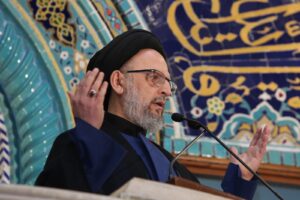
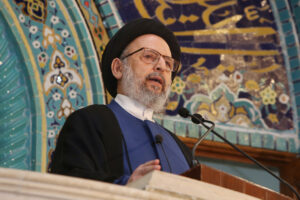
His Eminence, Sayyed Ali Fadlallah, delivered the two Friday prayer sermons at the Imamain Al-Hassanain Mosque, Friday Safar 17, 1448H/ July 31, 2026. Several prominent religious scholars, dignitaries and hundreds of believers attended the Jumu’a prayer. Following is summary of his sermons
First Sermon
.
Reflections from the Life and Sayings of Imam al-Riḍā (a.s.)
Allah, the Most Exalted, said:
“And We made them leaders guiding by Our command, and We revealed to them the doing of good deeds, the establishment of prayer, and the giving of zakāt; and they were worshippers of Us.”
Allah, The Most Exalted, has spoken the truth.
Today, on the seventeenth day of this blessed month of Ṣafar, we commemorate the passing of one of the Imams of the Ahl al-Bait (a.s.), Imam ʿAlī ibn Mūsā al-Riḍā (a.s.).
This Imam, whose title(al-Rida) — which became associated with his name — points to the position he attained with Allah, The Most Exalted, and in the hearts of people, even those who opposed him; for he gained the pleasure of his Lord and became a source of acceptance among people because of his knowledge, patience, excellent character, and humility.
It has been narrated from Ibrāhīm ibn al-ʿAbbās al-Ṣūlī, who was among the prominent figures of the Abbasid caliphate that he said:
“I have neither seen nor heard of anyone better than Abū al-Ḥasan al-Riḍā (a.s.). I witnessed from him things that I have never witnessed from anyone else. I never saw him treat anyone harshly with his words, nor did I ever see him interrupt anyone’s speech until that person had finished speaking. And I never saw him refuse anyone a request that he was capable of fulfilling.”
He also said “He was frequently engaged in acts of kindness and charity. And: “One of the signs of his humility was that whenever he was alone and his dining table was prepared, he would seat his servants and attendants with him at his table, even the gatekeeper and the stable worker.”
One of his companions said to him:
“May I be sacrificed for you, if only you would prepare a separate table for these people.”
The Imam (a.s.) replied:
“Stop! Indeed, the Lord, Blessed and Exalted, is One, the mother is one, the father is one, and reward is based on deeds.”
It has also been reported from Rajā’ ibn Abī al-Ḍaḥḥāk, whom al-Ma’moun sent to accompany Imam al-Riḍā (a.s.), that when al-Ma’moun asked him about the Imam, he said:
“By Allah, I have never seen a man who was more God-conscious than him, nor one who remembered Him more frequently at all times, nor one who feared Allah, The Most Exalted, more intensely…”
He also said:
“Whenever he entered a city, people would come to him seeking answers about the teachings of their religion, and he would respond to them.”
Al-Ma’moun said to him:
“O son of Abī al-Ḍaḥḥāk, this is the best of the people of the earth, the most knowledge able among them, and the most devoted of them in worship.”
During his Imamate, which extended for twenty years after the death of his father, Imam al-Kāẓim (a.s.), Imam al-Riḍā was distinguished by his acceptance of the position of heir apparent to the Abbasid caliph al-Ma’moun.
He accepted this position because he saw in it an opportunity that allowed him freedom of communication with people — something that had not been available to him — and the opportunity to spread the knowledge of the Ahl al-Bayt (a.s.) and confront the manifestations of deviation that had begun spreading in Islamic society, whether at the level of beliefs, concepts, hadith, or other areas.
Today, we will benefit from this honored occasion by reflecting on some of the sayings of Imam al-Riḍā (a.s.), hoping to gain from them, strengthen our faith, and strengthen our society through commitment to them.
The first narration is the Hadith that was called “The Golden Chain.”
It has been narrated that Imam al-Riḍā (a.s.), while he was on his way to Khurasan to assume the position of heir apparent, passed through the city of Nisapur. At that time, Nisapur was one of the largest centers of knowledge and hadith.
A large group of scholars and students of Hadith came out to welcome him and requested that he narrate a Hadith from his forefathers
The Imam (a.s.) said:
“I heard my father Mūsā ibn Jaʿfar say: I heard my father Jaʿfar ibn Muḥammad say: I heard my father Muḥammad ibn ʿAlī say: I heard my father ʿAlī ibn al-Ḥussein say: I heard my father al-Ḥussein ibn ʿAlī say: I heard my father the Commander of the Faithful, ʿAlī bin Abī Ṭālib, say: I heard the Messenger of Allah (p.) say: I heard Gabriel say: I heard Allah, The Most Exalted, say:
‘There is no god but Allah; it is My fortress. Whoever enters My fortress will be safe from My punishment.’”
Then the riding animal moved a little, and Imam al-Riḍā (a.s.) raised his head and said:
“With its conditions and their requirements, and I am among its conditions.”
Through this blessed Hadith, Imam al-Riḍā (a.s.) intended to point to the importance of the statement:
“There is no god but Allah.”He wanted to explain that this statement is the fortress that protects a person from falling into the punishment of Allah. However, the Imam (a.s.) did not intend that people merely pronounce this statement with their tongues in order to obtain its results. Rather, he intended that it should be reflected in their attitudes, behavior, and decisions; that they should see Allah, The Most Exalted, alone as the Creator, the Provider, the Supporter, the Helper, and the One who manages all affairs; that they should turn only to Him, follow His commands, and refrain from what He has prohibited.
Therefore, he said:
“With its conditions and their requirements,”
and then said:
“And I am among its conditions, “to clarify that commitment to his Imamate achieves this objective, because his Imamate is an expression of the Messenger of Allah (p.), and the Messenger of Allah is an expression of the command and guidance of Allah, The Most Exalted.
The second narration:
“Indeed, Allah dislikes idle talk and gossip, wasting wealth, and excessive asking.” The phrase “idle talk and gossip” refers to excessive speech without benefit, spreading people’s news without verification, pointless arguments, backbiting, and tale-bearing.
The second thing that Allah, The Most Exalted, dislikes is:
“Wasting wealth,” through extravagance, squandering it, and spending it in the wrong places, even if a person possesses a great amount of money.
This is what Allah, The Most Exalted, referred to when He said:
“Indeed, He does not love those who are extravagant.”
And when He said:
“Indeed, the wasteful are brothers of the devils.”
According to the standards of Allah, The Most Exalted, a person is not completely free to dispose of his wealth however he wishes. Just as he will be asked about where he obtained it from, he will also be asked about where he spent it.
The third thing that Allah, The Most Exalted dislikes is:
“Excessive asking.”
This Hadith does not mean that asking questions is prohibited, because asking questions may be necessary. Rather, Allah, The Most Exalted, encouraged asking when He said:
“So ask the people of remembrance if you do not know.”
What Imam al-Riḍā (a.s.) intended to discourage is excessive askng about matters that do not benefit a person in this world or the Hereafter, or excessive requests for assistance and asking others for giving without an urgent necessity.
The third narration is what was reported by Ibrāhīm ibn Abī Maḥmūd, who was among the companions of Imam al-Riḍā (a.s.).
He said to him:
“O son of the Messenger of Allah, we have reports among us regarding the virtues of the Commander of the Faithful (a.s.) and your virtues, the Ahl al-Bait, and they are narrated by those who oppose you. We do not know of similar reports from you. Should we follow them?”
The Imam (a.s.) advised him not to rush into accepting them and said:
“Our opponents fabricated reports regarding our virtues and divided them into three categories:
The first is exaggeration, the second is falling short regarding our status, and the third is explicitly mentioning the faults of our enemies.
When people hear exaggeration about us, they declare our followers unbelievers and attribute to them the belief in our divinity. When they hear statements that diminish our status, they believe that applies to us. And when they hear the faults of our enemies mentioned by their names, they respond by criticizing us by our names.
Allah, The Most Exalted, has said: ‘And do not insult those they invoke besides Allah, lest they insult Allah in hostility without knowledge.’
O son of Abī Maḥmūd, when people take paths to the right and left, hold firmly to our way…
O son of Abī Maḥmūd, preserve what I have narrated to you, for I have gathered for you within it the goodness of this world and the Hereafter.”
Dear brothers and sisters,
On the anniversary of Imam al-Riḍā (a.s.), we are in greatest need of following his words, advice, guidance, and positions, because this represents the revival of the matter of the Ahl al-Bait (a.s.).
Reviving their matter does not stop — as many people think — at holding celebrations during their occasions of happiness, mourning gatherings during their times of sorrow, or visiting them, despite the importance of all of these. Rather, it is achieved through acting according to what they wanted from us.
This is what Imam al-Riḍā (a.s.) indicated when he said:
“Revive our matter; may Allah have mercy upon whoever revives our matter.”
When he was asked:
“How do we revive your matter?”
He replied:
“A person learns our knowledge and teaches it to people, for if people knew the beauty of our words, they would follow us.”
Peace be upon Imam ʿAlī ibn Mūsā al-Riḍā (a.s.), on the day he was born, on the day he departed to the mercy of his Lord, and on the day he will be resurrected alive.
I bear witness that you established prayer, gave zakāt, commanded what is right, forbade what is wrong, and worshipped Allah sincerely until certainty came to you.
The Second Sermon
Worshippers of Allah,
I advise you, and I advise myself, with what Imam al-Ḥussein (a.s.) advised us — this Imam whose fortieth-day commemoration we will revive after a few days — when he said in his first statement after reaching Karbala:
“O people, indeed I heard the Messenger of Allah (p.) say: ‘Whoever among you sees a tyrannical ruler who considers what Allah has forbidden permissible, breaks Allah’s covenant, opposes the tradition of the Messenger of Allah, and acts among Allah’s servants with sin and aggression, yet does not seek to change this through an action or a word, then it is a right upon Allah to admit him into the same place as that ruler.
Indeed, these people have committed themselves to obedience to Satan and abandoned obedience to the Most Merciful. They have taken exclusive possession of public wealth, suspended the limits of Allah, made lawful what Allah has forbidden, and forbidden what Allah has made lawful…’”
Through this advice, Imam al-Ḥussein (a.s.) wanted us to expand the scope of our concerns.
He wanted us not to limit our responsibilities toward Allah, The Most Exalted, only to what we are accustomed to of prayer, fasting, pilgrimage, khums, and Zakāt. Rather, we must be present in all matters of justice, freedom, and truth.
We must stand against the oppressor, whoever that oppressor may be, and against the corrupt, whoever that corrupt person may be. We must confront every deviation at the intellectual, faith-based, or moral level.
We must not sit aside on the sidelines, watching the conflict taking place before us. For if we do so, we will become partners in what events eventually lead to, and we will bear the consequences afterward.
At that point, our prayers to Allah asking Him to free us from what we suffer will not succeed.
Through this alone, life is built, grows, and becomes more pure, upright, and just. Through it, we face challenges.
We begin with the Israeli attacks that continue to affect areas close to its occupation positions, with its fires not sparing even places where the Lebanese Army is present, in a blatant provocation aimed at obstructing its work and its role.
Meanwhile, the enemy continues its demolition and bulldozing operations against villages and towns that fall under its occupation. These operations target every sign of construction and development and do not even spare cemeteries.
The aim is to make their residents lose hope of returning to them and to establish its permanent control over them — something it has increasingly begun to announce publicly.
The latest example was the statement made by its army chief of staff, from inside Lebanese territory that Israel would not withdraw from the lands it had occupied and would remain there under the weak pretext of preserving its security.
In response to this, we renew our call to the Lebanese state, which has adopted diplomacy as its approach for restoring Lebanese rights.
It must not limit itself to statements of condemnation regarding what is happening. Rather, it must activate its role in this matter by raising its voice with: the state sponsoring the agreement,
International forums and organizations,
and influential countries that care about the sovereignty of this country, in order to pressure the enemy to stop its aggression…
While waiting for this, the essential matter remains what we always emphasize: working to build a unified Lebanese position that takes into consideration the interests of this country and its sovereignty over its land.
This dangerous stage — whether regarding the internal Lebanese situation or what is happening in the region — cannot be faced through this division that reflects weakness upon the country and encourages the enemy to continue its aggression.
Therefore, we have always called, and continue to insist, on the necessity of working to provide every means that contributes to bridging the gap among Lebanese people regarding how to deal with this stage and its requirements, especially among the main political positions in this country.
From here, we have praised and continue to praise every meeting that contributes to reaching steps capable of stopping the enemy’s attacks and achieving the complete restoration of Lebanese sovereignty over all the lands occupied by the enemy, allowing the residents to return to them and rebuild them.
We remain focused on our country and renew our call to the Lebanese government to activate its role in addressing the crises that are affecting it, whether regarding: depositors’ funds, resolving the electricity crisis, the crisis of rising prices, public sector salaries, and assisting those returning to their villages.
By doing so, it fulfills its duty and strengthens its presence among its people, so that the state does not remain, in their eyes, a harsh authority, but rather becomes a compassionate instrument that cares for its citizens.
We must stop at a phenomenon that has begun to appear, represented by preventing some Lebanese citizens from living or renting in certain areas because they belong to a specific religious sect.
Although this phenomenon remains limited to individual cases, we do not want it to be repeated or expanded because of the harm it could cause to national unity and to the spirit of coexistence among Lebanese people.
We want the relationship among Lebanese people to be built upon: mutual respect, a shared national identity, and adherence to the values of the heavenly messages that strengthen within them the spirit of love and unity…
.