
The Will: A Religious Responsibility and a Guarantee of Rights
- Date August 19, 2026
In the name of Allah, the Compassionate, the Merciful
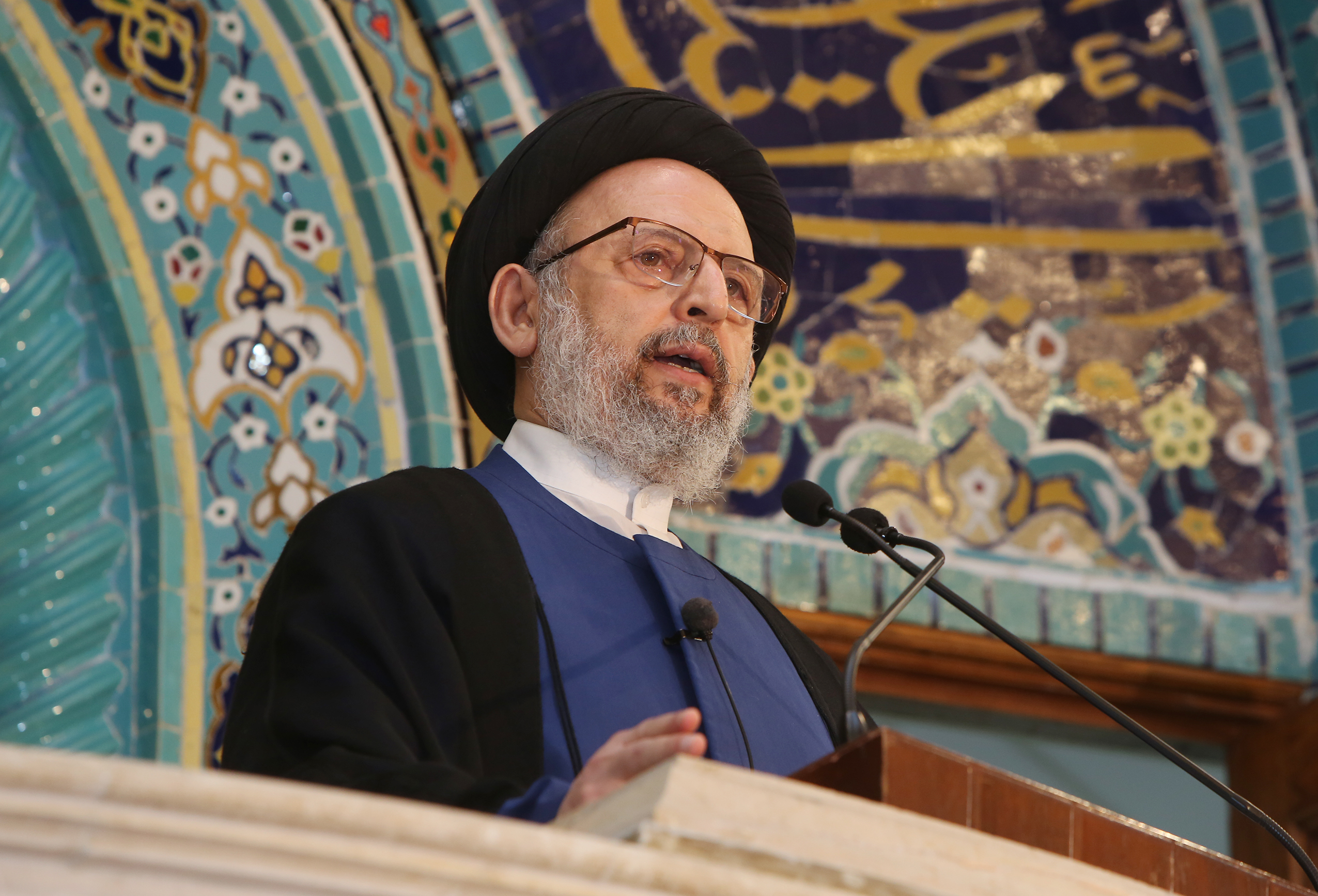
His Eminence, Sayyed Ali Fadlallah, delivered the two Friday prayer sermons at the Imamain Al-Hassanain Mosque, Rabialawal 1, 1448H/ August 14, 2026. Several prominent religious scholars, dignitaries and hundreds of believers attended the Jumu’a prayer. Following is summary of his sermons
First Sermon
.
The Will: A Religious Responsibility and a Guarantee of Rights
Allah, the Most Exalted, says in His Glorious Book:
“Prescribed for you when death approaches [any] one of you if he leaves wealth [is that he should make] a bequest for the parents and near relatives according to what is acceptable - a duty upon the righteous. Then whoever alters the bequest after he has heard it - the sin is only upon those who have altered it. Indeed, Allah is Hearing and Knowing.”
In this noble verse, Allah, the Most Exalted, urges His believing servants to write their wills and to hasten to do so, considering it a religious duty and obligation.
A will means that the person making the will entrusts someone with the responsibility of, after his death, fulfilling obligations that remained outstanding during his lifetime, settling his debts owed to Allah and to other people, spending part of his wealth in charitable causes, or overseeing the distribution of his estate.
It is true that the verse refers to making a will when the signs of death appear. This is natural and should be a priority: a person should not leave this life without having made arrangements for obligations he was unable to fulfill during his lifetime, or for matters he wishes to be carried out after his death.
However, a will should not be something one thinks about only at that point. Rather, it should remain present in a person’s mind at all times, as preparation for death, whose arrival no human being knows. When death comes, it does not ask anyone’s permission. It did not even seek permission from the prophets and the righteous, and it reaches even those who have fortified themselves in lofty towers and taken every possible precaution against it.
Allah, the Most Exalted, says:
“Wherever you may be, death will overtake you, even if you should be within towers of lofty construction.”
He, also, says:
“Say, ‘Indeed, the death from which you flee - indeed, it will meet you. Then you will be returned to the Knower of the unseen and the witnessed, and He will inform you about what you used to do.’”
This is also what the noble hadiths encourage. It has been narrated:
“It is not appropriate for a Muslim to spend a night without having his will under his head.”
A will should preferably be made in writing, although it may also be validly made verbally. If the person making the will says, for example, “This money is for so-and-so,” or “for a charitable cause,” or “for a particular institution,” his will must be carried out within the limits prescribed by Islamic law. Nevertheless, it is preferable for the will to be written in order to prevent any dispute that might arise concerning it.
A will is a right of the person making it, and the matter ultimately belongs to him. It is taken from one-third of his estate, while the remaining two-thirds are subject to what Allah, the Most Exalted, has established in the system of inheritance.
This does not mean that it is forbidden to make a will for more than one-third. It is possible to do so, but carrying out the amount exceeding one-third depends on the consent of the heirs. If some heirs agree while others do not, the additional amount is carried out only from the share of those who consent.
Once a will fulfills its required conditions, everything stated in it must be honored. No one has the right to alter or replace it, whether the person responsible for carrying it out or anyone else. Allah, the Most Exalted, warns against altering a will, as mentioned in the verse:
“Then whoever alters the bequest after he has heard it - the sin is only upon those who have altered it. Indeed, Allah is Hearing and Knowing.”
However, there are circumstances in which the person entrusted with the will is not required to carry it out. This applies when the will concerns the affairs and rights of other people—for example, if someone wills that a particular person be prevented from attending his funeral or memorial service because of a personal dispute; if he wills that his daughter marry someone he wants even though she does not want him; if he instructs his children to cut ties with someone because of a personal disagreement; or if the will violates Islamic law or infringes upon the rights of other people or heirs.
Allah, the Most Exalted, says:
“But if anyone fears that the person making the will has made a mistake or committed a sin, and then helps set things right between them, there is no sin upon him. Indeed, Allah is Forgiving and Merciful.
There are several guidelines that must be observed in order to prevent disputes that may arise concerning wills—disputes that we have increasingly witnessed and that have led to family disputers and, in some cases, to tragic consequences and even crimes.
First: Carefully choosing the person who will carry out or oversee the will. That person should be trustworthy and capable of implementing it. The choice should not be based on emotion or family considerations, but on who is most capable of carrying it out according to Islamic principles and protecting the rights entrusted to him.
Second: Clarity in the will. It should be written clearly, formally documented, and witnessed in order to prevent doubts about it or challenges to any of its provisions.
Third: The person making the will should limit it to the one-third that is his right and leave the distribution of the remaining two-thirds to what Allah, the Most Exalted, has established in the system of inheritance. This system takes into account justice, priorities, and balance in distributing rights and responsibilities between men and women. It safeguards the rights of men without neglecting the rights of women.
Allah, the Most Exalted, says:
“For men is a share of what the parents and close relatives leave, and for women is a share of what the parents and close relatives leave, be it little or much - an obligatory share.”
This helps prevent disputes that arise when one person is given more than others or when someone is deprived of his or her rightful share.
Here, we should point out that if the person making the will wishes to give preference to someone for a particular reason, that reason should be justified, and he should be confident that doing so will not cause problems for that person or among the heirs.
Fourth: A person should be the executor of his own will by making every effort during his lifetime to fulfill his obligations and settle debts owed to Allah or to other people, as well as performing charitable deeds himself. He is the one most qualified to fulfill what he owes, and he is more likely to ensure that it is done properly—or even in the best possible way.
Moreover, whatever good a person does himself during his lifetime is better for him and brings him greater reward. This is reflected in the words attributed to Imam Ali (a.s.):
“O son of Adam, be the executor of your own will concerning your wealth, and do with it during your life what you would like to be done with it after your death.”
It is also narrated that the Prophet (p.) was brought dates to give in charity on behalf of a man who had instructed that they be given after his death. One date fell, so he picked it up and said:
“Had this person spent this date himself during his lifetime, it would have been better for him than for me to spend this entire storehouse of dates on his behalf.”
Finally, attention should be given to an important matter that should be included in a will: parents should remind their children of their responsibilities toward their Lord, toward themselves, and toward other people, so that they do not forget these responsibilities.
Allah, the Most Exalted, refers to an example of such advice when speaking about the Prophet Abraham and the Prophet Jacob (a.s.)
“And Ibrahim instructed his sons [to do the same] and [so did] Yacob, [saying], ‘O my sons, indeed Allah has chosen for you this religion, so do not die except while you are Muslims.’ Or were you witnesses when death approached Yacob, when he said to his sons, ‘What will you worship after me?’ They said, ‘We will worship your God and the God of your fathers, Ibrahim and Ismail and Ishac - one God. And we are Muslims [in submission] to Him.’”
There are many such instructions narrated from the Messenger of Allah (p.) and from the Imams. Here, we specifically mention the advice of Imam Ali (a.s.) to his son Imam al-Hassan (a.s.), because of the profound guidance it contains—guidance that every father and mother should include in their will so that it may serve as provision for their children after their death and protect them from many of the difficulties of this world and the Hereafter.
Dear brothers and sisters, the legislation of the will is one manifestation of Allah’s mercy toward His servants. He has given them the opportunity for certain obligations to be fulfilled on their behalf after their death, compensating for what they may have fallen short in during their lifetime. At the same time, He has emphasized that heirs should not be deprived of their rights by allocating one-third for the will and leaving the remainder for the heirs.
Therefore, dear brothers and sisters, let us thank Allah, the Most Exalted, for this divine mercy that He has bestowed upon His servants. Let us hasten to write our wills today rather than tomorrow, and let us strive to make our wills a means of goodness. Let none of us deprive himself of what may benefit him when he meets his Lord, so that it may support him when he stands before his Lord, serve as provision for his Hereafter, and leave behind a good and lasting legacy.
And our final supplication is: Praise be to Allah, Lord of the worlds.
The Second Sermon
Worshippers of Allah, I advise you and myself to follow the advice of the Messenger of Allah (p.), when he said to his companions and to us:
“Be righteous brothers, loving one another and maintaining ties with one another.”
“A Muslim is the brother of a Muslim: he does not wrong him and does not insult him.”
“A Muslim is the brother of a Muslim: he does not betray him and does not call him a liar.”
“A Muslim is one from whose hand and tongue other Muslims are safe.”
“Whoever begins his morning without caring about the affairs of the Muslims is not a Muslim.”
“Whoever hears a man calling, ‘O Muslims, help!’ and does not respond to him is not a Muslim.”
“The believers, in their mutual love, mercy, and compassion, are like one body; when one part of it suffers, the rest of the body responds with fever and sleeplessness.”
Dear brothers and sisters, we are more in need than ever of these teachings so that we may build a society characterized by love, affection, and compassion—a society standing together like a firmly constructed building, whose members strengthen and support one another when confronted with challenges that seek to undermine its values, dignity, and honor. In this way, we can become stronger and better able to face challenges.
We begin with the Israeli attacks. The Israeli enemy continues what it began in terms of blowing up, bulldozing, and burning buildings, institutions, schools, and infrastructure in the southern villages and towns it has occupied. There appears to be no indication that this will stop anytime soon, as it continues its airstrikes on areas adjacent to its positions of occupation, while its surveillance drones continue to violate Lebanese sovereignty and reach Beirut and its southern suburbs.
A clear statement was also made by its war minister from Lebanese territory, calling on his army to prepare to remain in Lebanon for a long period. This comes in addition to the areas it has occupied in Syria and Gaza, once again confirming the intentions of this enemy and its unwillingness to comply with calls for withdrawal from Lebanese territory. Rather, it may seek further expansion whenever circumstances permit.
This calls upon the Lebanese state, which is responsible for restoring its sovereignty over the territories occupied by the enemy and fulfilling the hopes of the people longing to return to them, to reconsider continuing negotiations that do not meet its demands or the demands of the Lebanese people: a complete and permanent ceasefire, withdrawal from all occupied Lebanese territory, and the free return of residents to their homes.
It also calls upon the Lebanese people to maintain internal unity in confronting the challenges posed by this enemy and its expansionist project in Lebanon.
At this time, we once again emphasize the need for the state to assume its responsibility in finding a solution to the crisis facing tens of thousands of families who remain displaced, as well as those whose homes are overcrowded with people who have sought refuge there.
This should include providing housing for them or helping them secure it, in addition to providing decent means of livelihood for those who have lost their jobs or the resources upon which they depended for their daily lives. This is a responsibility of the state, not a favor it is doing.
We also commend some of the initiatives we have begun to see from the state, municipalities, individuals, and institutions, and we call for these efforts to be strengthened.
We remain on the subject of the most recent legislative session of Parliament and wish to comment on the legislations that emerged from it.
Regarding the amnesty law, which was approved after generating considerable debate, we have been and remain in favor of providing justice to anyone who has been wronged, ending the suffering of those who have spent many years in detention without trial, and addressing overcrowding in prisons.
However, we did not want this amnesty to become a political amnesty resulting from sectarian compromise or political power-sharing, where each party obtains amnesty for the group that concerns it, rather than following the principles of justice, law, and social security that we advocate.
We want an amnesty decision, when granted, to correct injustice rather than abolish justice, and to open the way toward reforming the judiciary and prisons rather than becoming a substitute for reform or a means of avoiding it.
As for the media law, we support every step that leads to modernizing media legislation in all its forms, in a way that prevents the media from becoming a tool for incitement, distorting the truth, or assisting the enemies of the nation in undermining it.
However, we do not want this law to contain vague provisions that allow those seeking to exploit loopholes to interpret them in ways that conceal the truth, silence people, or turn the law into a sword hanging over the heads of those who seek to express their opinions freely—a freedom that we always want to be exercised responsibly.
Freedom of the press is not a privilege granted to journalists; it is a right of citizens. Without a free media, citizens lose their right to know.
We now turn to what is happening in Gaza, where pressure continues to be exerted, both through security measures and the comprehensive blockade imposed upon it, a situation that is also being extended to the West Bank.
This is part of the enemy’s efforts to make the Palestinian people lose hope and push them to leave their homeland.
This calls upon the parties sponsoring the agreement reached in Gaza to fulfill their responsibility to stop the bloodshed and destruction affecting the urban and economic fabric and to secure the legitimate rights of the Palestinian people.

Previous post
On the Anniversary of the Death of the Messenger of Allah (p): The Trust of the Message and the Covenant of Loyalty
You may also like


