
Advice from Imam Hasan al-Askari (a.s.)
In the name of Allah, the Compassionate, the Merciful
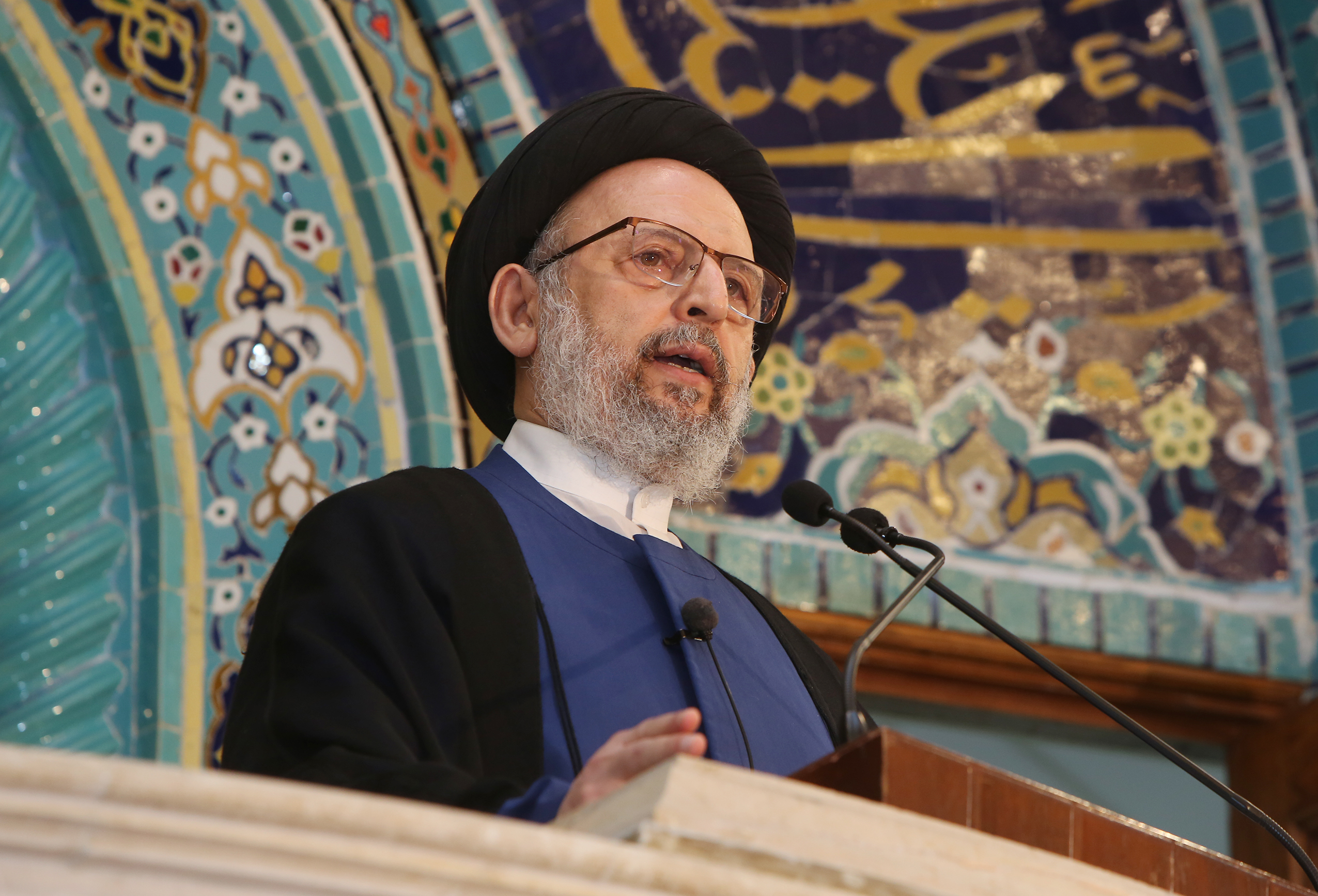
His Eminence, Sayyed Ali Fadlallah, delivered the two Friday prayer sermons at the Imamain Al-Hassanain Mosque, Rabialawal 8, 1448H/ August 21, 2026. Several prominent religious scholars, dignitaries and hundreds of believers attended the Jumu’a prayer. Following is summary of his sermons
First Sermon
.
Advice from Imam Hasan al-Askari (a.s.)
Allah, the Most Exalted, says in His Glorious Book
“Allah only desires to remove impurity from you, O People of the Household, and to purify you completely.”
Allah, the Most Exalted, has spoken the truth.
Today, on the eighth of Rabiʿ al-Awwal, we remember the passing of one of the Imams of the Ahl al-Bayt (a.s.), whom Allah, The Most Exalted, purified from all impurity and whom the Messenger of Allah (p.) commanded us to hold on to and learn from their pure source. He is Imam Hasan ibn Ali al-Askari (a.s.).
This Imam was known through his life for his knowledge, worship, good character, humility, and generosity. These qualities made him greatly respected and loved by people, even by those who did not believe in his Imamate and by those who considered themselves his rivals.
This is reflected in the words of the Abbasid caliph al-Muʿtamid’s minister. When his son asked him why he showed such great respect and admiration for Imam Hasan al-Askari (a.s.) whenever he met him or spoke about him, he said:
“My son, if the position of Imamate were taken away from the Abbasid caliphs, no one from Banu Hashim would deserve it more than this man. He truly deserves it because of his excellence, modesty, guidance, dignity, self-restraint, worship, good character, and righteousness.”
The minister’s son said:
“After hearing this, I became even more worried and thoughtful, and angry with my father because of what I had heard him say about him. From then on, I had no concern except to ask about him and learn more about him. I asked members of Banu Hashim, military commanders, writers, judges, scholars, and all kinds of people about him. I found that everyone held him in the highest respect and regarded him as a man of great status. They spoke very well of him and placed him above all the members of his family and their elders. His position became even greater in my eyes because I did not find a supporter or an enemy of his who did not speak well of him and praise him.”
Despite the short period that Imam al-Askari (a.s.) lived, as his Imamate lasted only six years, he fulfilled his role. His first major responsibility was to guide, teach, and educate people and to confront the intellectual deviations that had appeared during his time, especially in matters of belief and misunderstandings of the Qur’an.
His second role was to prepare his followers for the period that would come after him, with the absence of Imam al-Mahdi (a.s.), and to guide them regarding whom they should turn to during that period.
Today, we will use this occasion to reflect on some of his teachings so that we can take guidance from them.
The first saying is:
“Whoever advises his brother privately has honored him, while whoever advises him publicly has humiliated him.”
Through this saying, Imam al-Askari (a.s.) teaches believers not to withhold advice from their fellow believers. But he also wanted advice to truly be advice, to achieve its purpose, and not to become a reason for harming the dignity of the person being advised or hurting them and their role.
For this reason, advice should be given away from people’s eyes. In this way, a person achieves what the Imam meant when he said, “he has honored him,” meaning that he protects his dignity while delivering the advice to him.
But when advice is given publicly, he “has humiliated him,” meaning that he has exposed and insulted him. The advice will then not reach him because he will not accept it. No one accepts advice when it attacks their dignity.
This was also the approach that the Messenger of Allah (p.) used to follow. When he heard that one of his companions had done something wrong, he would not criticize him in front of people. Instead, he would stand and say:
“What is wrong with some people who say this or do that?”
By doing this, he would point to the mistake that had been made. The person who had made the mistake would understand the Prophet’s guidance and follow it, without knowing that the Messenger of Allah (p.) was referring specifically to his mistake.
The second saying is:
“The best of your brothers is the one who forgets your mistake and remembers your kindness toward him.”
Through this saying, Imam al-Askari (a.s.) wanted to give us a standard by which we can measure the sincerity of brotherhood based on faith.
A believing brother is someone who, when you make a mistake toward him, forgets your mistakes and remembers your kindness and good deeds toward him. He does not turn your mistakes into a weapon that he uses whenever a disagreement occurs between you. Nor does he keep bringing them up or talking about them in front of others.
According to Imam al-Askari (A.S.), the best brother is the one who remembers your kindness, forgets your mistakes, and does not destroy the love between you because of a mistake that happens between him and his fellow believer.
The third saying is:
“You are living through shortened lifespans and numbered days. Death comes suddenly. Whoever plants good will harvest joy, and whoever plants evil will harvest regret. Every farmer receives what he has planted.”
Imam al-Askari (a.s.) points out in this saying that a person’s life becomes shorter every day. Every day that passes from our lives is gone and will never return.
Our days in this life are limited. No one has lived forever and no one will. Allah, The Most Exalted, says:
“Everyone upon it will perish, while the Face of your Lord, full of Majesty and Honor, will remain.”
And He says:
“Every soul will taste death.”
The value of life depends on what we plant in it through our actions, because we will harvest the results of those actions. Everyone receives what they have planted.
Whoever plants obedience, honesty, trustworthiness, kindness, and repentance will eventually harvest happiness, blessings, and joy.
But whoever plants sin, neglect of duties, injustice, and harm toward people will harvest regret and will face a difficult moment before Allah Almighty.
Allah, The Most Exalted, says:
“Whoever does an atom’s weight of good will see it, and whoever does an atom’s weight of evil will see it.”
And He says:
“A person will have only what they strive for, and their efforts will be seen. Then they will be fully rewarded for them.”
The fourth saying is:
“The weakest enemy in his ability to scheme is the one who openly shows his hostility.”
Imam al-Askari (a.s.) wanted to point out that an enemy whom you know to be an enemy is less dangerous in terms of plotting against you than an enemy who hides his hostility and shows you love and friendship.
An open enemy makes you alert. You know his position, you are careful about what he says, and you do not give him your secrets or reveal your weaknesses to him. Because of this, there are fewer opportunities for him to plot against you.
But someone who hides his hostility while showing friendship is more dangerous, because you may trust him, tell him about your affairs, and accept his advice. He may then use what he knows about you to harm you when the right opportunity comes.
But this does not mean that we should suspect every friend. It means that we should remain aware and careful so that we are not surprised by changes in the behavior of someone we have trusted.
This means that a person should not place all his secrets and weaknesses in the hands of just anyone.
This is also consistent with the saying of Imam Ali (a.s.):
“Love your beloved moderately, for perhaps one day he may become someone you dislike. And dislike the one you dislike moderately, for perhaps one day he may become someone you love.”
And:
“Do not place complete trust in your”—meaning blind trust—“for the consequences of complete openness may not be possible to undo.”
Dear brothers and sisters, our loyalty to this Imam can only be genuine if we are loyal to all the values and meanings for which he suffered, endured pain, and made sacrifices.
We must be faithful to these values and to the trust placed with us: the trust of Allah, The Most Exalted, with us and the trust of His Messenger among us—the trust of Imam al-Mahdi (a.s.).
We ask Allah to hasten his reappearance and his relief, and to make us among those who prepare the way for him, and among his supporters and helpers.
And we bear witness to him:
“I bear witness, my master, that you established prayer, paid the zakat, commanded what is right, forbade what is wrong, and called people to the path of your Lord with wisdom and good advice. You worshipped Allah sincerely until certainty came to you. May Allah reward you greatly on our behalf and on behalf of your community.”
The Second Sermon
In the name of Allah, the Most Compassionate, the Most Merciful.
Worshipers of Allah, I advise you and myself to follow what the Messenger of Allah (p.) advised us when he said to his cousin Ibn Abbas:
“O Ibn Abbas, be mindful of Allah and He will protect you. Be mindful of Allah and you will find Him before you. When you ask, ask Allah, and when you seek help, seek help from Allah. Know that if the entire community came together to benefit you with something, they could benefit you only with something Allah had already written for you. And if they came together to harm you with something, they could harm you only with something Allah had already written against you.”
All people have no power to bring you benefit or harm except through Allah, and He is the One who controls everything.
Dear brothers and sisters, let our hearts depend on Allah alone. Let us call upon Him and no one else, seek His help and no one else’s, and place our trust in Him and no one else.
Let us not be found where He has forbidden us to be, and let us not be absent where He has commanded us to be.
In this way, we can achieve our hopes in this life and in the Hereafter, because they can only be achieved through Him. We will then be better able to face difficulties and challenges.
We begin with the Israeli attacks that we are witnessing every day and before our eyes: the bombing and destruction of homes and infrastructure, and the destruction of every sign of development and normal life in the villages and towns occupied by the enemy.
The airstrikes have also increased and are no longer limited to areas close to the enemy’s positions of occupation. They have reached areas farther away and have resulted in dozens of martyrs and wounded, including an entire family.
At the same time, there continues to be talk in the enemy’s media about its intention to expand its occupation to new areas that it wants to reach, claiming that they are part of its security zone. This requires us to remain alert and cautious about any new adventure the enemy may undertake.
In light of what is happening, we once again call on the Lebanese state, which is responsible for sovereignty over its territory and for protecting its citizens, to fulfill its responsibility.
It must not remain indifferent in the face of this continued aggression. It should raise its voice in international forums and knock on every door to stop this suffering, protect the resources of the Lebanese people, and protect what they have worked their entire lives to build.
The state must truly represent their suffering, hopes, and aspirations and consider this one of its highest priorities.
It has become clear that the enemy will not respond to calls for withdrawal from the territories it has occupied. Instead, it may move toward annexing these territories and possibly others as well.
This is also so that the Lebanese people can feel that their state is not standing helplessly, with its hands tied, in the face of their suffering, and so that the state remains their choice.
At the same time, we call on all Lebanese to unite their efforts and stand together in facing what is happening to their country.
They should stop making statements, particularly by those in positions of responsibility, which we see in the media and on social media when such statements could harm national unity.
They must understand that their division encourages the enemy to further violate and interfere with the sovereignty and future of this country, so that they do not become among those who destroy their own homes with their own hands and through the hands of others.
Here, we repeat what we said before: we do not deny that there are disagreements among the Lebanese over the options available for dealing with what the country is facing.
But we do not want this disagreement to turn into hostility.
The Lebanese will not overcome their suffering by one side defeating another. Rather, they will overcome it by coming together and reaching a common approach that helps save the country and removes the fears that each side has about the other.
No group should feel that its existence and identity are threatened by the others.
We support any inclusive meeting that can help achieve this goal.
The Lebanese must understand that they are all in the same boat. If it sinks, they all sink, and if it survives, they all survive.
We now turn to the enemy’s recent targeting of Syria, which once again points to the goals it is pursuing: not allowing any Arab or Muslim country to have the ability and strength even to defend itself, so that it can maintain dominance over the region and have the strongest position in it.
This comes within the context of an ongoing strategy based on pressure, expansion, and weakening any source of strength in this region and in the world…

You may also like


