The Importance of Consultation in Building a Strong, Cooperative Society

In the name of Allah, the Compassionate, the Merciful
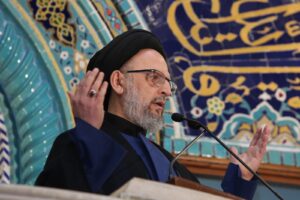
His Eminence, Sayyed Ali Fadlallah, delivered the two Friday prayer sermons at the Imamain Al-Hassanain Mosque, Rabialawal 29, 1448H/September 11, 2026. Several prominent religious scholars, dignitaries and hundreds of believers attended the Jumu’a prayer. Following is summary of his sermons
.
The Importance of Consultation in Building a Strong, Cooperative Society
Allah, Most Exalted, said in His Noble Book:
And those who have responded to their lord and established prayer and whose affair is [determined by] consultation among themselves, and from what We have provided them, they spend.
Allah, The Most Exalted, has spoken the truth.
In this verse, Allah, The Most Exalted, calls the believers to adopt consultation as a principle in managing all aspects of their lives: personal, family, social, political, and security affairs. No one should impose his opinion or act alone. Rather, they should consult one another and exchange views in order to reach the soundest position, as Allah, Most Exalted, says: {and whose affair is [determined by] consultation among themselves.}
A believer should not make a decision or adopt an idea or opinion before consulting others, nor should he limit himself to what he himself sees or to what his own thinking has reached. When the culture of consultation becomes stronger among individuals and in society, it helps people reach the soundest and safest opinion, reduces the mistakes that often result from acting alone or imposing one’s opinion, and opens the door for everyone who has an idea or opinion to express what they have.
A person, no matter how much knowledge, experience, and expertise he has, remains liable to make mistakes. There may be matters that he does not know or facts that are hidden from him but are known to others.
To show the importance of consultation, Allah, Most Exalted, has placed it together with responding to His command, establishing prayer, and spending in His way. He even called upon His Messenger (p.) to consult others, despite his not needing consultation because Allah had given him prophethood, wisdom, and connection with revelation. This was to train Muslims to cooperate and participate in giving their opinions, and to keep them away from authoritarianism and acting alone.
Allah, Most Exalted, said:
{And consult them in the matter. And when you have decided, then rely upon Allah. Indeed, Allah loves those who rely [upon Him]
The noble hadiths have also pointed to the importance of consultation. It was reported from the Messenger of Allah (p.):
“No servant was made unhappy by consultation, and no servant was made happy by relying solely on his own opinion.”
It is reported in a hadith that Imam Ali (a.s.) said:
“The Messenger of Allah (p.) sent me to Yemen and said to me while advising me: ‘O Ali, whoever seeks guidance from Allah will not be disappointed, and whoever consults will not regret it.”
It was also reported from him (a.s.):
“Whoever acts alone according to his own opinion will perish, and whoever consults people shares in their minds.”
It is also reported in a hadith:
“Whenever a people consult one another, they are guided to what is right for them.”
And in another hadith:
“A wise person cannot do without consultation.”
In contrast, the Noble Qur’an presents imposing one’s opinion and acting alone according to it as the approach of Pharaoh, who considered himself the only one entitled to have an opinion and would not allow his people to discuss matters with him or share their views. He said:
{I do not show you except what I see, and I do not guide you except to the way of right conduct.}
This was one of the reasons for his destruction.
The Messenger of Allah (p.) was keen to establish the principle of consultation through his own practice. Whenever he wanted to undertake an important matter, he would say to his companions:
“Advise me.”
One of his companions described this by saying:
“I have never seen anyone who consulted his companions more than the Messenger of Allah (p.).”
This was clearly demonstrated in his life. At the Battle of Badr, when the Messenger (p.) went out to intercept a Quraysh trade caravan, as a means of putting pressure on them to stop plotting against the Muslims and inciting the tribes surrounding Madinah against them, the Muslims received news that the Quraish army had moved and reached the outskirts of the area where they were.
The Prophet (p.) was then faced with two difficult choices: either to confront them or return to Madinah. He did not tell his companions, “I am the Prophet and I am your leader. I have made the decision, and you must obey.” Rather, he gathered them and said:
His companions expressed their opinions, and the Messenger of Allah (p.) followed the opinion reached through consultation. The decision was to confront them.
This principle also appeared at the Battle of Uhud. When the Quraish army moved toward Madinah, the Messenger of Allah (p.) gathered his companions and said to them:
“Advise me.”
Some advised fortifying themselves inside Madinah and fighting Quraish from there, so that the people of Madinah could participate in defending it. The Messenger of Allah (p.) inclined toward this opinion. But others believed they should go out and confront Quraish outside the city, and they represented the majority. The Messenger of Allah (p.) followed their opinion, confirming his respect for the principle of consultation.
Consultation was also evident in the Battle of the Trench. When Quraish came with their allies with an army estimated at ten thousand men, intending to reach Madinah and take control of it, the Messenger of Allah (p.) gathered his companions and asked for advice
The companion Salman al-Farisi suggested digging a trench around the city to prevent the army from reaching it. The Messenger of Allah (p.) accepted this opinion. This surprised Quraish and their allies, helped stop their advance, disrupted their plans, and brought victory to the Muslims over the Confederates.
Consultation was also practiced when, after the Treaty of Hudaybiyyah, the Messenger of Allah (p.) wanted to send letters to the kings inviting them to Islam. He consulted some of his companions about the most appropriate form for the letters he would send to them.
They said to him:
“O Messenger of Allah, kings do not read a letter unless it is sealed.”
The Messenger of Allah (p.) followed their advice and took a silver ring engraved with three words:
“Muhammad: the Messenger of Allah
Dear brothers and sisters, for consultation to play its true role and achieve its intended purpose, a number of matters must be taken into consideration:
First: Those whom we consult should be people of knowledge and experience in the subject. We should not consult a coward, a miser, or a greedy person. This is what Imam Ali (a.s.) expressed in his letter to Malik al-Ashtar:
“Do not include in your consultation a miser who would turn you away from generosity and promise you poverty, nor a coward who would weaken you in matters, nor a greedy person who would make greed seem good to you through injustice.”
Second: We should consult those who possess sound reason, good judgment, wisdom, and the ability to assess matters, away from personal desires, personal interests, and private calculations.
Third: The purpose of consultation should be to reach the truth and achieve what is in the public interest. It should not be merely a formal courtesy. Rather, we should listen to the advice and pay attention to the person giving it, and we should thank the person who gives it, even if we do not follow his opinion.
Fourth: We should broaden the scope of our consultations, especially concerning crucial matters, so that we can reach the soundest opinion, and we should not underestimate any opinion presented to us.
To strengthen this principle, the hadiths encourage those who are capable of consultation not to withhold their opinion and advice. It is reported in a hadith:
“Whoever is consulted by his brother and does not give him sincere advice, Allah, Most Exalted, will take away his sound judgment.”
The Messenger of Allah (p.) also
considered offering useful knowledge and sound advice a form of charity. He said:
“Give charity to your brother by giving him knowledge that guides him and an opinion that sets him right.”
Imam Ali (a.s.) also referred to this when he said:
“Do not refrain from speaking a word of truth or offering fair advice.”
It is also stated in the Treatise on Rights:
“As for the right of the one who seeks your counsel: if you have an opinion for him, strive to advise him sincerely, and point out to him what you know you would have done if you were in his place. If you do not have an opinion for him, and you know someone whose opinion you trust and whose advice you would accept for yourself, direct him to that person and guide him to him.”
Dear brothers and sisters, we have suffered, and continue to suffer, from those who impose their opinions and who see consultation as weakness or as diminishing their status. Consultation is not weakness; rather, it is a source of strength. It does not diminish a person; rather, it supports him and helps him reach the soundest opinion. It does not mean giving up the decision; rather, it is a means that helps make the decision wiser and more mature and less likely to result in error.
Let us strengthen the principle of consultation in our lives and bring it into all our spheres. It should exist in our homes, so that the husband consults his wife and children about family matters. Managers and officials should adopt it by listening to those who work with them, even if they are lower than them in position. In our schools, universities, institutions, and social, political, and security bodies, we should establish committees and councils that allow people to express their opinions and participate in decision-making.
Through consultation, we build a strong and united society; a cooperative society in which its members think of one another and respect one another’s opinions. In this way, we become better able to face difficulties and overcome crises.
The Second Sermon
In the name of Allah, the Most Compassionate, the Most Merciful.
Worshippers of Allah, I advise you and I advise myself to be patient in performing acts of obedience and abandoning sin, to be patient when trials, challenges, and crises face us, so that we do not fall before them, that we remain steadfast, and do not get defeated or retreat from our values, our principles, our honor, and our dignity, in order to gain what God, the Mighty and Sublime, has promised to the patient, among what God, Glory be to Him and Most Exalted, pointed to: {And give good news to the patient Who, when a disaster strikes them, say: “Indeed we belong to God and indeed to Him we will return.” Those are the ones upon whom are blessings from their Lord and mercy, and those are the guided ones, {And be patient, indeed God is with the patient} {And We made from among them leaders guiding by Our command when they were patient}.
And in the Hadith: “Patience is to faith in the position of the head to the body,” “The believer is naturally disposed to patience over misfortunes.” And in another Hadith: “Through patience, high matters are attained,” “And victory comes with patience, and relief comes with distress, and indeed with hardship comes ease.”
We are in the direst need at this stage to commit to this value which makes us capable of carrying out our responsibilities, and properly assessing matters to overcome difficulties, and so that we become more capable of facing challenges.
And the beginning is from the ongoing aggression against Lebanon, which we are witnessing in the raids that have targeted and are still targeting residential buildings, official institutions, and health facilities, and have led to the falling of martyrs and wounded, and have not spared women and children, even infants.
While the enemy continues its policy based on bombing, burning, and bulldozing houses, institutions, and infrastructure of the villages it controls, the latest of which was what took place at the Ali al-Taher site, where the volume of explosive materials in it led to an earthquake, which points to the gravity of what happened, and its contempt for stone and human beings and for this nation, at a time when its leaders threaten, with complete clarity, to occupy more Lebanese lands.
And it benefits in that from the destructive capabilities it possesses, and the international coverage it enjoys, which makes it capable of doing whatever it wishes without any voice rising to condemn its crimes; rather, we find that there are those who justify its actions, whatever their catastrophic results may be. And what encourages it in that, is that what is being done by the enemy on the Lebanese scene has come to enter into the calculations of the electoral process, even if at the expense of the blood of the Lebanese and their resources.
Facing what is happening, we renew our call to the Lebanese to be patient and steadfast in positions, and to keep the door of hope open, and to trust that God, the Mighty and Sublime, will make after hardship, ease.
While we call upon the Lebanese state, in facing what is happening, not to settle for statements of condemnation for the crimes and massacres committed by the enemy, but rather to activate its role in the choice it has taken on the diplomatic level, by raising its voice in international forums, and benefiting from Lebanon’s standing on the Arab, Islamic, and international levels, and for its position to be firm, that it will not remain standing still in negotiations that will not lead to any result, but rather the enemy has come to benefit from them to cover up its crimes. At the same time, we call upon it to exert its efforts to strengthen the resilience of the people in the villages adjacent to the enemy’s occupation sites and their steadfastness in their land, and their return to their villages, by emphasizing the active presence of the state in all fields that the citizen needs, whether security, living, educational, or health, and operating state facilities and strengthening its presence alongside them, so that they feel that there is a state embracing them and being with them when they face challenges, and this is their right upon it.
While we re-invite the Lebanese to be aware of the dangers of what the enemy may seek, which may not stop at the limits of what it has reached; rather, all statements of its officials indicate that what it aims for goes beyond that to touch the whole nation, which requires the Lebanese to meet in a serious internal dialogue that takes into account the interest of the nation, to reach the best choice to deal with this difficult stage and face its dangers. Or at least, that disagreement be organized, so it does not lead to harming internal unity, which should be above all consideration.
At this time, we reaffirm to the government, regarding the budget it is preparing, not to repeat in it the mistakes of previous budgets, and that its budget reflects an economic and social policy capable of addressing the crises suffered by the the Lebanese, and what resulted from the Zionist aggression, and to contribute to stimulating growth, and be a tool for economic and livelihood recovery, not merely a means to fund expenditures.
We are aware of the size of the state’s need to secure its expenditures, but this does not justify for it the ease of extending its hand into the pockets of citizens, after their pockets have become empty, and because of the difficult reality they live, and they are the ones who bear the burdens of the taxes imposed on them, and the outrageous inflation that has come to touch all their needs, and that the priority in that be a serious addressing of the places of corruption and waste that are still rampant in the joints of the state, and the proper utilization of its resources.
And we return to Palestine, where the enemy continues its raids on Gaza, which target civilians and hit its infrastructure, and which are completed in the West Bank, in a way that blows up all the agreements concluded with it under international cover, in a pursuit from it to make the Palestinian people despair and push them to leave their land.
Which calls upon the Arab and Islamic countries, and all free people of the world, to carry out their responsibilities toward this people. And here we commend the positions of many European countries in taking punitive steps against the Zionist entity because of its expansionist settlement policy.

You may also like


Cooperation and Solidarity: The Strength of Society in Facing Crises