Lady al-Zahra (a.s.): An Inspiring Example of Faith and Morality
In the name of Allah, the Compassionate, the Merciful
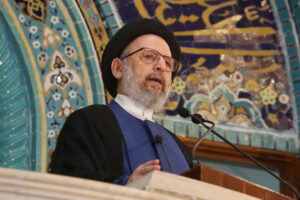
His Eminence, Sayyed Ali Fadlallah, delivered the two Friday prayer sermons at the Imamain Al-Hassanain Mosque, JamadiII 04, 1448H/ November 13, 2026. Several prominent religious scholars, dignitaries and hundreds of believers attended the Jumu’a prayer. Following is summary of his sermons
.
.
Lady al-Zahra (a.s.): An Inspiring Example of Faith and Morality
Allah, The Most Exalted, says in His Glorious Book:
“Indeed, Allah intends only to remove from you the impurity, O people of the household, and to purify you with [extensive] purification.”
On the third of JumadaII, we commemorate the passing of the truthful and pure Lady Fatima al-Zahra (a.s.), the leader of the women of the worlds. She was among those to whom this noble verse was revealed. She spent her life in worship, generosity, giving, helping people, shouldering their burdens, and easing their suffering.
Her passing left profound pain and sorrow in the heart of the Commander of the Faithful (a.s.), in the hearts of her children Zaynab, Umm Kulthum, al-Hassan and al-Hussein (a.s.), and in the hearts of all Muslims, who, with her departure, lost the outpouring of love she had bestowed upon them, as well as the care and embrace she had always been keen to provide.
The Commander of the Faithful (a.s.) expressed this grief as he stood beside her pure body, tears streaming from his eyes, saying:
“It is indeed hard for me to part with you and lose you. However, it is an inevitable matter. By Allah, your departure has renewed for me the tragedy of the Messenger of Allah (p.). Your death and loss are indeed grievous. We belong to Allah, and to Him we shall return, for what a devastating, painful, bitter and sorrowful calamity this is! By Allah, this is a calamity for which there is no consolation, and a loss for which there is no replacement.”
On this painful occasion, we shall reflect on some aspects of her life.
It is related that a man once came to Lady al-Zahra (a.s.) and said to her: “O daughter of the Messenger of Allah, did the Messenger of Allah (p.) leave anything with you that you could share with me?” In other words, did you retain any of the words of the Messenger of Allah (p.)?
She said to her maidservant: “Bring me that piece of parchment.” It contained a hadith narrated from her father, the Messenger of Allah (p.). Today, we shall reflect on this hadith because of its importance and seek guidance from it in building ourselves and our society.
The first point highlighted by the hadith is: Whoever believes in Allah and the Last Day should not harm his neighbor.
This hadith points to the close connection between belief in Allah and the Last Day and refraining from causing harm. A person cannot truly believe in Allah and the Last Day while causing harm to his neighbor.
Harm here is not limited to physical harm; it also includes emotional and psychological harm. It may take the form of a hurtful word, mockery, excessive noise, an invasion of privacy, or the disclosure of secrets learned through the relationship of neighborhood. It may also involve failing to lend a helping hand when a neighbor falls ill or faces hardship, or failing to share in their pain and sorrow.
The hadith specifically highlights the harm caused to neighbors, even though refraining from harming others is required in our dealings with everyone. A Muslim is one from whose hands and tongue people are safe. A Muslim cannot truly be a Muslim while causing harm to others, regardless of their religions, sects or positions.
However, the emphasis on neighbors is due to the fact that they are among the people with whom we have the most frequent contact and interaction in our daily lives because of their physical proximity. It was therefore necessary to stress that the relationship should be built on refraining from harming one’s neighbor and treating them with kindness. This is also what Allah, The Most Exalted, has indicated:
“Worship Allah and associate nothing with Him, and to parents do good, and to relatives, orphans, the needy, the near neighbor, the neighbor farther away…”
Secondly: “Whoever believes in Allah and the Last Day should speak good or remain silent.”
This hadith points to another principle by which a believer is evaluated: the need to restrain one’s tongue. It calls upon a person to choose between two options in everything they say, with no third option: either their words should be good and beneficial to others, by calling them to what is right, forbidding what is wrong, reconciling differences between them, speaking the truth, standing against injustice, and contributing to the improvement of their lives and conduct; or they should remain silent.
This calls upon the believer to ask themselves, before uttering any word: Does what I am about to say contain something good or beneficial? If it does, let them speak; otherwise, they should remain silent.
A believer regards every word as a responsibility and must either use it appropriately or refrain from saying it. They should not occupy themselves or others with words that serve no purpose and offer no benefit.
Thirdly: “Indeed, Allah loves the person who is good, forbearing and self-restrained.”
Here, the hadith mentions three qualities through which a person can attain the love of Allah:
The first is to be a person of goodness. It is not enough, in order to attain the love of Allah, for a person merely to avoid evil. They must also take the initiative to do good by coming to the aid of those in distress, meeting the needs of the needy, reconciling those who are in conflict, comforting those burdened with worries, relieving the distress of the afflicted, and standing alongside the oppressed against their oppressors.
This is what is indicated by the hadiths: “All of creation are dependents of Allah, and the most beloved of them to Him are those who are most beneficial to His dependents,” and “Whoever brings joy to a household.”
The second is to be forbearing. This means having control over oneself when angry, refraining from uttering words, taking actions or adopting positions driven by emotion or anger. Rather, one’s words and actions should be guided by reason and faith.
The third is to be self-restrained. A self-restrained person preserves their dignity, stays away from greed and what is forbidden, does not ask people for help unless there is a genuine need, is content with what Allah has provided, and remains patient in the face of poverty and hardship.
Fourthly: “Indeed, Allah detests the foul-mouthed, the miserly and the persistent beggar.”
Allah, The Most Exalted, detests, first, the foul-mouthed person who uses obscene and vulgar language, and those who use their tongues to violate the dignity and honor of others.
Secondly, He detests the miserly person, meaning one who is extremely stingy and withholds what should be given of the knowledge, abilities, wealth and experience that Allah has bestowed upon them.
Thirdly, He detests the persistent beggar, who insists on asking and does not take into consideration the circumstances of the person from whom they are asking.
Finally: “Whoever obeys Allah is saved, and whoever disobeys Him perishes.”
This hadith indicates that salvation in this world and in the Hereafter is attained through obedience to Allah, The Most Exalted, because Allah has never commanded anything or prohibited anything except that it serves the good of the human being and life itself, and protects people from the pitfalls they may encounter.
This is what Allah, The Most Exalted, has indicated when He says:
“And if only the people of the cities had believed and feared Allah, We would have opened upon them blessings from the heaven and the earth; but they denied [the messengers], so We seized them for what they were earning.”
This is salvation in the Hereafter as well, as Allah, The Most Exalted, says:
“These are the limits [set by] Allah, and whoever obeys Allah and His Messenger will be admitted by Him to gardens beneath which rivers flow, abiding eternally therein; and that is the great attainment.
And whoever disobeys Allah and His Messenger and transgresses His limits will be admitted by Him to a Fire, abiding eternally therein, and he will have a humiliating punishment.”
We are in greater need than ever, on this painful anniversary, to draw inspiration from Lady al-Zahra (a.s.), to bring her into our daily lives, and to ensure that she remains present within us through her life, words and positions, in the fields of worship, knowledge, jihad, and missionary and social work, as well as in confronting injustice and deviation…
In doing so, we demonstrate our sincerity towards Lady al-Zahra (a.s.). Our loyalty to her is not expressed merely through rejoicing on the anniversary of her birth, shedding tears on the anniversary of her passing to her Lord, or condemning the injustice she suffered. She expects more of us than that. She wants us to embody her faith and moral character and to work towards the very goal for which she endured suffering, pain and sacrifice, and faced all that she went through.
Let us ask Allah, The Most Exalted, to grant us success in doing so, so that we may attain her love and intercession and be reunited with her in the gardens of eternal bliss.
Peace be upon her on the day she was born, the day she passed into the presence of her Lord, and the day she is raised alive to receive the everlasting blessings Allah, The Most Exalted, has prepared for her.
In the Name of Allah, the Most Compassionate, the Most Merciful
The Second Sermon
Worshipers of Allah, I urge you, and urge myself, to follow what the Messenger of Allah (p.) taught Lady al-Zahra (a.s.) and the Commander of the Faithful (a.s.), when al-Zahra (a.s.) came to him asking for a servant to help her with the burdens of the household and the heavy responsibilities she shouldered in caring for her children and fulfilling her social and missionary role.
He addressed both of them, rather than Lady al-Zahra (a.s.) alone, since Ali (a.s.) also shared the responsibilities of the household. He said:
“Shall I not teach you something that is better for you than a servant? When you go to bed, say Allahu Akbar (Allah is Greater) thirty-four times, Subhan Allah (Glory be to Allah) thirty-three times, and Alhamdulillah (Praise be to Allah) thirty-three times.”
Lady al-Zahra (a.s.) replied: “I am content with Allah and His Messenger. I am content with Allah and His Messenger.”
From that time onward, this glorification became a constant practice for both of them, helping them face life’s burdens and hardships and providing them with patience, tranquility and determination.
Dear brothers and sisters, we are in greater need than ever to seek guidance from the example of Lady al-Zahra (a.s.) and to maintain this glorification before going to sleep and after every prayer, so that we may draw from it the strength to face life’s difficulties and become among those who remember and worship Allah.
It has been narrated in a hadith:
“Allah has not been worshipped through any form of praise better than the Tasbih of Fatima. Had there been anything better than it, the Messenger of Allah (p.) would have bestowed it upon Fatima al-Zahra (a.s.).”
We begin with Lebanon, where Israeli attacks on the South continue through shelling and airstrikes targeting areas adjacent to the occupation areas, while the enemy continues to demolish homes and destroy what remains of the villages and towns it occupies, in an attempt to erase all signs of life there and make their residents lose hope of returning. This is in addition to the daily aerial violations that violate Lebanese sovereignty.
In the face of this reality, we reiterate our call on the Lebanese state, which bears responsibility above all other parties for protecting its land, people and sovereignty, not to pin its hopes on developments that may take place in the region or on external changes that may occur following the elections held within the Zionist entity.
We recognize the extent of the influence that external developments may have, and they should not be overlooked. However, this does not free the state of its responsibility to act with utmost seriousness on both the political and diplomatic fronts, and to employ its available sources of strength to stop the bloodshed and destruction, reclaim the land and enable its residents to return to it. These matters must be placed among its highest priorities.
At the same time, we call upon the Lebanese people to unite their efforts and emerge from the state of division that is exhausting them, weakening their position and encouraging the enemy to commit further acts of aggression.
The dangerous phase we are still facing cannot be confronted through indifference, division, mutual accusations, or decisions and positions that deepen anxieties and widen the gaps between the country’s various components. The country is in greater need than ever of wisdom, dialogue and everything that helps ease tensions when addressing contentious issues.
In this context, we reiterate our call on political forces to keep the military institution away from political disputes and targeting, and not to undermine its standing or its role in protecting the homeland and maintaining internal stability. Its unity must be preserved and the role of the army strengthened, as it should be a source of consensus among the Lebanese, not a cause of division.
Turning to domestic affairs, we call upon the state to deal more seriously with lawlessness that threatens the security of citizens, their property and their freedom of movement, and which has also begun to affect the country’s image and stability.
While we appreciate the efforts made by the security forces to pursue those who undermine security, we call for their capabilities to be strengthened and for any obstacles preventing them from carrying out their duties to be removed.
At the same time, the issue of living and social conditions must not be allowed to slip from the top of the state’s priorities. Poverty and economic hardship are no longer merely figures; they have come to produce security, social and humanitarian repercussions that affect people’s lives and dignity.
The state is required to assume its responsibility in addressing this reality, while also strengthening social solidarity and standing alongside the most vulnerable groups, so that citizens are not left alone to face their crises.
A state truly becomes a state when it is present in the concerns of its citizens and contributes to addressing their suffering. It is then that it establishes its presence in their eyes.
Finally, the suffering of the Palestinian people remains before us, whether in the daily killings in Gaza and the siege imposed upon it, or in the humanitarian catastrophe endured by its people, a part of which was exposed by the floods in recent days, after they swept away tents and left families without shelter or even the most basic necessities of life.
This is in addition to what is taking place in the West Bank and Jerusalem, where attacks, settlement expansion and continued threats to the land and holy sites persist.
All of this calls upon us to keep the Palestinian cause alive in the Arab and Islamic conscience and to assume our responsibility by making every possible effort to save the Palestinian people from killing, siege and displacement, and to protect their right to their land, dignity and future.