
Lady al-Zahra (a.s.): The Model of a Person Who Carries the Message
In the name of Allah, the Compassionate, the Merciful
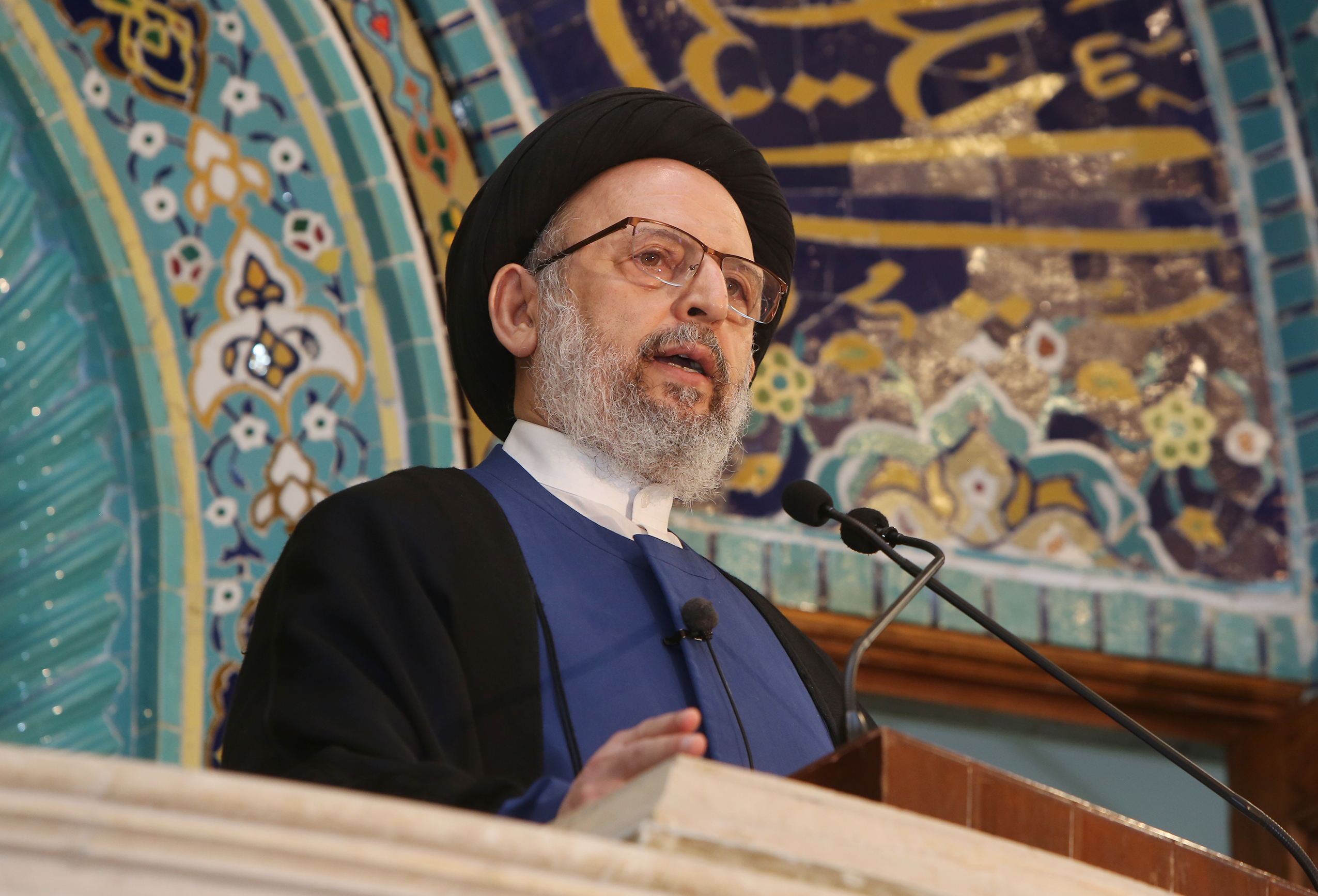
His Eminence, Sayyed Ali Fadlallah, delivered the two Friday prayer sermons at the Imamain Al-Hassanain Mosque JamadiI 10, 1448H/ October 23, 2026. Several prominent religious scholars, dignitaries and hundreds of believers attended the Jumu’a prayer. Following is summary of his sermons
.
Friday Sermon
Lady al-Zahra (a.s.): The Model of a Person Who Carries the Message
Allah, The Most Exalted, says in His Glorious Book:
“Allah intends only to remove from you the impurity, O people of the household, and to purify you with [extensive] purification.”
Allah, The Most Exalted, has spoken the truth.
On the thirteenth of Jumada I, we mark the anniversary of the passing of the pure and truthful Fatima al-Zahra (a.s.), the leader of the women of the worlds, to her Lord. Her passing left grief and pain in the hearts of the Commander of the Faithful, al-Hassan, al-Hussein, Zaynab and Umm Kulthum (a.s.), as well as in the hearts of all those who knew her merit, her worth, and the great position she had reached in the sight of Allah, The Most Exalted.
She (a.s.) was one of those from whom Allah removed impurity and whom He purified completely. The Messenger of Allah (p.) said that Allah, The Most Exalted, becomes angry when she is angry and is pleased when she is pleased, because she was pleased with what pleased Allah and became angry at what angered Him.
She had such a high standing with the Messenger of Allah (p.) that he said about her: “Fatima is a part of me. Whoever pleases her pleases me, and whoever hurts her hurts me.” He also said: Fatima is my heart and my soul between my sides.”
As for the Commander of the Faithful (a.s.), his words expressed his feelings when he stood beside her grave and said:
“O Messenger of Allah, my patience has grown weak over your chosen one”—although he was known for his patience in the face of hardships— “and my strength to endure has weakened. Yet in following your example in your great separation and terrible loss, I find a source of comfort. Indeed, we belong to Allah, and to Him we shall return.”
He continued:
“The trust has been returned.” She had been a trust in my care, and now I return that trust to you after fulfilling my duty. This shows his faithfulness and the great sense of responsibility he felt towards her.
“As for my grief, it is everlasting, and my nights are sleepless” because of her place in his heart, “until Allah chooses for me the home in which you now reside.”
He also said:
“Peace be upon you both, a farewell from one who is neither weary nor tired. If I leave, it is not because I am tired of staying here; and if I remain”—standing for a long time beside her grave, weeping and grieving— “it is not because I doubt Allah’s decree or what Allah has promised those who are patient.”
Rather, his grief came from love and faithfulness, together with complete acceptance of Allah’s decree and submission to His will.
Lady al-Zahra (a.s.) passed away after a life spent under the care of the Messenger of Allah (p.). During that time, she drew from his knowledge and took on the qualities of his character. She reflected his example in her worship, manners, patience, generosity, giving and love for people. She also shared with him the burdens of carrying the message, supporting and helping him. This led him to say about her: “Fatima is the mother of her father.”
This was also expressed by Aisha, the wife of the Messenger of Allah (p.), when she said: “I have never seen anyone more like the Messenger of Allah (p.) in manner, guidance and conduct than Fatima.”
Together with Ali (a.s.), she also presented a model of married life. She chose him as her husband from among all those who had asked to marry her, even though he did not possess the wealth, status and standing that they possessed. She chose him because of what the Messenger of Allah (p.) had pointed out about his merit, his Islam and his love for Allah, The Most Exalted.
She was patient with him through a difficult life and harsh living conditions, while he was constantly occupied with taking part in battles and wars, in addition to the responsibilities that the Messenger of Allah (p.) placed upon him.
She never complained about her household duties or about taking responsibility for the children, caring for them and raising them, despite his frequent absences from home. Instead, she prepared the conditions that helped him fulfil his role in carrying the message and in striving for its cause. She was truly his partner in this.
He expressed this himself when he said:
“By Allah, I never made her angry or forced her to do anything until Allah,The Most Exalted, took her away. She never made me angry or disobeyed me. Whenever I looked at her, my worries and sorrows would disappear.”
Despite all this, she never neglected her role in guiding and educating others. Women and men alike turned to her for guidance.
She showed this through her courageous stand after the death of the Messenger of Allah (p.), when she saw that a deviation was beginning to take place in the Muslim community. She raised her voice before the women and men of the Muhajirin and the Ansar in her father’s mosque, in order to preserve his instructions after his death and protect the values of Islam, its purity and its clarity.
She left behind a legacy that remains alive today and will remain so until the Day of Resurrection.
Today, we take this occasion to speak about what Imam al-Hassan (a.s.) reported about his mother, al-Zahra (a.s.). He said:
“I saw my mother, Fatima (a.s.), standing in her prayer place on the night of Friday. She continued bowing and prostrating until the first light of dawn appeared. I heard her praying for believing men and women, mentioning them by name and praying for them at length, without asking for anything for herself. I said to her, ‘Mother, why do you not pray for yourself as you pray for others?’ She replied, ‘My son, the neighbor first, then the home.’”
Lady al-Zahra (a.s.) wanted to teach us lessons through this example, lessons that we need more than ever.
First: This hadith shows the high level Lady al-Zahra (a.s.) reached in worshipping her Lord. She would spend the night in worship until dawn. It is reported that al-Hassan al-Basri said:
“There was no one in this community who worshipped Allah more than Fatima, the daughter of the Messenger of Allah (p.). She would stand in prayer until her feet became swollen.”
Yet her worship did not prevent her from feeling the pain and suffering of others. During her prayers, she turned to Allah, The Most Exalted, asking Him to help believing men and women, mentioning those who needed prayers one by one by name.
This shows the connection between worshipping Allah and serving His servants. Allah, The Most Exalted, has called us to this when He says:
“O you who have believed, bow and prostrate and worship your Lord and do good—that you may succeed.”
Second: Through her actions, she showed the place that neighbors should have in our lives. Our dealings with them should be based on kindness and even putting their needs before our own.
Allah, The Most Exalted, has pointed this out when He says:
“Worship Allah and associate nothing with Him, and to parents do good, and to relatives, orphans, the needy, the near neighbor, the neighbor farther away, the companion at your side, the traveler, and those whom your right hands possess. Indeed, Allah does not like those who are self-deluding and boastful.”
Allah, The Most Exalted, has made kindness to neighbors a moral duty and a right that must be respected. This includes checking on them, helping them, visiting them when they are sick, and sharing their happiness and sadness.
Al-Zahra (a.s.) made praying for them in their absence one of the most important ways of showing kindness to them, putting their needs before her own.
Third: Al-Zahra (a.s.) stressed the importance of praying for others in their absence. Such a prayer reaches Allah without any barrier standing in its way.
A hadith states: “There are four whose prayers are not rejected…” One of them is a believing brother who prays for his brother in his absence.Another hadith states: “The quickest prayer to be answered is a person’s prayer for his brother in his absence.”
Such prayers also benefit the person who makes them. Allah, The Most Exalted, says:
“And He responds to those who believe and do righteous deeds and increases them from His bounty; but the disbelievers will have a severe punishment.”
Allah, The Most Exalted, answers the prayer of a believer who does good deeds and prays for his brother in his absence. The angel then says to him:“And the same for you as what you asked for.”
Fourth: Teaching through example. As al-Zahra (a.s.) prayed and made supplications, she made sure that her son was beside her, so that the image of prayer, supplication, selflessness, love for people and service to them would become firmly rooted in his mind.
She did not rely on words alone to raise him. She raised him through her own actions and example.
Through this lesson, al-Zahra (a.s.) wanted to teach every father and mother to raise their children to worship Allah and to be truthful, trustworthy, treat others well, help them and show them compassion. They should do so through their own behavior in front of their children.
Teaching through example has a greater effect and leaves a deeper impression. This is something Allah, The Most Exalted, has also done for us. He did not limit Himself to giving us the verses of the Holy Quran. He also presented the Messenger of Allah (p.), followed by the People of the Household (a.s.), as examples for us to follow. Allah says:
“There has certainly been for you in the Messenger of Allah an excellent example for anyone whose hope is in Allah and the Last Day and [who] remembers Allah often.”
Dear loved ones, on this sad anniversary, which reminds us of what al-Zahra (a.s.) endured in her efforts to uphold Islam, preserve its laws and teachings, and put them into practice, we need more than ever to remain committed to what she was committed to and draw lessons and meanings from her life, words and actions.
In this way, we express our love and loyalty to her and make her a model for us to follow.
Let us ask Allah to grant us success in doing so.
Peace be upon her on the day she was born, on the day she passed into the presence of her Lord, and on the day, she is raised to life again.
In the Name of Allah, the Most Compassionate, the Most Merciful
The Second Sermon
Worshippers of Allah, I urge you, and urge myself, to follow the example of those whom Allah, the Most Exalted, refers to when He says:
“Those to whom people said, ‘Indeed, the people have gathered against you, so fear them.’ But it [only] increased them in faith, and they said, ‘Sufficient for us is Allah, and [He is] the best Disposer of affairs.’”
Allah, The Most Exalted, is enough for us. He is the best support and the best helper.
Dear loved ones, in the face of the challenges before us and the difficult circumstances that test us, we need more than ever to remember these verses and say:
“Sufficient for us is Allah, and [He is] the best Disposer of affairs.”
The result will be what Allah, The Most Exalted, says:
“So they returned with favor from Allah and bounty, no harm having touched them. And they pursued the pleasure of Allah, and Allah is the Possessor of great bounty.”
In this way, we will have greater peace of mind and tranquility, and become stronger and better able to face challenges.
We begin with Lebanon, where the enemy continues its attacks without stopping. It carries out air strikes and continues what it began by destroying infrastructure and institutions, including educational and care institutions in the villages and towns it occupies.
Its drones continue to violate Lebanese airspace, reaching as far as the capital. At the same time, it declares that it has no intention of withdrawing from the villages and towns it occupies, even in the trial areas, or of responding to any demands made by the Lebanese state through the ongoing negotiations.
Instead, it responds to these demands by placing responsibility for what is happening on the Lebanese state, accusing it of failing to carry out its role. It has expressed this by questioning whether the Lebanese Army is carrying out its security duties.
In doing so, the enemy wants the Lebanese Army to become a tool that readily carries out its goals. We therefore commend the position of the army’s leadership, which refuses to submit to the will of this enemy or meet its demands at the expense of the interests of the Lebanese people and their freedom to make their own decisions.
For this reason, we renew our call for the Lebanese state to review its choices after the enemy’s stubbornness and its unwillingness to provide what the state is seeking through the ongoing negotiations.
Instead, the enemy threatens to occupy more land. The state must therefore prepare to face any aggression the enemy may carry out following the recent threats made by its leaders.
We stress the need for the Lebanese people to work to strengthen their internal unity in the face of what is happening and what may happen, and the consequences these events may have within Lebanon and across the region. In this regard, we call on everyone to act wisely when making decisions and taking positions, in order to prevent any strife that threatens civil peace, which we want to remain a priority. We also call for protecting the Lebanese people from further pain and suffering and preventing the enemy from achieving the goals it seeks in this country.
We renew our call on the media to play the role required of it by putting an end to any strife rather than helping to inflame it. The media must work to strengthen internal unity and deepen the bonds and solidarity among the Lebanese people, not undermine them.
At the same time, the government’s priority must remain the difficult economic and living conditions that weigh heavily on the Lebanese people. The effects of these conditions are beginning to appear in the areas of security and social stability.
Here, we commend initiatives that help Lebanon overcome its economic and social crises and strengthen the Lebanese people’s ability to endure.
We now turn to the escalation taking place in the region as a result of repeated threats of war directed once again at the Islamic Republic of Iran. Such a war would have serious consequences for the security and economy of the region.
Although we do not rule out this escalation, whose signs have become clear through the threats, preparations and warnings we are witnessing, we continue to hope that the ongoing mediation efforts will prevent it and all its dangerous consequences.
Those seeking escalation must understand that it will not achieve their goals and may instead bring harm upon them.
We call on everyone who cares about the security and stability of the world to play their part in removing the threat of war. We also renew our call on the Arab and Islamic countries to play an active role in this regard, because they may be among those most exposed to the consequences of what could happen.
We therefore call on them to work to stop the bloodshed that is intended to continue among their countries. We believe that its continuation weakens all their sources of strength, benefiting the enemy and everyone who seeks to bring the Arab and Islamic world under their control.
This can be achieved by addressing the causes of these conflicts and removing any injustice in this regard.
Amid everything that is happening, we must not forget the Palestinian cause. It must remain at the heart of the concerns of Arabs, Muslims and free people throughout the world.
Our resolve should focus on supporting the Palestinian people, not on hoping for a change resulting from elections in the Zionist entity. Such elections will not change the enemy’s strategy or its goals of eliminating the Palestinian cause and bringing the entire region under its control.

You may also like


