Following Imam al-Sadiq (a.s.)
In the name of Allah, the Compassionate, the Merciful
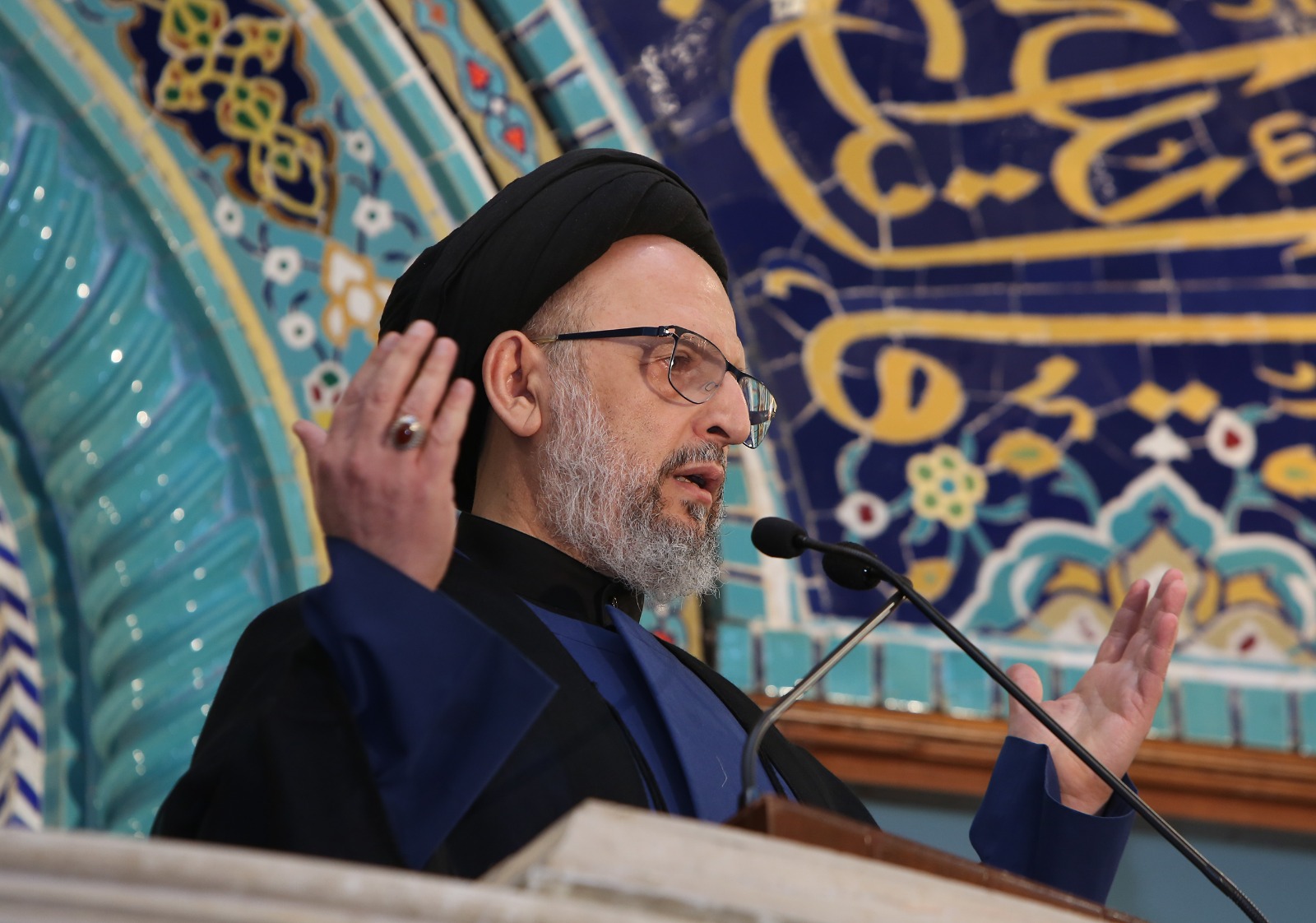
His Eminence, Sayyed Ali Fadlallah, delivered the two Friday prayer sermons at the Imamain Al-Hassanain Mosque, Rabialawal 22, 1448H/September 4, 2026. Several prominent religious scholars, dignitaries and hundreds of believers attended the Jumu’a prayer. Following is summary of his sermons
First Sermon
.
Following Imam al-Sadiq (a.s.)
Allah, the Most Exalted, says:
“That is [of which] Allah gives good tidings to His servants who believe and do righteous deeds. Say, [O Muhammad (p.)], ‘I do not ask you for this message any payment [but] only good will through kinship.'”
Allah, The Most Exalted, has spoken the truth.
On the seventeenth of the month of Rabi’ al-Awwal, we marked the blessed anniversary of the birth of one of the Imams of Ahl al-Bayt (a.s.), Imam Ja’far ibn Muhammad al-Sadiq (a.s.).
This Imam was known for knowledge, forbearance, worship, frequent remembrance of Allah, good character, and abundant charity, generosity, and giving.
Imam al-Sadiq (a.s.) lived during the transitional period between the decline of the Umayyad rule and the beginning of the Abbasid rule. This gave him a degree of freedom that was not available to the other Imams (a.s.). He contributed to spreading the teachings of Ahl al-Bayt (a.s.) to the extent that their school became associated with his name and came to be called the Ja’fari school. Sheikh al-Mufid said:
“So much knowledge was transmitted from him that travelers carried it everywhere, and his fame spread throughout the lands. No scholar from his family had as much transmitted from him as was transmitted from him.”
His mosque, the Mosque of Kufa, was a destination for students of knowledge who came from different parts of the Islamic world to learn from him. They found with him vast knowledge and satisfying answers to the questions and doubts that were being raised in the Islamic arena. One narrator said:
“I entered the Mosque of Kufa”—twenty years after the death of Imam al-Sadiq (a.s.)—”and found nine hundred scholars, each saying: Ja’far ibn Muhammad told me.”
This Imam was distinguished by his openness to all Islamic juristic, intellectual, and doctrinal schools. Abu Hanifa al-Nu’man, the Imam of the Hanafi school, studied under him and benefited from his knowledge, saying:
“Had it not been for those two years, al-Nu’man would have perished.”
Likewise, Malik ibn Anas, the Imam of the Maliki school, studied under him and said:
“No eye has seen, no ear has heard, and no human heart has conceived anyone better than Ja’far al-Sadiq in virtue, knowledge, worship, and piety.”
He was also known for dialogue. He debated atheists, skeptics, extremists, Sufis, and followers of the heavenly religions. Everyone who debated him testified to his good manner, respect for other opinions, sound reasoning, and rational responses.
Today, on the anniversary of this great Imam’s birth, we will mention some of his sayings so that we may be guided by them.
The first saying:
“The most beloved of my brothers to me is the one who gives me my faults as a gift.”
Through this saying, Imam al-Sadiq (a.s.) wanted to show a standard by which we measure the love of others for us. The dearest person to us should not be the one who praises us, agrees with us, or remains silent about our mistakes. Rather, it should be the one who points out our faults and shows us our mistakes, because by doing so he helps us improve ourselves so that we become better in behavior, direction, and actions.
Each of us easily sees the mistakes of others, but often does not notice his own faults. To remove the annoyance that may result when someone points out our mistakes, Imam al-Sadiq (a.s.) called on us to regard such a person as someone bringing us a gift. We should welcome it, be pleased with it, and thank him for it.
The second saying:
“He is not one of us who does not hold himself accountable every day. If he has done good, he asks Allah for more of it and praises Allah for it. If he has done evil, he seeks Allah’s forgiveness and repents to Him.”
This saying points to the importance of self-accountability. Imam al-Sadiq (a.s.) considered that a believer is not truly a believer if he does not examine himself every day.
He should ask himself what good he has done. If he has made a mistake, he should ask why he made that mistake and crossed the limits with Allah, The Most Exalted, and with people. If he fell short in his duties and responsibilities, he should ask why. If he performed a task, he should ask why he did not perform it in the best way.
If a believer finds good within himself, he should praise Allah, the Most Exalted, for granting him success and should not become proud of his deeds. Rather, he should ask Allah, The Most Exalted, to help him do even more. If he finds shortcomings within himself, he should not surrender to sin or despair of his Lord’s mercy. Instead, he should hasten to repent, correct his mistake, and turn away from sin.
The third saying:
“Anger is the key to every evil.”
This saying explains what anger can lead to. Imam al-Sadiq (a.s.) described it as a gate and a key to evil, because when anger takes control of a person, he loses the ability to think correctly and to understand the consequences of his actions. As a result, he loses control of his actions, words, and decisions, and may harm himself and those around him.
A look at reality is enough to show us how much anger causes problems, tensions, conflicts, and strife. Therefore, it was said:
“Beware of anger; its beginning is madness and its end is regret.”
This calls on a person to control his anger so that his decisions and positions do not arise from it, and so that he may attain what has been promised to those who restrain their anger. It is reported:
“Whoever suppresses his anger, Allah will fill his heart with security and faith on the Day of Resurrection.”
The fourth saying:
“Interpret your brother’s words and actions in the best way, and never think badly of a word that comes from your brother while you can find a good interpretation for it.”
Imam al-Sadiq (a.s.) calls on the believer that if he sees something from his Muslim brother that could be interpreted as either good or bad, he should not rush to interpret it negatively. Rather, he should interpret it in the best possible way as long as such an interpretation is possible.
For example, you may find someone who does not reply to your messages. Do not immediately say that he is arrogant toward you or deliberately ignoring you. He may be busy, sick, or may not have seen the message at all. Likewise, if he says something that can have two meanings, do not prefer the bad meaning over the good one.
This saves society from many disputes that arise not from words themselves, but from their negative interpretation.
The fifth saying:
It is reported that Imam al-Sadiq (a.s.) met one of his companions who had returned from a journey. He asked him:
“How are the brothers you left behind?”
The man praised them and referred to their loyalty to the Imam (a.s.). The Imam (a.s.) then asked:
“How do their rich visit their poor?”
The man replied:
“Very little.”
The Imam asked:
“How often do their rich meet their poor?”
He replied:
“Very little.”
The Imam (a.s.) then asked:
“How much do their rich share their wealth with their poor?”
The man said:
“You are mentioning qualities that are rarely found among our people.”
The Imam (a.s.) replied:
“Then how can these people claim that they are Shi’a?”
Through this saying, Imam al-Sadiq (a.s.) wanted to define his view of the Shi’a. In his view, the Shi’a are those who stay connected with one another, help one another, show mercy to one another, and whose rich support their poor. They do not distinguish themselves by status or wealth.
The final saying:
“Increase your supplication, for Allah loves those of His servants who call upon Him. He has promised the believing servants a response. Allah will make the supplications of the believers on the Day of Resurrection a deed that increases their reward in Paradise.
Increase your remembrance of Allah as much as you can in every hour of the day and night, for Allah has commanded you to remember Him often, and Allah remembers every believer who remembers Him.
Hold firmly to the prayers and the middle prayer, and stand before Allah in devotion, as Allah commanded the believers before you in His Book.
Beware of allowing yourselves to desire anything that Allah has forbidden for you. Whoever violates what Allah has forbidden in this world, Allah will keep him away from Paradise, its blessings, its pleasures, and its honor.”
Dear beloved ones,
Our loyalty to this Imam does not stop at merely belonging to him, mentioning his name, or visiting him. The loyalty that he called for is to adopt his morals, follow the guidance of his words, commit ourselves to his method of dialogue that reached both hearts and minds, and strive to build bridges of communication with others, something that we are in great need of.
By doing this, we truly follow his example and become an adornment for him, so that people may say:
“May Allah have mercy on Ja’far ibn Muhammad. How excellent was the manner in which he educated his companions!”
.
The Second Sermon
In the name of Allah, the Most Compassionate, the Most Merciful.
Worshippers of Allah, I advise you and myself with what Imam al-Sadiq (a.s.) advised one of his companions when he said:
“If Allah grants you a blessing and you wish for it to remain and continue, then increase your praise and thanks to Him. For Allah, the Most Exalted, says:
‘If you are grateful, I will surely increase you [in favor].’
And if you find your provision delayed, then increase your seeking forgiveness, for Allah, the Most Exalted, says:
‘Ask forgiveness of your Lord. Indeed, He is ever a Perpetual Forgiver. He will send from the sky upon you [continuing] showers. And give you increase in wealth and children and provide for you gardens and provide for you rivers.’
And if something saddens you, then frequently say: ‘There is no power and no strength except through Allah, the Most High, the Most Great,’ for it is a key to relief and a treasure from the treasures of Paradise.”
And if you wish to supplicate to Allah, then make the supplication of Imam al-Sadiq (a.s.):
“O Allah, honor me through obedience to You, and do not disgrace me through disobedience to You. O Allah, grant me the ability to comfort and support those whose provision You have restricted, through what You have generously granted me from Your bounty.”
Imam al-Sadiq (a.s.) considered that our safety valve in this life is for Allah to be present in our hearts and on our tongues; that we remember Him and thank Him, and see no power and no strength except from Him. He is the One in Whose hand is the affair of our existence and the existence of everything around us, throughout the earth, the horizons of the sky, and the depths of the seas.
When we truly live this reality deep in our hearts, we will feel strength, determination, security, and peace of mind, and we will be more capable of facing challenges.
We begin with the Israeli attacks that continue through air raids and artillery shelling. The enemy has expanded the scope of these attacks beyond the villages and towns adjacent to its occupied positions. At the same time, it continues demolition, bulldozing, and burning operations against infrastructure in the areas it occupies.
In doing so, it benefits from the capabilities it possesses, from the cover that has been provided to it, which gives it freedom in all that it does, and from the silence regarding its crimes, as no voice is raised in condemnation of its actions.
All of this is happening while the doors to solutions remain closed, after the enemy refused to respond to any of the proposals put forward by the Lebanese side. It has openly declared that it will not withdraw from any of the areas it has occupied, including the areas it has classified as security zones, and it is even threatening to expand the scope of its occupation.
In light of what is happening, we call for patience, steadfastness, and avoiding despair and collapse despite the severity of the situation.
At the same time, we renew our call to the Lebanese state not to base its hopes in confronting what the enemy is doing on pressures exerted upon it, on changes that may occur within the entity, or on symbolic initiatives. Despite their importance, such measures do not address the essence of the problem and do not lead to a solution, such as what happened with the release of some prisoners.
Rather, its reliance should be on strengthening internal unity, both at the state level and among the people, preserving that unity, standing against those who threaten it, not giving up any position of strength that it possesses internally, and benefiting from every sincere helping hand extended from abroad by those who seek good for this country and support it in regaining its land and sovereignty.
Here, we commend the initiatives taking place in this regard, which we see as contributing to strengthening and reinforcing the Lebanese position.
At this time, we renew our call to the Lebanese state to fulfill its responsibility toward the displaced people from the villages and towns occupied by the enemy, as well as those who have lost their homes or whose homes have been damaged, by providing suitable housing for them or helping them secure it.
This is especially important following the decision to evacuate public schools and public facilities, where many of them still reside. This requires the concerned ministries to fulfill their duty in this regard.
At the same time, we renew the call to strengthen social solidarity among all Lebanese people by extending assistance to those who have suffered and continue to suffer from the consequences of the aggression that has struck this country, helping them overcome this difficult stage and strengthening their steadfastness and resilience on their land.
We remain in this country to point to the difficult social and economic situation that many Lebanese people are experiencing, a situation that worsens day after day because of rising food prices, essential living needs, rent costs, and the financial burden resulting from the near-total electricity outage.
This has increased the bills imposed by generator owners, while people are also struggling with the costs of education at the beginning of the school year.
This calls on the Lebanese state to listen to their suffering and fulfill its responsibility toward its citizens by mobilizing efforts to control prices, reduce burdens on the people, and increase assistance to poor and vulnerable groups, so that they may feel that there is a state that cares for them and stands by them amid the successive crises they face at every level.
Finally, we come to what is happening in Gaza, where the enemy continues its aggressive practices against the people of Gaza, ignoring the decisions issued by the Peace Council calling for a halt to military operations and the lifting of the blockade.
This is being done in order to empty Gaza of its people, displace them, remove them from their land, and end their cause. The same is being done in the West Bank.
This requires Arab and Islamic solidarity with the Palestinian people, even if only by raising voices and expressing objection with a tone that has largely been absent since the Al-Aqsa Flood until now.