
Trust in Allah in the Face of Despair and Challenges
.
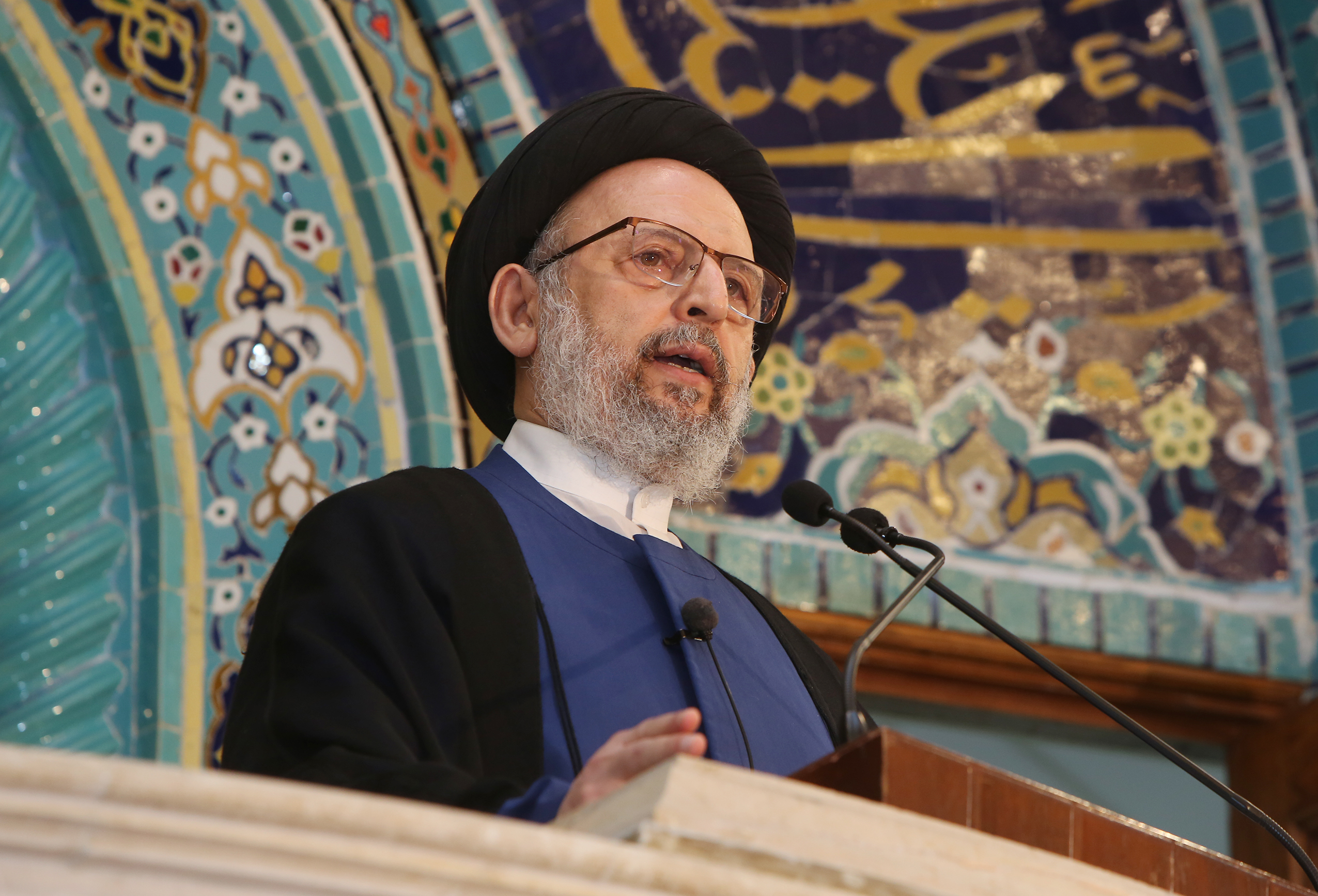
His Eminence, Sayyed Ali Fadlallah, delivered the two Friday prayer sermons at the Imamain Al-Hassanain Mosque, Friday Muhaaram 18, 1448H/ July 3, 2026. Several prominent religious scholars, dignitaries and hundreds of believers attended the Jumu’a prayer. Following is summary of his sermons
First Sermon
Trust in Allah in the Face of Despair and Challenges
Allah, the Most Exalted, says in His Noble Book: “And do not despair of relief from Allah. Indeed, no one despairs of relief from Allah except the disbelieving people.”
Truthful is Allah, the Most Exalted.
Allah, the Most Exalted, wants His servants not to fall into despair when they face difficulties, when pressures become intense upon them, and when challenges grow before them—whether on a personal, social, political, or security level—due to the dangerous effects that despair may leave on people’s faith, behavior, psychological condition, and social relations. It may even push some people to end their lives because of it.
Despair means that a person feels that hope is cut off from achieving the goals he is striving for, that he is unable to overcome the problems that confront him and the obstacles that stand in his way, and that the door of relief will never open for him. This is what we hear from those who say: there is no hope, there is no use, the situation cannot be fixed, and there is no way out… and similar expressions.
The noble verse we recited points to this meaning: “And do not despair of relief from Allah. Indeed, no one despairs of relief from Allah except the disbelieving people.”
It shows that despair does not align with faith; the believer cannot be one who despairs.
Islam addressed this phenomenon in the human being first by calling him not to forget Allah, because the believer’s faith leads him to see Allah, the Most Exalted, present when crises occur and when challenges intensify. He trusts that the matter is in His hands, that He is capable of all things, and that he constantly feels His presence in life, and that He is able to change its events and outcomes. His door is never closed to any of His servants if they call upon Him and supplicate to Him, and He fulfills His promise to answer them, as He says:
“And when My servants ask you concerning Me—indeed I am near. I respond to the invocation of the supplicant when he calls upon Me. So let them respond to Me and believe in Me that they may be guided.”
Secondly, Allah, the Most Exalted, opened for human beings the doors of hope when He said: “For indeed, with hardship comes ease. Indeed, with hardship comes ease.”
And in another verse:
“Allah will bring about, after hardship, ease.”
“And whoever relies upon Allah—then He is sufficient for him.”
This shows that among Allah’s laws in life is that hardship does not last, and that after hardship comes relief.
Thirdly, Allah, The Most Exalted, called the believer to have a sense of continuous optimism in Him and a good opinion of his Lord, so that he does not surrender to superstition or pessimism, but lives trust in Him and hope in His mercy and wisdom. This is what the hadith indicates: “He is not from us who practices omens or for whom omens are practiced.”
Fourthly, Allah, The Most Exalted, wants the human being to see that behind trials there may be blessings he does not perceive, and to look at the blessings surrounding him. This is indicated in the hadith: “No calamity occurs except that Allah places within it a blessing that surrounds it.” And in another hadith: “No fatigue, nor illness, nor sorrow, nor grief, nor harm, nor distress befalls a Muslim—even a thorn that pricks him—except that Allah expiates by it some of his sins.”
And that he should see in challenges a path toward Paradise, as Allah, The Most Exalted, says:
“Or do you think that you will enter Paradise while such (trials) have not yet come to you as came to those who passed on before you? They were afflicted with poverty and hardship and were shaken until even the Messenger and those who believed with him said, ‘When is the help of Allah?’ Unquestionably, the help of Allah is near.”
The Noble Qur’an strengthened this hope when it spoke about how the prophets, messengers, and believers dealt with hardship and sorrow. It mentioned Nouh (a.s.) who called his people for nine hundred and fifty years, yet he did not despair.
And it pointed to Prophet Ayoub (a.s.), who suffered illness for years, to the extent that he lost wealth and family, yet he remained patient, as Allah says about him: “Indeed, We found him patient, an excellent servant. Indeed, he was ever-turning in repentance.”
And he was satisfied with saying:
“Indeed, adversity has touched me, and You are the Most Merciful of the merciful.”
Until Allah healed him from his illness.
And regarding Prophet Yaqoub (a.s.), who was struck by the loss of his son Yousif (a.s.) after his brothers’ plot against him, and then the loss of his other son Benjamin, he still said to his sons:
“O my sons, go and find out about Yusif and his brother, and do not despair of relief from Allah. Indeed, no one despairs of relief from Allah except the disbelieving people.”
And Allah, the Most Exalted, mentioned Prophet Younis (a.s.), when he was swallowed by the whale and entered the darkness of its belly, that he did not lose his trust in his Lord, but called upon Him:
“There is no deity except You; exalted are You. Indeed, I have been of the wrongdoers.”
So Allah responded to him and brought him out of his distress:
“So We responded to him and saved him from distress. And thus do We save the believers.”
And this was the case of the Messenger of Allah (p.), who despite all the harm he faced from Quraish, did not retreat from his mission. He lived with hope in Allah and strengthened it among his companions, giving them glad tidings of victory to come.
Allah also referred to the hope expressed by the believers after the Battle of Uhud when they were told that Abu Sufyan was coming with a great army to attack them after what happened at Uhud, so they said as Allah mentions:
“Those to whom people said, ‘Indeed, the people have gathered against you, so fear them.’ But it increased them in faith, and they said, ‘Sufficient for us is Allah, and He is the best Disposer of affairs.’ So they returned with favor from Allah and bounty, no harm having touched them, and they pursued the pleasure of Allah. And Allah is the possessor of great bounty.”
And after that, in the Battle of the Trench, when the confederates of Quraish and their allies besieged the city, they did not despair, but said as Allah says:
“And when the believers saw the confederates, they said, ‘This is what Allah and His Messenger promised us, and Allah and His Messenger spoke the truth.’ And it only increased them in faith and submission.”
O dear ones, the scale of the challenges we face and that threaten our existence should not lead us to despair. Rather, it is our responsibility to examine the ideas that lead us to despair, for we may discover their falsehood, which then changes our view of trials. Then we return to see the future with hope and optimism in Allah’s relief, relying on our faith in Him, His presence, His support, and that He makes after every hardship ease.
Let our supplication to Allah,The Most Exalted, be what the Messenger of Allah (p.) used to say during crises:
“O Allah, nothing is easy except what You make easy, and You make difficulty, if You will, easy.”
And what Imam Hussein (a.s.) supplicated in Karbala:
“O Allah, You are my trust in every hardship, and You are my hope in every difficulty, and You are for me in every matter that descends upon me a trust and support. You are the guardian of every blessing, the companion of every good deed, and the ultimate goal of every desire.”
And our final call is: all praise is due to Allah, Lord of the worlds.
In the name of Allah, the Merciful, the Compassionate
The second sermon
Worshippers of Allah, I advise you and myself to have taqwa (piety) of Allah, the Most Exalted, in what Commander of the Faithful (a.s.) called us to when he said:
“Fear Allah regarding His servants and His lands, for you will be held responsible even for regions and animals.”
Fear Allah regarding His servants by ensuring that the servants of Allah are made honorable, dignified, and free through our presence. And fear Him regarding His lands by not accepting, while we are alive, that the land entrusted to us by Allah be defiled by an occupier, invader, or aggressor. And fear Him regarding animals by caring for their needs, not harming them, and not burdening them beyond their capacity.
Allah, the Most Exalted, will question us not only about prayer, fasting, Hajj, khums, and zakat, but also about how we left behind servants, lands, and animals, and what good impact we left in the life we lived with them. And when we become aware of this, we will fulfill our responsibility and become more capable of facing challenges.
We begin with this country, where the Israeli enemy continues its aggressions and its bombing of residential buildings and infrastructure in the areas it has occupied, seeking to complete what it started in order to leave no sign of life in them. Meanwhile, its leaders openly declare that they do not intend to withdraw from them, even from the experimental areas mentioned in the framework agreement with the Lebanese state, except under an impossible condition that the enemy already knew could not be implemented. This indicates the lack of seriousness of the Zionist entity in implementing even partial withdrawal, and it has become clear that the real goal behind the agreement is to consolidate its occupation of Lebanese land and legitimize it.
In light of what is happening, we call on the Lebanese not to rely on an agreement that has clearly shown political fractures and gaps in its clauses, which affect Lebanese sovereignty and security. It will not achieve what people hope for in terms of a full withdrawal from the occupied territories, the return of residents to their villages, and the beginning of reconstruction. Rather, it remains within the framework of promises with no defined timeline for implementation and no guarantee of fulfillment from this enemy or those who influence it.
Consequently, we call on the Lebanese to make their reliance on their internal will and their own effort, for dignity, honor, and sovereignty are not granted by anyone; they are taken through awareness, action, and sacrifice.
The Lebanese are capable of achieving their goals of freedom, independence, and sovereignty if they overcome their differences and conflicts, preserve their internal unity, make good use of their available capabilities, recognize their sources of strength—foremost among them the people of this country who prove every day their patience, steadfastness, and dignity despite wounds and suffering—and benefit from supporting countries that wish them well.
At this time, the Islamic Republic of Iran will be witnessing, starting from today, the funeral ceremonies of the leader of the Islamic Republic in Iran, the martyr Sayyed Ali Khamenei (ra), who was targeted by the Israeli enemy, after he dedicated his life to the rise of the Islamic Republic in Iran from its beginnings, strengthening its presence and capabilities, supporting the causes of Muslims and oppressed peoples, working for Islam, and presenting its civilized image.
We see that this painful occasion, with its large crowds and emotional expressions, will be an expression of the Iranian people’s gratitude and loyalty for all the efforts he made and the life he devoted to those causes. We share with the Iranian people and all those who love him their grief and loyalty, and we ask Allah to accept his struggle and martyrdom, and to place him among the prophets, the truthful, the martyrs, and the righteous, and what excellent companions they are.
Finally, we come to the sixteenth anniversary of the passing of the Sayyed (ra), who despite his long absence, remains present among us in his renewed thought capable of engaging with the modern age, and in all the achievements he accomplished during his life, which remain before us.
We commemorate his memory today not to renew our sorrow, but to renew our loyalty to him, to one who exhausted himself in order to deliver to us a pure and refined thought, a renewed jurisprudence, a deep awareness of reality, and a will and determination in stance against those who occupy land and violate human dignity, and a continuous effort that did not stop until his final breath for the service of the human being—every human being—and for his elevation in all aspects.
We want his memory to be an incentive for us to continue what he began: preserving Islam pure, alive, and present in our words, positions, and actions; working for Islamic unity, which he considered a religious duty; promoting dialogue between followers of heavenly religions and on the national level, making dialogue the basis of relationships instead of division and conflict; and building strength within the nation in a world where only the strong are respected.
He used to say: be strong in thought, politics, and economics, and do not be consumers of what others impose on you, but producers at the level of individuals, society, and the state. And work for a state of moral and human values in a country that embraces within it all divine messages that came to strengthen human values and life; a state that respects human dignity because of humanity itself; a state capable of protecting its people and land and ensuring dignity and honor by strengthening its elements of power, not by weakness; a strength that was manifested in his support for resistance in Lebanon and Palestine; and in building institutions so that no poor, orphan, elderly, or disabled person is left without support or shelter; and in calling for a cooperative and united Arab-Islamic world capable of facing challenges, especially in Palestine, and advancing civilization; and for a world in which the strong do not exploit the weak and the resources and security of peoples are not violated.
O dear ones, our connection to the Sayyed (ra) is not a connection to a person—since he himself rejected the worship of personalities—but a connection to a path, thought, and goals for which he dedicated his entire life.
May Allah have mercy on you, my father, and keep your path alive in our hearts and minds, so we may draw inspiration from it in all our movement and life.

You may also like


