
Karbala : A lesson for all ages the First Sermon
[
In the name of Allah, the Compassionate, the Merciful
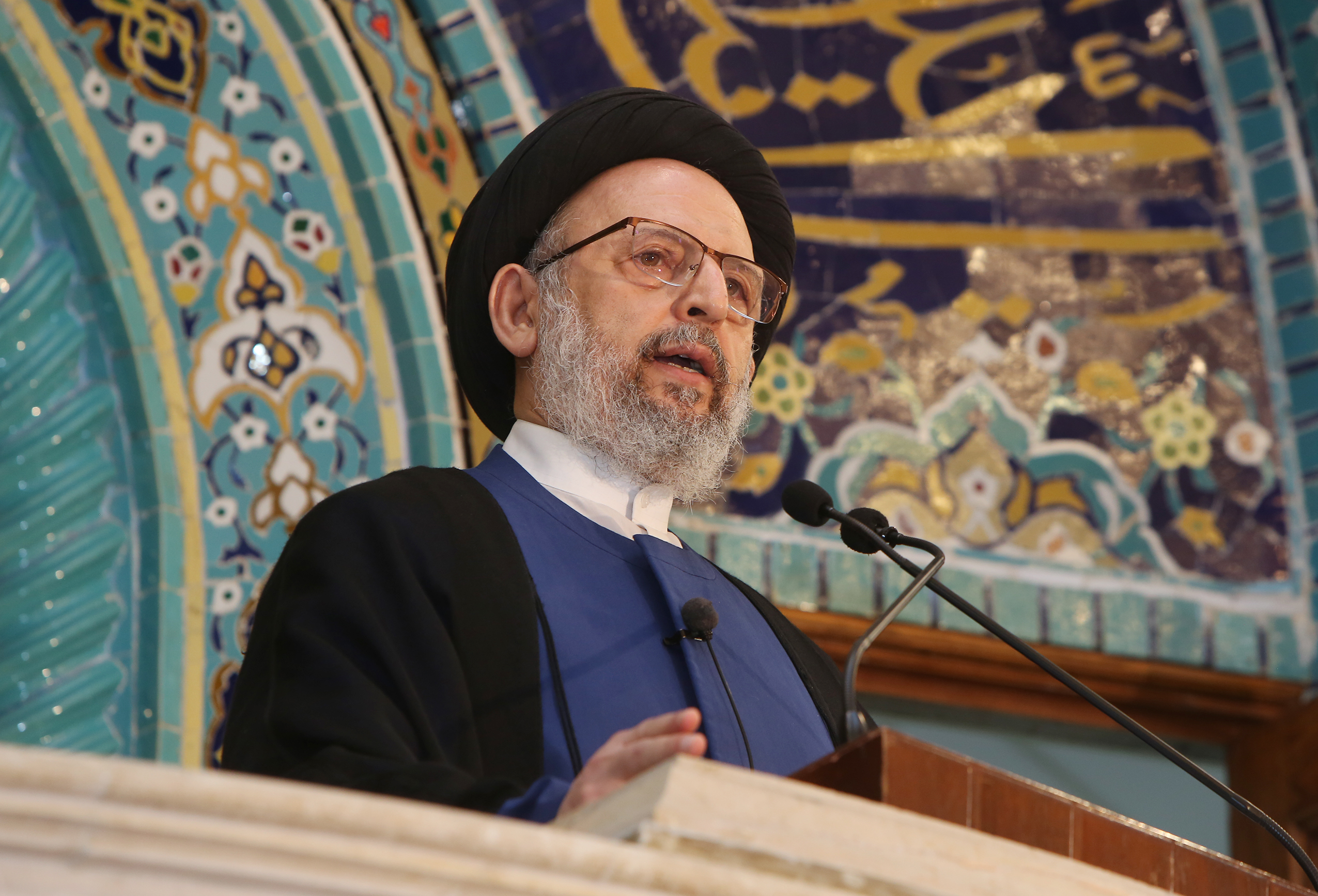
His Eminence, Sayyed Ali Fadlallah, delivered the two Friday prayer sermons at the Imamain Al-Hassanain Mosque, Friday Muharam, 1448AH /June21, 2026. Several prominent religious scholars, dignitaries and hundreds of believers attended the Jumu’a prayer. Following is summary of his sermons
Karbala : A lesson for all ages
the First Sermon
Allah, The Most Exalted, says in His Glorious Book:
“Allah would not leave the believers in the condition you are in until He separates the evil from the good.”
Allah, the Most Exalted, has spoken the truth
Allah, the Most Exalted, points in this verse to one of the laws He has placed in life: that He will not be satisfied with His servants merely declaring their faith by saying, “We believe.” Rather, He will put them through trials and tests through which He distinguishes the impure from the pure, and the one who is truthful in his faith from the one who is lying.
This is what another verse pointsto: “Alif, Lam, Meem. Do the people think that they will be left to say, ‘We believe’ and they will not be tried? But We have certainly tried those before them, and Allah will surely make evident those who are truthful, and He will surely make evident the liars.”
The believers who are sincere in their faith are those who remain firm in it and do not retreat from it no matter how high the cost may be, even if it is at their own expense. By contrast, those whose faith is weak and those who are insincere quickly abandon it when they find that commitment to it will cost them something or affect their interests.
Today, we will point to some of the tests faced by those to whom Imam al-Hussein (a.s.) came seeking support and asking them to stand with him. Some failed the test, while others succeeded.
The first example is Ubayd Allah ibn al-Hurr al-Ju’fi, who was one of the nobles of Kufa. When this man learned that Imam al-Hussein (a.s.) was coming to Kufa, he left the city so that he would not be placed in the embarrassing position of having to decide whether to stand with him. He went into the desert and set up a tent in a place far from the road people normally used, so that nobody would see him, while waiting for matters to become clear.
But circumstances decreed that Imam al-Hussein (a.s.) would take that very road where he had pitched his tent. The Imam (a.s.) asked, “Who owns this tent?” He was told that it belonged to Ubayd Allah ibn al-Hurr al-Ju’fi. The Imam (a.s.) then sent him a messenger, who was a cousin of al-Ju’fi, to invite him to come.
Ubayd Allah said, “Indeed we belong to Allah, and indeed to Him we will return. By Allah, I left Kufa only because I disliked that al-Hussein (a.s.) should enter it while I was there. By Allah, I do not want to see him, nor do I want him to see me.”
Despite this, Imam al-Hussein (a.s.) himself came to him, perhaps hoping he would change his position, or in order to establish the proof against him.
Ubayd Allah replied to the Imam
“By Allah, I know that whoever supports you will be successful in the Hereafter, but I cannot bring myself to enter into what you are entering into. However, I can help you with my horse, for by Allah, I never pursued anyone while riding it except that I caught him, and no one pursued me while I was riding it except that I outran him. Take it, along with my sword with which I fight.”
The Imam (a.s.) replied:
“O Ibn al-Hurr, we did not come for your horse or your sword. We came to ask for your support for your religion. If you have withheld yourself from us, then we have no need for any of your wealth.”
Ubayd Allah ibn al-Hurr al-Ju’fi failed to seize this precious opportunity, and later regretted the decision through which he lost an opportunity he never made use of, and from which he gained neither honor in this world nor in the Hereafter.
The second example is Umar ibn Sa’d. This was the man whom the Imam (a.s.) met after learning that he would command the army that was going to fight him, after he had been promised the governorship of Rayy in return, which had long been his ambition.
The Imam (a.s.) met him in the hope that he might change his decision, or in order to establish the proof against him. He said to him:
“O Ibn Sa’d, will you fight me? Do you not fear Allah regarding your return to Him? I am the son of whom you know, and concerning me the Messenger of Allah (p.) said: ‘Hussein is from me and I am from Hussein. Allah loves whoever loves Hussein.’ And he said concerning me and my brother: ‘Al-Hasan and al-Hussein are the leaders of the youth of Paradise.’
Will you not be with me and leave Yazid, the immoral, wicked man who sheds protected blood, and those who have adhered to obedience to Satan and abandoned obedience to the Most Merciful, who have made lawful what Allah prohibited and prohibited what Allah made lawful, monopolized public wealth, and neglected the prescribed punishments? Would this not bring you closer to Allah and improve your standing with Him?”
Umar ibn Sa’d replied:
“I fear that my house will be destroyed.”
Al-Hussein (a.s.) said:
“I will rebuild it for you.”
He replied:
“I fear that my property will be confiscated.”
Al-Hussein (a.s.) said:
“I will compensate you with something better.”
He replied:
“I have family in Kufa, and I fear that Ibn Ziyad will kill them.”
At that point the Imam (a.s.) left him after realizing that there was no benefit in continuing this discussion, for he had sold his religion and the future of his Ummah and had become a prisoner of his interests and ambitions.
This became clear when he fired the first arrow toward the camp of Imam al-Hussein (a.s.) and said:
“Bear witness for me before the governor, Ibn Ziyad, that I was the first to shoot.”
Thus, he lost this world and the Hereafter, and that is the clear loss. He never gained the governorship of Rayy, and was later killed by al-Mukhtar al-Thaqafi in a terrible manner.
The third example is the companions of Imam al-Hussein (a.s.). They faced a test when he gave them permission, on the night of the tenth of Muharram, to leave under the cover of darkness.
He said to them:
“The night has now covered you, so take it as a means of departure. Let each of you take the hand of one of my family members. May Allah reward you all with goodness. Disperse among your tribes and cities until Allah grants relief. These people are only after me, and if they get me, they will stop pursuing anyone else.”
All of them replied with one voice:
“All praise belongs to Allah, Who honored us by supporting you and honored us by being killed with you. Should we not be pleased to be with you in your rank, O son of the Messenger of Allah (p.)?”
Thus, they passed the test and attained success in the Hereafter.
The final example is al-Hurr ibn Yazid al-Riyahi, who joined Imam al-Hussein (a.s.) on the tenth day after having led the force that had surrounded him in Karbala and prevented him from continuing toward Kufa.
When the tenth day arrived and he became certain that the battle would take place and that Umar ibn Sa’d was serious about fighting al-Hussein (a.s.) he stood confused about where he belonged between the two sides.
Should he remain with Yazid, Ubayd Allah ibn Ziyad, and Umar ibn Sa’d, preserving his position and perhaps even advancing in rank among them, while becoming a partner in the killing of the imam (a.s.) and his companions, with the Fire and punishment awaiting him afterwards?
Or should he join the Imam (a.s.) and stand with him in the position of honor, dignity, and humanity, pleasing Allah for Whose sake al-Husein (a.s.) had risen and sacrificed, thereby attaining Paradise, though through death?
Because of this struggle he began trembling.
Someone who saw him said:
“Are you trembling? If we were asked who was the bravest man of Kufa, we would never look beyond you.”
He replied:
“I am not trembling out of fear. Rather, I am choosing for myself between Paradise and Hellfire.”
Then he said:
“By Allah, I will choose nothing over Paradise, even if I am cut to pieces or burned.”
He then joined the army of al-Hussein(a.s.), carrying with him his free stand and courageous decision. He came to him repentant and regretful for what he had done, and was martyred before him.
On that day Imam al-Hussein (a.s.) granted him the medal of freedom, saying:
“You are free as your mother named you, free in this world and in the Hereafter.
Dear beloved ones, all of these people faced their test. Some succeeded, leaving everything behind them and making their greatest concern the reform of the Ummah of the Messenger of Allah (p.) and the correction of its course. Thus, they gained the good of this world and safety in the Hereafter.
Others lost this world and the Hereafter for the sake of a worldly gain that did not remain for them or a fading kingdom that did not last.
What remains for us is to prepare ourselves to succeed in whatever tests may come our way, for each of us has his own test.
One of us may be tested with wealth that is offered unlawfully, with a position for which he may lose his faith and principles, or with a forbidden desire presented to him.
We may even be tested, as the people of Karbala were tested, by standing with the truth in the face of falsehood.
So let us prepare ourselves for these tests and strengthen faith in our hearts, so that we may hope to be among those who succeed, and among those patient and steadfast believers who hold firmly to their positions no matter how severe the challenges or how great the sacrifices become.
In the Name of Allah, the Compassionate, the Merciful
The Second Sermon
Woeshippers of Allah, I advise you and myself with the advice of Imam al-Hussein (a.s.) which he gave to his brother Muhammad ibn al-Hanafiyyah before leaving Madina. He said:
“I did not rise out of arrogance or pride, nor as one spreading corruption or oppression. Rather, I rose to seek reform in the Ummah of my grandfather, the Messenger of Allah (p.). I wish to enjoin what is right and forbid what is wrong, and to follow the way of my grandfather and my father Ali ibn Abi Talib (a.s.). Whoever accepts me with acceptance of the truth, then Allah has more right to the truth. Whoever rejects me, I shall remain patient until Allah judges between me and the people, and He is the best of judges… This is my will to you, my brother. My success is only through Allah. Upon Him I rely and to Him I return.”
Imam al-Hussein (a.s.) thus clearly defined the goals of his revolution, for which he shed his blood and offered immense sacrifices.
Therefore, our loyalty to the Imam(a.s.) should not stop at shedding tears when his tragedy is mentioned. Rather, it should lead us to work for the goals for which that tragedy occurred and for which all those sufferings were endured.
We should be present in every arena of truth and justice and be voices raised against every oppressor, corrupt person, or one who deviates from the path of truth, without favoritism regardless of the identity of the oppressor, the corrupt person, or the deviant, and regardless of the sect or school to which they belong. In this way we will be able to face the challenges.
We begin with the enemy’s continued violations of the ceasefire through its attacks on many areas in the south and other regions, which have led to martyrs and wounded through its warplanes and through its drones that roam Lebanese regions and rarely leave the skies of Beirut.
This confirms what we had previously pointed to regarding the enemy’s intention to undermine the decision contained in the understanding reached between the United States of America and the Islamic Republic of Iran, which called for a complete ceasefire, something the enemy does not want because it restricts its freedom of movement.
This calls upon the countries sponsoring this agreement to quickly fulfill their role and intensify their efforts to prevent the enemy from continuing these violations and the escalation that may result from them, and to affirm the credibility of this understanding and the seriousness of efforts to end the war, from which the Lebanese have drawn hope and upon which they are placing their trust.
At the same time, Lebanese negotiations with the Zionist entity continue, and it has become clear that they will not lead to any hoped-for result, whether regarding a complete withdrawal from occupied Lebanese lands, the return of residents to them, the release of prisoners from occupation prisons, or even a timetable for withdrawal, because the enemy has no desire for any of this.
This is something the leaders of the enemy openly declared before the negotiations, during them, and after them.
Therefore, we again stress to the Lebanese state the need to activate its role in working for a complete withdrawal of the enemy from Lebanese territory and in fulfilling the hopes of the Lebanese to return to their towns and villages in a manner that does not affect the country’s sovereignty or internal unity.
In doing so, it should rely on the positions of strength it possesses internally, which have proven capable of unsettling the enemy, as well as on the outcomes of the negotiations that took place in Switzerland between the United States and Iran, in which the Islamic Republic was keen to place Lebanon among its priorities, whether regarding the ceasefire, the enemy’s withdrawal from all Lebanese land, or support for all those who seek good for this country.
At the same time, we stress to the Lebanese the importance of preserving their internal unity and avoiding every provocative discourse that threatens the unity and stability of the country.
They should come together at all levels and work jointly to confront the current local and regional challenges, which cannot be faced through weakness and division, as we are witnessing today. Such division only leads to greater suffering for them while leaving their homeland exposed to the winds of others.
We also call on the state to fulfill its role in providing the infrastructure necessary in the areas to which residents can return, whether in electricity networks, water supplies, roads, or the restoration of educational and health institutions so they can resume their work, along with reactivating official administrations, all of which would help residents firmly re-establish themselves in their land.
Finally, we must take pride in the deep emotions expressed by the lovers of the Ahl al-Bayt (a.s.) through their attendance at the gatherings and their participation in the processions, and in the love and loyalty they show to al-Hussein (a.s.) and to all those who offered sacrifices for Allah and for the support of His religion.
Alongside this love must come action to achieve the goals for which these sacrifices were made.

You may also like


